Why Generic Intent Data Misses Plants That Are About to Buy and What Facility-Level Signals Catch
Permits, financing, and hiring show which plants are nearing a purchase.

Generic intent data misses plants about to buy because it tracks what people read online, while plants need to buy when they have equipment, compliance, and capacity needs. For industrial sales outreach timing, facility-level signals such as permits, equipment financing, capital expenditure disclosures, and hiring reveal where a buying window may be opening. Corroborating those events at the same plant gives a rep a more specific reason to engage than a company-level surge score.
How generic intent data is built, and what that architecture cannot see
In the dominant collection model, a publisher co-op places tracking tags across B2B media sites and aggregates anonymized reading behavior. The system resolves that activity to company domains and scores accounts by topic. When people associated with a domain read more than usual about a category, the platform flags a “surge.”
Intentsify’s intent data guide describes the largest multi-source intent aggregator as monitoring trillions of intent signals per month across tens of thousands of topics. Scale broadens coverage of observable reading behavior. It does not make a physical event visible when that event produces no content-consumption signal. A surge therefore reflects what people at a domain are reading.
The distinction is a boundary of the measurement system. A platform can accurately detect increased interest in a topic while providing little evidence of an equipment purchase at a particular location. Its topic taxonomy adds another constraint because categories are built for a wide addressable market across SaaS, finance, and HR buyers. Breadth does not supply plant-level specificity. A broad topic alone cannot show which equipment, process chemistry, or operating conditions are behind what a plant needs.
Where manufacturing buying decisions actually begin
For a plant manager, the starting point is an operating condition. An old machine needs to be replaced, a compliance deadline means a process must change, or a plant needs a new line to add capacity. Those conditions create the purchase requirement before anyone reads an article about the category. The plant must solve an operating problem. Its path to a supplier follows that problem rather than a predictable sequence of online research.
A VP of Operations looking into a packaging line may call peers at other plants, attend Pack Expo, ask OEMs directly for spec sheets, and read through vendor proposals. Those steps can all take place outside a publisher co-op. Research can also take place in industry-specific forums, trade publications outside the network, and regional conference conversations. The absence of a content signal does not mean that evaluation has not begun.
Major equipment purchases and expansions involve plant managers, operations VPs, procurement, finance, engineering, and sometimes an executive sponsor, while industrial sales cycles can stretch past a year. By the time a buyer submits a form or requests a demonstration, shortlists, opinions, and evaluation criteria may already be established. Late digital visibility leaves little room to influence them. Small and mid-size plants are especially difficult to detect because their buying activity often starts with an aging machine, a compliance date, or new capacity, while their online research footprint remains thin.
Which plants go invisible and why the miss is systematic, not random
The resulting gap creates a structural bias favoring buyers who produce observable content activity over plants with an operational need. A facility can be moving toward a capacity expansion or compliance-driven replacement without generating the behavior that raises its account score. Meanwhile, what people elsewhere in the company read can make the account look active without showing a purchase that matters to the supplier.
A company with a dozen plants may have a dozen purchasing processes, each with its own budget authority, equipment needs, and compliance context. Yet a domain-level score rolls what they do into one account. The location of the need remains unresolved. Even when the company surges, the reader may be a junior engineer gathering background information rather than the operations VP responsible for the purchase order.
Industry codes can distort the target list before scoring begins. A small custom woodworker and a larger mass-production woodworking facility may have the same NAICS code even though they need different equipment and supplies. Automated classification based on company-description keywords adds another source of imprecision, including the possibility of assigning a manufacturing code to a distributor described as providing industrial solutions. These are different problems with a common consequence. Plants that are upgrading equipment, expanding, or replacing equipment to meet compliance needs can fall below generic scoring thresholds, so suppliers miss the chance to reach plants likely to buy while those plants are still choosing vendors.
What signals indicate a plant is about to make a capital purchase, and where do they come from
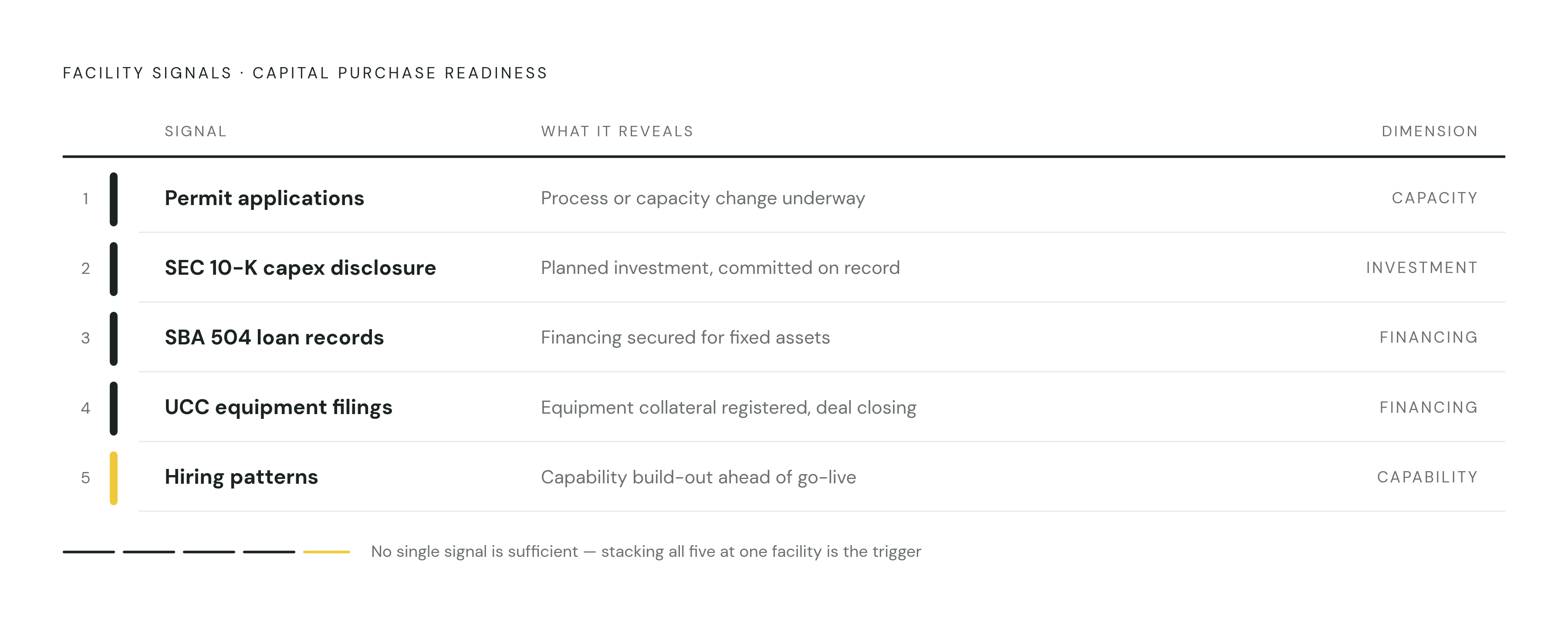
Facility-level signals are observable external events tied to physical plant activity. They include permits, financing records, equipment patterns, capital expenditure disclosures, and hiring. Their value comes from connecting an event to a particular facility and the operating change it indicates. The plant is the unit of analysis. These records can reveal a buying window months before an RFP or a detectable content-consumption trail appears.
Environmental permit applications filed with agencies such as the EPA can precede a production line becoming operational by months. A new permit can indicate new process chemistry, equipment, or expanded capacity, each of which creates material and supply requirements. Building permits provide a related view of physical expansion and can precede trade press coverage by months. Both provide an early planning reference. Their commercial relevance depends on the activity authorized and the facility to which it applies.
Financial records reveal a different part of the investment cycle. SEC 10-K and similar filings show capital expenditure plans before they are carried out, while SBA 504 loans help pay for major fixed assets, including owner-occupied commercial real estate, construction, and long-term equipment purchases. UCC filings record equipment purchase financing and can reveal what a plant has recently acquired or is acquiring. Hiring patterns add evidence about the capabilities being built around the investment, giving the commercial team context before an expansion reaches the trade press, when vendor evaluation may already be underway.
How stacking multiple facility signals produces a prioritized, timed opportunity
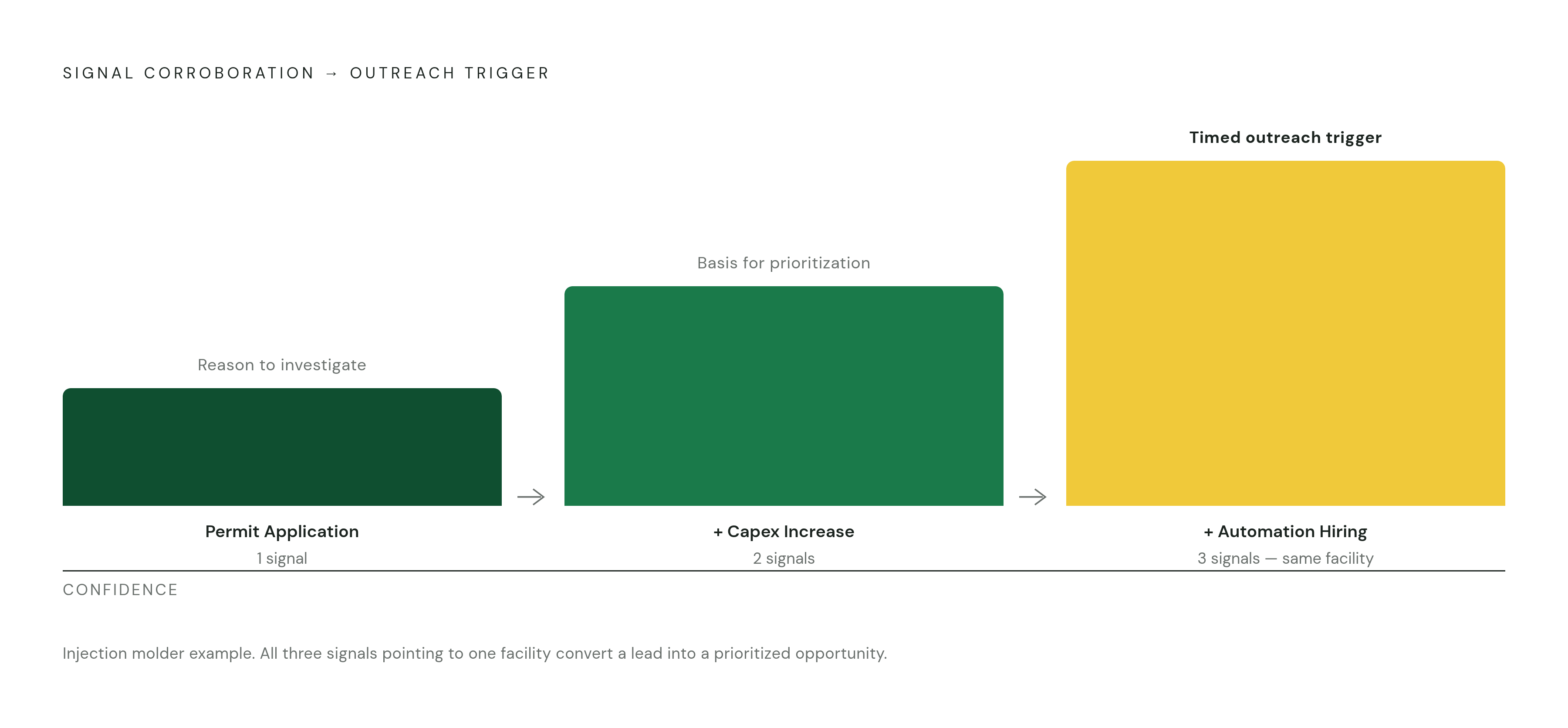
A single event gives a team a reason to investigate a plant. Corroborating events give that team a stronger basis for prioritization. When a permit application, hiring surge, and capital expenditure disclosure point to the same facility within a short window, they provide more evidence of an active need and available budget than any one event alone. The signals reinforce one another. Equipment and process fit explain whether the plant is relevant, while recency and corroboration explain why engagement is timely.
Consider an injection molder as an illustrative case. A permit application alone identifies a possible change worth understanding, but a capital expenditure increase and hiring for automation engineers at that same facility would strengthen the case for outreach. The combined picture connects a physical project, investment plans, and staffing. It is a more specific basis for asking about the project than either an industry classification or a topic surge.
The same logic distinguishes cross-sell from new-account prospecting. An existing corporate account may contain several plants, only some of which buy from the supplier, so a signal at a non-buying location identifies a facility-level cross-sell opportunity. Without that plant-level view, the relationship with the company can hide where new demand is opening up. The commercial output is a ranked queue of plants ordered by open volume, signal recency, and reason to engage, with decision-stage events receiving prompt attention because their useful outreach window is short.
What a rep does differently when the signal comes from the plant, not a surge score
A plant-specific event changes the substance of the opening conversation. Rather than introducing a product category to a company that appears interested, the rep can ask about a process the facility is running or expanding. A new solvent-use permit, for example, supports a question about the process change behind the filing. That is a concrete starting point for qualification. The discussion can address the plant’s work rather than requiring the buyer to translate a general capability presentation into an operating need.
This distinction is especially important in specialty chemicals, coatings, adhesives, and metalworking fluids. Qualification takes lab trials, pilot runs, and line approvals, so plants start weighing suppliers earlier than a routine purchasing conversation would suggest. Arriving after a competitor has been designed into the trial process can mean the window is already closed. Early access shapes the opportunity to qualify. A permit for a surface-treatment line or a hire for a coatings process engineer can give a rep time to engage before the trial process is built around another formulation.
The evidence behind the signal supports that conversation. Providing the original public source and direct quotes lets the rep reference what the plant has disclosed. Ownership changes, carve-outs, and distributor consolidations give reps another reason to look into a plant, because plants caught up in those changes may take a fresh look at their existing suppliers. The opportunity still has to resolve to a facility. For distributors managing large portfolios across thousands of end-use applications, cross-sell therefore becomes a signal-routing problem, matching the SKU to lead with to the plant’s equipment, processes, and current change.
Building a facility-signal layer into an existing commercial motion
For a commercial team acting on these distinctions, the goal is to add a facility-signal layer to existing sales data. Account-level platforms show what a company is doing, while plant-specific intelligence links physical events to where they happen and which products the plant needs. Profiling plants by equipment, permits, and materials processed gives a more accurate market definition than NAICS or SIC filtering alone.
Permit filings, equipment financings, and hiring patterns change month to month, so a list that was accurate when purchased may misrepresent plant conditions within the same quarter. For real-time outreach timing, the useful capability is current event monitoring tied to a specific facility. The system needs to distinguish a plant that generally suits the portfolio from one where a recent event supplies a reason to engage.
The capability to look for combines plant profiling, opportunity sizing, portfolio matching, and signal monitoring. It should describe what each facility makes and runs, express the opportunity in product-relevant units such as gallons, pounds, or units, and connect that need to the supplier’s products. Demand-intelligence platforms that do these things can fill this role. They should give the sales team a queue it can work from.
Instead of relying on anecdotes about which account might expand, the team can route a documented plant event to the rep with the relevant product opportunity. The rep arrives with a specific operating context. At the plant, the conversation begins with what the facility runs, which product fits, and why the discussion is timely because the plant filed for a new line last month.