Plant Ownership Changes and Account Re-entry Timing
New owners make supplier decisions in the first 90 to 180 days after a deal closes.

Over the next 15 years, more than 125,000 family-owned manufacturing businesses are expected to change hands as the Boomer generation retires. This is not a Fortune 500 story about headline mergers; it is plant-level churn happening across small, private facilities, and every one of those transitions resets the supplier relationships inside the building. Most manufacturers are small: 87% employ fewer than 50 workers, according to CBIZ research, and the vast majority are privately held. Sales teams in specialty chemicals, metalworking fluids, coatings, and similar categories will run into these transitions constantly. The only real question is whether they see one coming in time to act on it.
The window for re-entry is widest in the first 90 to 180 days after a deal closes, before the new owner has locked in formal renewals or absorbed a preferred vendor list from a parent company. The transition type determines exactly when that window opens: a strategic acquirer moves fastest, with supplier decisions baked into integration planning; a PE roll-up requires acting before the platform-wide contract is signed; an MBO or ESOP opens its window later, triggered by margin pressure rather than any change on the org chart; and an unplanned generational transfer opens immediately and chaotically, rewarding whichever credible supplier reaches the new decision-maker first. For planned exits, there is also a quieter secondary window in the final 6 to 12 months before close, when the outgoing owner is least engaged in vendor management. Acting in week three of a new ownership situation is a fundamentally different conversation than calling in month seven, after a renewal has already been signed and the window has shut.
How vendor relationships actually work inside family-owned manufacturing plants — and why they don't survive ownership transitions intact
In a lower-middle-market plant, the owner usually isn't just running the business; the owner often is the business, at least as far as relationships go. Customers know the owner. Suppliers know the owner. The person who set the pricing terms, remembers why a vendor got picked over a competitor five years ago, and knows which rep actually shows up when there's a problem: that's one person, and the knowledge rarely gets written down anywhere.
Per REA Advisory, the most valuable institutional knowledge inside family-owned manufacturers tends to live only in someone's head, not in a procurement manual or a shared drive. When ownership changes, that knowledge doesn't transfer. It just leaves.
For an incumbent supplier, this is a real problem, even if nobody frames it that way at first. The relationship that kept the account safe was personal, not contractual, and the person holding it is gone. For a challenger, the same fact cuts the other way: the incoming owner has no loyalty to protect, no history to defend, and a supplier list full of names they didn't choose and can't yet evaluate.
New owners also tend to review everything at once. Every cost center gets a fresh look in the months after a deal closes, and supplier spend is one of the easiest lines to question because nobody incoming has a personal stake in defending it. Ownership change is also, as a matter of contract law, one of the cleanest triggers for a full procurement review; a change of control is widely recognized as grounds for revisiting existing vendor agreements without breaching them. The review isn't just likely. It's expected, on both sides of the table.
The four ownership transition types and how the re-entry window differs in each
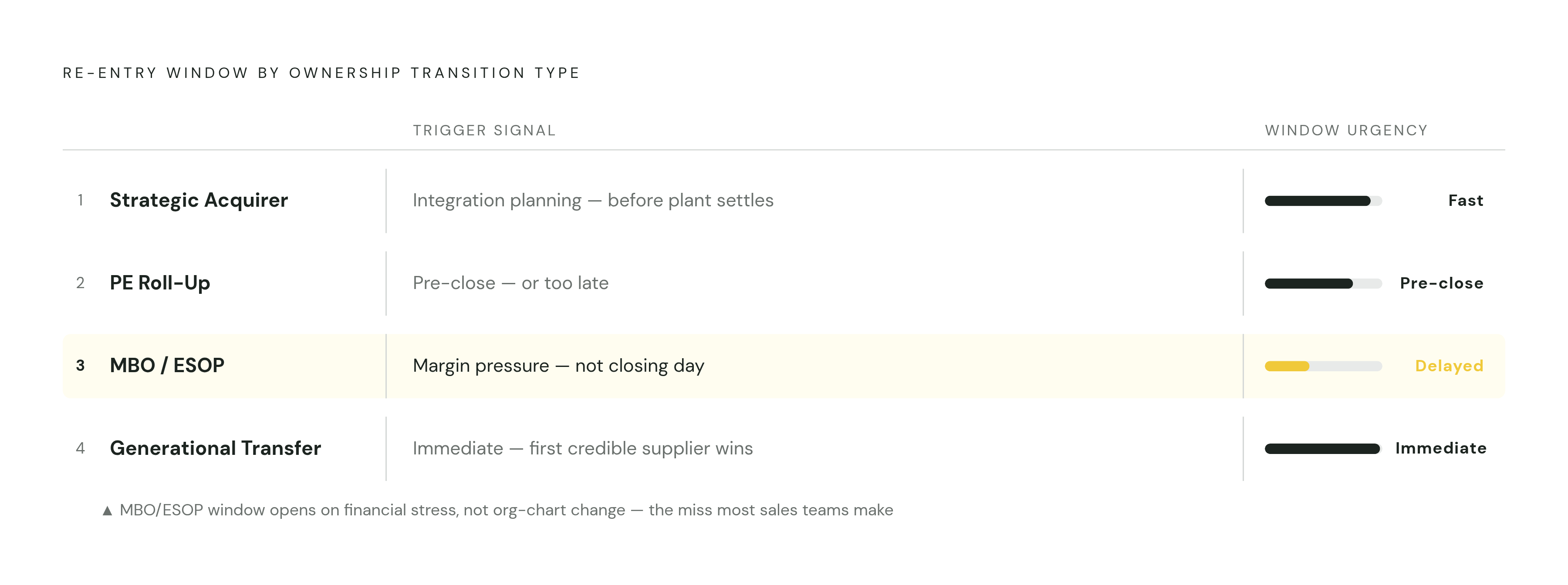
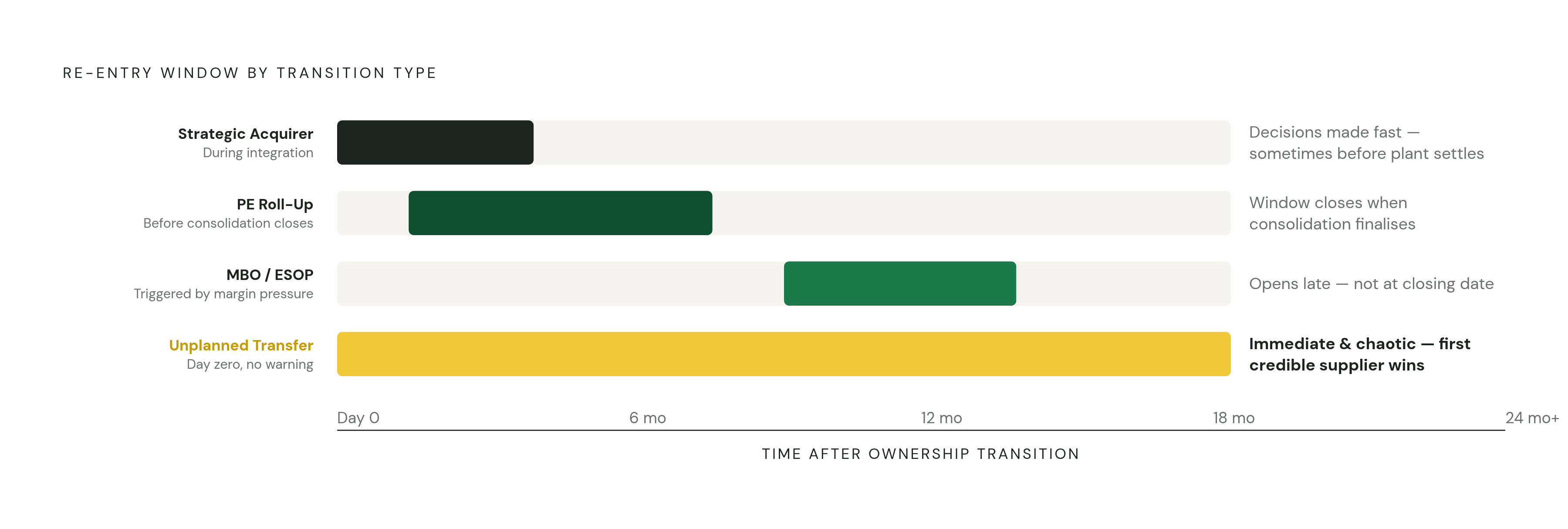
Not every ownership change opens the same door at the same speed. There are four broad patterns, and each one sets a different clock.
A strategic acquirer, meaning a competitor or a company in an adjacent industry, often already has preferred supplier agreements in place and may simply extend them to the newly acquired plant. That's a direct threat to the incumbent at that plant, but it's an opening for any supplier who already serves the acquirer's other facilities. This is also the fastest-moving window of the four: decisions get made during integration planning, sometimes before the acquired plant has even settled into its new routine.
Private equity roll-ups work differently. Specialty chemical manufacturing has been flagged as a high-value roll-up target, and PE-driven consolidation cuts both ways. A plant getting folded into a platform might get excluded from a new preferred vendor list, or a supplier might win the platform-wide agreement and suddenly gain access to several plants at once instead of one. The catch is timing: waiting until consolidation is finished means showing up to compete against an agreement that's already signed.
Management buyouts and ESOPs move slower, often deliberately so. These structures are usually staged over years to let managers grow into ownership gradually, and supplier relationships tend to survive the early going intact. The pressure comes later, when new ownership starts feeling the financial weight of the deal and starts questioning costs. The re-entry window here doesn't open at closing; it opens when margin pressure becomes visible, which means the signal to watch is financial, not organizational.
Unplanned generational transfers, triggered by a health event or a sudden retirement, are the most disruptive of the four. There's no staged handoff and no transfer of institutional knowledge, which creates an immediate vacuum across every vendor relationship at once. Contrast that with a planned family transfer, which according to horizonmaa.com often runs 12 to 36 months as a deliberate exit; when the outgoing owner actively manages that handoff, supplier continuity tends to hold. When the transfer is sudden, nothing holds.
Reading the physical signals that precede and accompany an ownership change
Private manufacturing transitions rarely get announced. There's no press release when a 40-person machine shop changes hands, and public filings or business media coverage catch only a small slice of the actual volume. The signal exists, but it shows up on the ground, not in the news.
Several patterns tend to show up before or during a transition. A new plant manager or new procurement contact shows up on a call, or a job posting hints at restructuring that hasn't been announced yet. Permit activity picks up: expansion filings, environmental compliance paperwork, new equipment installations, the kind of groundwork that happens either to prep a plant for sale or to integrate it after one. A previously stable account starts buying less, consistent with a plant coasting toward a transition or already sitting inside a post-close review. An RFI shows up in a category where one supplier has gone unchallenged for years, which is about as direct a signal of a procurement review as exists. Quality recertification, IATF 16949, AS9100, ISO 9001, often gets triggered post-acquisition as new owners revalidate the plant's processes, and that revalidation opens a parallel door for chemistry and consumable suppliers.
None of these signals means much alone. A leadership change by itself could be routine turnover. But a plant showing a new procurement contact, permit activity, and a volume decline all at once is a materially different priority than any one of those signals in isolation; the cluster is the finding.
The practical problem is that most sales teams find out from a contact who calls to say the plant has a new owner, and by the time that call happens, the window is already narrowing. Catching the signal earlier requires plant-level data, not a generic CRM record or a NAICS code search that describes a business category rather than what's actually happening inside the building.
What the plant actually makes — and why production process determines re-entry angle
An ownership change gets a supplier in the door. What the plant actually manufactures determines what to say once inside.
Take metalworking fluids. Removal operations (cutting, grinding, milling, drilling, turning) accounted for roughly 48.5% of the market in 2025, making it the dominant process category and the one most sensitive to fluid chemistry decisions. The process mix tells a supplier what conversation to have. Heavy machining, turning, and milling point toward coolant chemistry, emulsifiable concentrates, and semi-synthetics. Grinding operations point toward wheel-compatible fluids and rust inhibition. Automotive supply chain plants, the largest end-use segment by share, run under IATF 16949 and consume fluid at volumes that make fluid management programs relevant. Aerospace-serving plants carry tighter specs and are moving toward bio-based, PFAS-compliant formulations as a baseline requirement rather than a nice-to-have.
Regulation adds another angle. European PFAS bans starting in 2026 are forcing reformulation across the industry, and an incoming owner who hasn't yet mapped the plant's compliance posture is unusually receptive to a supplier who leads with regulatory expertise instead of price. Bio-based fluids made up 24% of new product launches in 2025, which gives a sustainability angle real weight, especially when new ownership brings ESG priorities down from a parent company.
None of this works as a generic pitch. A chemistry proposal that could apply to any plant gets dismissed by an incoming owner who's already skeptical of vendor pitches. A proposal built around what that specific plant actually runs signals that the seller did the homework the new owner hasn't had time to do yet.
When should a specialty chemical or metalworking fluid supplier move to re-enter an account after a plant ownership change?
The window is widest in the first 90 to 180 days after close. Incoming ownership is actively sizing up suppliers during that stretch, no loyalty has built up toward the incumbent, and budget decisions haven't hardened into anything permanent.
Several things close it. The incumbent re-engages first and locks in a formal renewal before anyone questions the relationship. A strategic acquirer's procurement team rolls out a preferred vendor list from the parent company. A PE platform finishes consolidating supplier contracts across its portfolio. Or the new owner inherits documented performance data that clearly favors whoever's already there.
MBO and ESOP transitions run on a different clock: the window opens later, and it's triggered by financial pressure rather than a change in the org chart, so the signal worth watching is margin compression, not a new name on the door. Unplanned transfers open immediately and tend to be chaotic; in that chaos, the first credible supplier to reach the new decision-maker with a clear, well-informed proposal carries outsized weight, simply because almost nobody else has shown up yet.
There's also a window that opens before the formal transition, in planned exits. In the final 6 to 12 months before a known closing, the outgoing owner is often the least engaged in vendor management of the entire process, which creates a quieter, secondary opening before anything officially changes.
The practical difference is stark. A seller who acts in week three of a new ownership situation is having a fundamentally different conversation than one who calls in month seven, after a renewal has already been signed and the window has shut.
How to build a re-entry approach that the incoming owner actually receives well
The incoming owner has a specific problem: a supplier book they didn't choose, no documented performance history to lean on, no clear read on whether current pricing is even competitive, and, often, a plant they don't yet fully understand operationally. The job of a re-entry pitch is to solve that problem, not to sell product.
A few things earn the first meeting. Demonstrating real knowledge of what the plant makes and runs signals credibility before a single product gets mentioned. Framing the conversation as a no-obligation review, something like "you're inheriting relationships you didn't choose, here's what we'd do differently," respects the owner's position instead of pushing past it. Leading with regulatory or compliance expertise, PFAS exposure, IATF status, environmental permitting, lands especially well, since new owners frequently inherit compliance gaps nobody has flagged for them yet.
A few things lose it just as fast. Generic outreach that could be sent to any plant in any state reads as exactly that. Leading with product features before establishing process fit skips the part the buyer actually cares about. And treating the new owner as a gatekeeper standing between the seller and "the real decision-maker" misreads the situation entirely; in most post-acquisition scenarios, the new owner is the decision-maker, and has no incumbent to protect.
For PE-backed acquisitions specifically, understanding the platform strategy matters more than understanding the single plant. A supplier who can offer consistent supply, reporting, and service standards across several portfolio plants has a structurally stronger position than one pitching a one-plant relationship, because the buyer is thinking in portfolio terms even if the initial conversation is about one facility.
Outreach also shouldn't stop at the ownership level. New ownership, the incoming plant manager, and any retained operations staff all deserve a call, and the retained operations team in particular often has the most day-to-day influence over chemistry and consumable decisions, despite being the group most sales teams skip entirely.
Building a territory plan that systematically surfaces ownership-change accounts before the window closes
Most industrial sales teams learn about ownership changes the way they learn about most things worth knowing: by accident, through a contact who happens to mention it on an unrelated call. That's not a process. It's luck, and luck doesn't scale across a territory with hundreds of accounts in it.
A territory plan built on facility-level data can flag which plants in a region carry the highest probability of a near-term transition. Long-tenured private ownership with no announced succession plan is one marker. Facilities in sectors seeing elevated M&A activity, specialty chemicals, metal fabrication, automotive supply, is another. Recent leadership turnover in operations or procurement roles is a third. Equipment investment or permitting activity that looks like pre-sale preparation rounds it out.
NAICS codes and headcount counts can't surface any of this. They describe what a business is classified as, not what it produces, who's currently running it, or whether it's quietly heading toward a sale. Plant-level data, what the facility actually makes, what equipment sits on the floor, what certifications it holds, what its environmental filings look like, is what lets a sales team rank re-entry candidates and walk in with a process-matched proposal instead of a guess.
CRM enrichment matters here as a forcing function, not a nice-to-have. Signals that never make it into the CRM don't drive anyone's next call, and a territory plan built on stale or generic account records will keep missing windows that were, in fact, visible the entire time in facility-level data. The practical output worth building is a tiered watchlist, accounts segmented by transition type, urgency, and process fit, reviewed on a set schedule rather than chased after the fact. Platforms built specifically for industrial commercial teams, ones that index facilities at the plant level across ownership signals, production data, and activity triggers, are what turn this into a repeatable system instead of another thing that happens to get noticed occasionally.