Prioritizing Your Plant Territory by Signal Strength Instead of Call Rotation
Ranking plants by live operational signals beats visiting them on a fixed schedule.

Real-time plant activity signals help industrial sales reps time their outreach by showing where changes at a plant create a buying window. Equipment and process changes, certifications, hiring, capacity expansion, and compliance reviews provide stronger grounds for prioritizing a facility than its place in a call rotation. Reps can rank plants by product-process fit, signal strength, and timing, then make field visits to those with the best chance of buying now.
Why fixed call rotation fails manufacturing territories
A rep drives a fixed route because Monday is Tier A accounts and Thursday is Tier B. Nothing has changed at those plants. The rotation schedules visits independently of a facility’s equipment evaluations, chemical specification reviews, or production capacity additions. Although the tiers may distinguish larger accounts from smaller ones, the schedule still distributes attention without reference to current purchase readiness.
Most accounts in a territory are not in-market during a given planning cycle, so spreading visits evenly directs much of the rep’s field time toward plants that will not buy this quarter. A scheduled visit when nothing is changing creates little momentum, while contact during a capital decision or compliance review can advance a purchase conversation. For specialty chemicals and process inputs, long buying cycles make entry timing especially consequential. More frequent contact cannot compensate for arriving after the relevant decision window has closed.
What plant-level signals actually are, and why they differ from generic intent data
A plant-level signal is an observable operational fact that reveals something about a facility’s production and procurement cycle. A maintenance manager job posting or a NADCAP certification appearing on a plant’s record gives the rep evidence of activity at a particular facility. Generic intent data tracks digital behavior, while plant intelligence shows the processes, equipment, and qualifications that shape what a manufacturer must buy. The distinction is between interest in a topic and a production requirement.
That requirement constrains the buying decision. In machining, the wrong fluid can degrade tolerance, surface finish, and tool life, so material profile and equipment class help establish whether a product belongs in the conversation at all. A signal then helps show when the plant may need to have that conversation. Fit or activity on its own cannot prove that a plant is weighing suppliers, but together they give the rep a reason to look into it.
Much of the evidence is public and observable. Job postings, equipment listings, certification records, OEM approval lists, trade press, capacity announcements, federal contract awards, and permit filings can reveal changes that ordinary contact records miss. Their value depends on what each fact says about the specific plant. A record that establishes an enduring production capability answers a different question from an announcement that reveals a current procurement trigger.
Which five signals indicate a plant is approaching a buying decision?
The five categories are equipment and process, certification and OEM approval, hiring, capacity, and compliance. They do not deserve equal weight. Process, certification, and hiring signals come first because they can show decisions a plant has already made, though a job posting on its own is weaker than an earned certification or named equipment investment. Capacity and compliance signals require particular attention to timing. Their usefulness depends on whether the rep can enter before a specification decision or review deadline passes.
Equipment and process signals provide the most direct connection to product requirements. What a plant cuts, grinds, casts, or forms, and the equipment it uses, helps specify the class of fluid, coating, or chemical it consumes. Published capabilities, equipment listings, and postings for specific machine operators can expose that connection. Certification and OEM approval signals also help show which plants qualify. When a fluid or coating earns a specific OEM approval, subcontractors serving that OEM become qualified prospects where their processes also fit the product.
Hiring signals point toward developing requirements. A maintenance manager, controls engineer, or new-product-introduction engineer posting can indicate forthcoming spending on equipment, automation, or components. A VP of Operations hire can also signal procurement activity, but hiring evidence requires interpretation before an account is promoted to the highest tier. A job posting alone may not convert into a purchase. Its confidence rises when it accompanies a relevant process change or named capital investment.
Capacity signals include announced expansions and facilities under construction. These can create buying windows for equipment and production inputs, but the useful outreach period depends on when specifications will be set. OSHA and EPA requirements involving VOC emissions, restricted additives, and disposal can prompt fluid and chemical reviews, exposing older incumbent formulations to replacement.
How to weight signals and build a priority queue from your territory
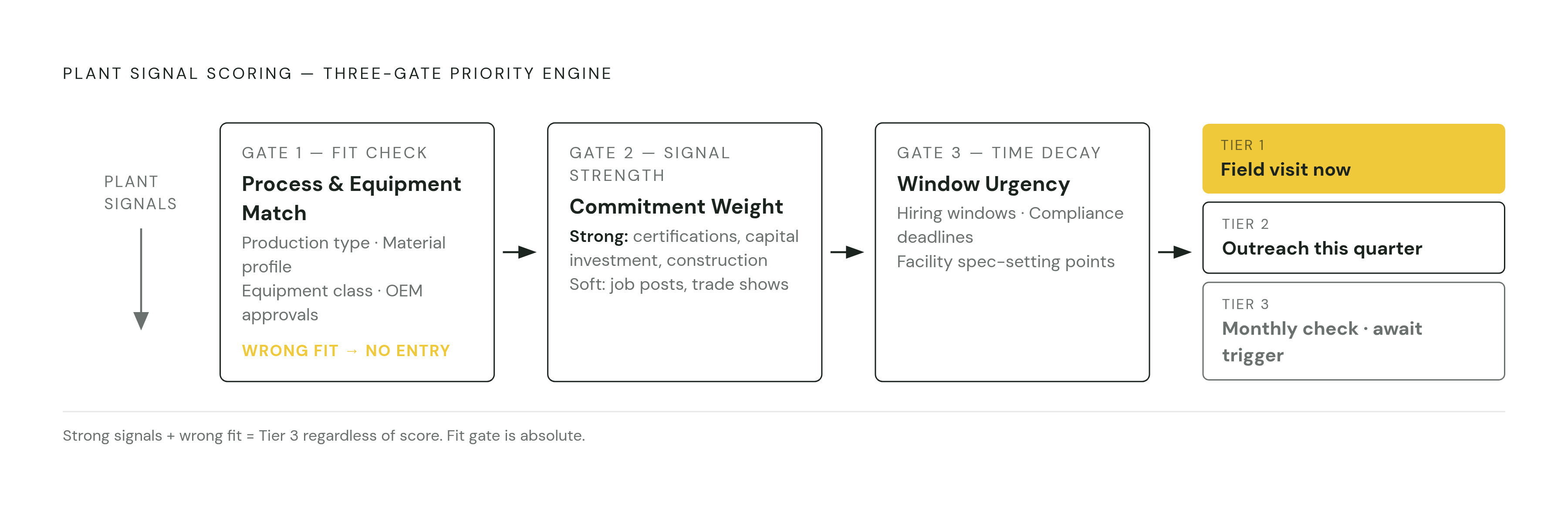
The scoring method should begin with fit. A plant running the wrong process or operating outside a product’s approval scope remains a low-priority call even when its activity signal is strong. The rep should therefore first check production type, material profile, equipment class, and the approvals that apply to the product. Signal strength should rank suitable accounts.
The next layer is confidence in the trigger. A facility under construction, an earned certification, or a named capital investment deserves more weight than a job posting alone or trade show attendance because it reflects a firmer commitment. The scoring need not be elaborate. A rep can distinguish strong commitments from softer indicators without a data team, provided the same criteria apply across the territory. Software accelerates the work, but it is not a prerequisite for the method.
A time-decay flag then establishes whether the opportunity is still current. Hiring has a window, compliance reviews have deadlines, and new facilities move toward a point when fluid specifications are set. A once-strong signal should not retain its place indefinitely after the trigger event passes without contact. The queue must distinguish an attractive plant from an actionable opportunity.
The resulting tiers determine the next action. Tier 1 accounts have product-process fit and strong signals that are still current, so they get field visits now. Tier 2 accounts get a planned outreach sequence this quarter, while Tier 3 accounts get a signal check each month and move up when a trigger points to a need for the product. This preserves coverage without treating every account as equally urgent. It also gives the rep a concrete reason for each visit rather than a date inherited from the previous rotation.
What signal-led prioritization does to field time and pipeline quality
A rep who knows the facility’s operation type, material profile, equipment mix, and compliance exposure can begin with a process hypothesis. That preparation reduces the basic discovery work that can otherwise consume the call or give an incumbent time to stall. The rep can then ask whether the change at the plant creates a need for the product.
The field-time benefit follows from that difference. Because much of a rotation-based territory is not in-market, visits concentrated on signal-flagged plants bring rep activity closer to actual buying moments.
Pipeline quality improves through the same mechanism. When fit and a current trigger are established before the visit, the rep has a stronger basis for distinguishing a qualified opportunity from general account interest. Earlier entry into the qualifying window can also shorten the sales cycle compared with arriving after the incumbent has reinforced its position.
Applying signal logic inside existing accounts, not just for new prospects
An established customer can add equipment, introduce a product, gain a certification in an adjacent process scope, or expand capacity without that change appearing in the rep’s normal account conversation. Installed-base intelligence fills in what the rep is missing by showing the equipment, certifications, and production lines that the rep’s sales do not yet cover. Operational changes can then expose a cross-sell or upsell opening.
For an existing account, the lesson is to read those changes against what the rep already supplies. A new-product-introduction hire or equipment addition in a different process area may justify a conversation that the current purchasing pattern would never suggest. The advantage comes from noticing the change before the renewal and building the discussion around it. A better account plan alone cannot tell the rep when to act.
What the CRM needs to hold for signal prioritization to work at scale
A CRM built around NAICS codes, headcounts, and last year’s call notes cannot represent the distinctions that signal ranking requires. The record needs production type, equipment class, certifications held, end-market exposure, including which OEMs the plant serves, and current operational signals. Without that foundation, the rep must reconstruct product-process fit whenever a new trigger appears. Across hundreds of accounts, that turns prioritization back into repeated research.
Plant managers, procurement, R&D, and EHS participate in decisions through different responsibilities, so a single contact per account is an inadequate model. Role-based tracking helps the rep reach the people whose work is tied to the signal. The plant record establishes the operational reason for contact, while the contact record identifies who can address it.
When plant-level data feeds the CRM, prioritization and its supporting research can become part of the same workflow. Corvus, a demand intelligence platform that maps what more than 500,000 manufacturing plants make and run, so suppliers can reach likely buyers before a competitor does, is one option for supplying that layer. The queue can update as signals appear, and the rep’s daily view can reflect changes rather than the conditions recorded when the territory plan was built. Automation alone does not establish relevance. The system still needs the fit criteria, signal weights, and timing rules that distinguish a qualified trigger from background activity.
How to run the weekly territory review that keeps the signal queue current
The weekly review should bring together new signals, time-decay flags, and outcomes from completed visits. New hiring posts, announcements, certification updates, and regulatory news show which accounts may need to move up the queue. Aging signals identify priorities whose original justification may have expired. Visit outcomes show where engagement warrants a follow-up sequence and where the next signal check needs to be reset. These inputs keep the queue responsive to both public activity and actual conversations.
Sales managers should set the rules before pressure to win a deal puts them to the test. That means deciding who maintains signal criteria, what triggers a tier upgrade, and how simultaneous signals on the same account affect priority. With consistent rules, managers can handle each change without having to make a fresh judgment call. They also keep a soft indicator from displacing a stronger opportunity simply because it is newer or more visible. A live queue needs governed decisions as well as current data.
An account can move toward a visit when fit, confidence, and timing align, then move into follow-up or back to monitoring as conditions change. The rep on rotation and the rep using a live queue may cover the same territory and the same accounts. Their effort follows different instructions. Rotation identifies the next scheduled stop, while the signal queue identifies where a buying moment deserves attention now.