Environmental Permit Activity as a Sales Trigger
State environmental permits reveal equipment purchases months before factories start buying.

An environmental permit is a public record of a plant's future purchasing decisions, filed months before that plant is ready to buy anything. Air quality approvals, wastewater discharge permits, hazardous waste registrations: read together, they tell you which lines are being added, what chemicals will run through them, and roughly when the equipment goes live. Most industrial sellers never read them. Meanwhile, the actual lead time sits in a state agency database, free to search, ignored.
Environmental permit filings are among the earliest and most reliable buying signals available to industrial equipment and chemical suppliers. A New Source Review air permit, for example, lands months or years before a facility makes its first purchase, naming the specific machinery going in, the process it supports, the raw materials consumed, and the chemicals that will run through the new line. Stacking permit data against local building and zoning records catches site activity even earlier, since EPA rule changes in 2025 and 2026 now allow construction of non-emitting components before the environmental permit is issued. Beyond permits, sites operating under a Plantwide Applicability Limit can expand without triggering a fresh NSR filing, so job postings, equipment delivery records, and local zoning filings have to cover what the permit databases miss.
What are the best ways to find early buying signals for industrial equipment and chemical suppliers?
A permit is a government sign-off a facility needs before it builds, modifies, or runs equipment that touches air, water, or land. Some types matter far more to a sales team than others, and the gap comes down to timing and how much detail the filing actually contains.
New Source Review air permits sit at the top of the list. A facility needs one before it starts construction on a new plant or a change big enough to meaningfully raise regulated pollutants, and that filing lands months or years ahead of the equipment actually running. NSR splits into two programs: Prevention of Significant Deterioration, for areas that already meet air quality standards, and Nonattainment NSR, for areas that don't. PSD reviews require a full air quality impact analysis, and those routinely take a year or longer. That's a long window where the prospect just sits there, permit filed, nobody calling. The triggers that set off an NSR filing (a new production line, higher throughput, a swapped raw material, a new combustion unit) are the same events that create demand for the process inputs a supplier sells.
One exception is worth knowing cold: the Plantwide Applicability Limit, or PAL. A PAL lets a facility manage emissions across the whole site instead of permit by permit, so it can add or change equipment without triggering a fresh NSR filing every time. A plant under a PAL can expand quietly, and anyone watching only permit databases will miss it entirely. Those sites need a different kind of digging: job postings, equipment delivery records, local zoning filings, stacked on top of whatever environmental data exists.
NPDES stormwater and construction general permits, required under the Clean Water Act whenever construction disturbs an acre or more of land, tend to show up right at or just before site prep starts. They won't tell you what a plant makes, but they confirm dirt is actually moving. Wastewater and industrial process discharge permits do more of the real work: any facility discharging washwater, cooling water, or process effluent needs one, and that filing tells you the plant runs a wet process (metalworking, food processing, surface treatment, chemical production) before you've ever set foot on site.
There's a timing wrinkle for 2025 and 2026 worth sitting with. The EPA proposed a rule in May 2026 that would let facilities start building the non-emitting parts, piping, foundations, electrical work, before the NSR permit is actually issued. Construction can now get ahead of the permit in some cases. Building permits and zoning records need to sit alongside EPA data in the monitoring routine now, not behind it.
How to read a permit application as a plant-level intelligence brief
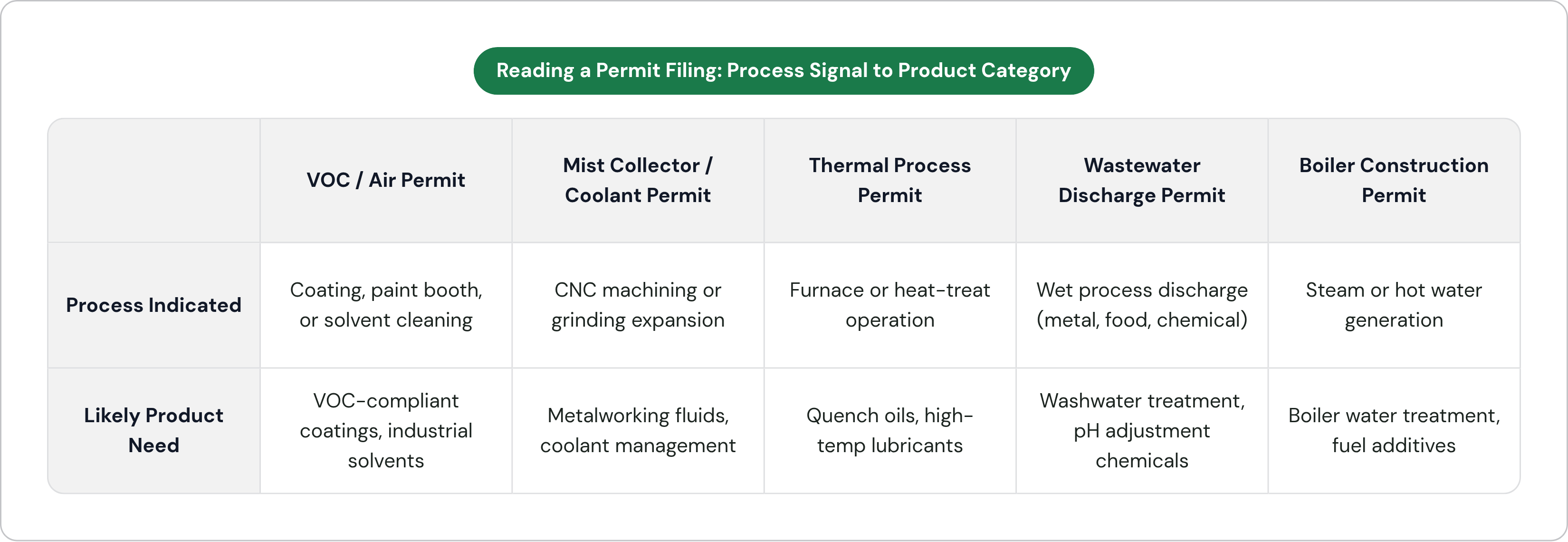
A permit application isn't paperwork filed to satisfy a regulator and forgotten about. It's a declaration of intent, written at the equipment level, often in more operational detail than a press release or an earnings call will ever give you.
Applications list the specific machinery going in, describe the process it supports, calculate the pollutants it'll emit (which names the chemicals and fuels involved), estimate throughput, and identify the raw materials consumed. Lay that list next to a product catalog and most of the work is done for you. VOC emissions point to coating lines, paint booths, or solvent cleaning, which points to VOC-compliant coatings and industrial solvents. A mist collector or coolant system permit points to CNC machining or grinding expansion, which points to metalworking fluids and coolant management. A thermal process permit for a furnace or heat-treat unit points to quench oils and high-temperature lubricants. A wastewater permit for process discharge points to washwater treatment chemicals and pH adjustment. A boiler construction permit points to boiler water treatment and fuel additives.
This is roughly the same exercise an environmental compliance consultant runs to assess a client's regulatory exposure. A rep running it isn't doing anything novel, just aiming the same read at a different goal. NSR permitting covers paper mills, plastics plants, automotive assembly, food processing, and nearly everything in between, so this holds up across almost every end market a specialty chemical or metalworking fluid seller touches.
Why the timing gap between permit filing and production startup is the commercial opportunity
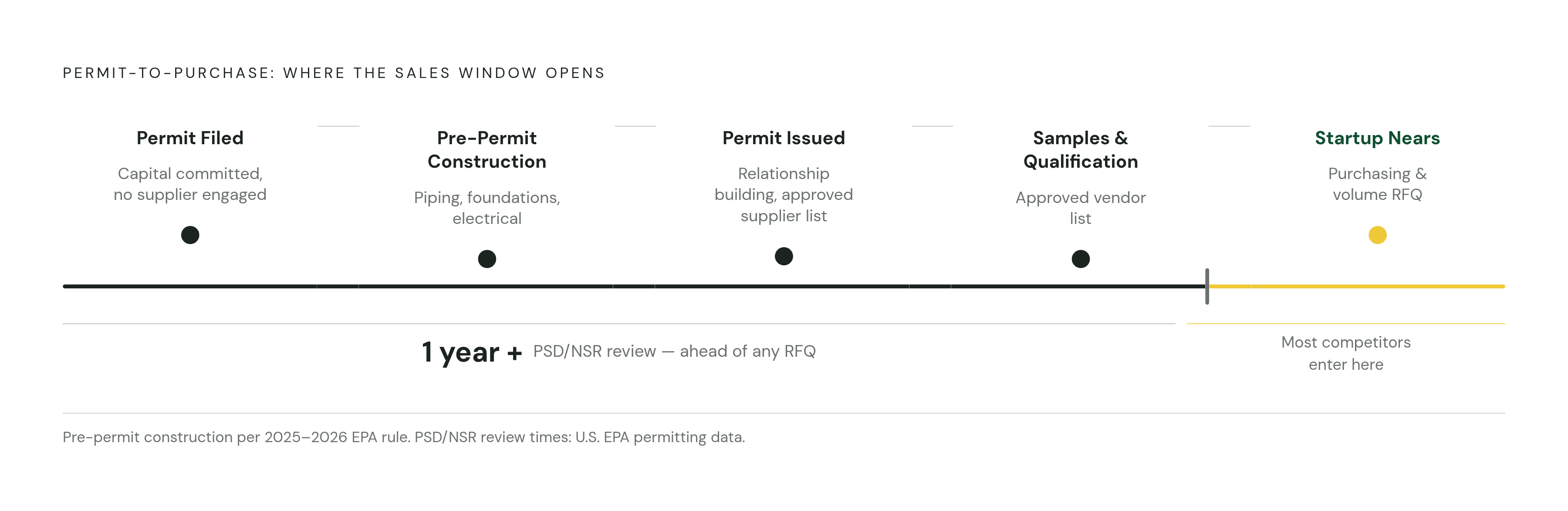
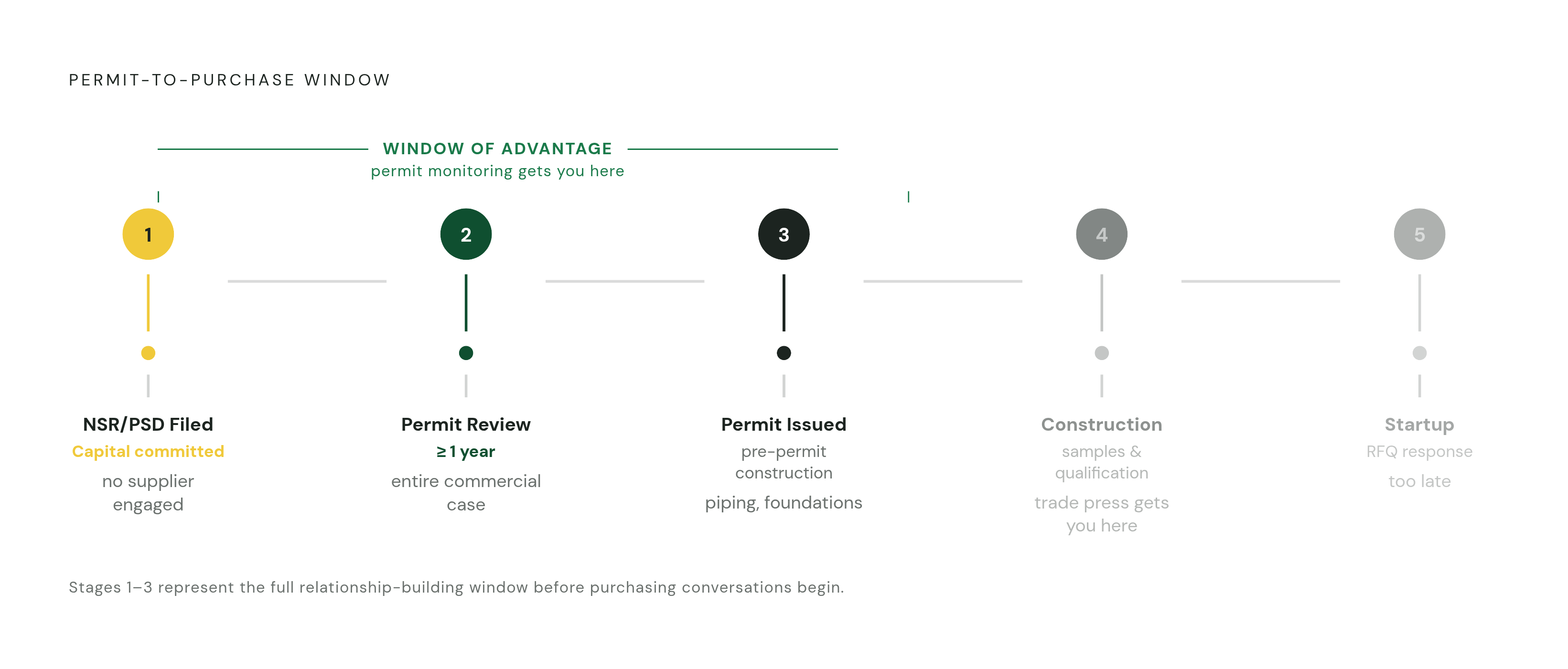
Manufacturers expanding in the U.S. keep underestimating how long environmental approval takes. Foley's 2025 analysis of permitting in the current manufacturing boom found NSR and PSD reviews for major sources routinely run a year or more. That gap is the whole commercial case: a permit filed today points to a purchasing need that won't show up for a year or longer, which is enough runway to build a supplier relationship well before a competitor even knows the account is expanding.
Compare that to how most industrial sales teams actually spend their day. Responding to an RFQ means the decision is already narrowing and incumbents are already in the room. Reading trade press for expansion news means finding out after the permit's been filed or approved, sometimes well after. A permit filing gets recorded the moment a facility commits capital to a project, before any supplier has been engaged at all.
A plant that just filed a permit isn't the same prospect as a same-size facility picked at random off an industry list. The permit is evidence of committed spend, not a guess about future intent. And the regulatory loosening moving through the system in 2025 and 2026, the EPA's push to allow pre-permit construction of non-emitting components, squeezes that runway tighter in some cases. That's a reason to act on the signal sooner, not wait around for confirmation. For sellers in specialty chemicals, metalworking fluids, water treatment, and coatings, the accounts driving your highest volume two years out are filing permits right now, maybe this month.
The markets where permit monitoring produces the densest opportunity right now
Not every sector files at the same clip. The reshoring wave running through U.S. manufacturing right now is concentrated enough that a handful of industries and states carry most of the volume worth tracking.
Semiconductor fabs throw off an unusually high number of permits across air, water, and hazardous waste, and the process chemistry is intensive enough that these sites are prime targets for specialty process chemicals and ultrapure water treatment. Arizona, Texas, Ohio, and New York carry most of that activity. EV battery and automotive expansion, clustered in Georgia, Kentucky, Tennessee, Michigan, South Carolina, and Alabama, is standing up new machining and assembly lines that need metalworking fluids, coatings, and coolants. Food and beverage expansion is triggering wastewater permits and thermal process filings, opening the door for industrial cleaners, water treatment chemicals, and food-grade lubricants. Pharma and biotech growth in North Carolina, Massachusetts, and Indiana is generating demand for cleanroom-compatible chemicals and pharmaceutical wastewater treatment.
The numbers back up why the timing matters. The metalworking fluids market hit $14.5 billion in 2026, up from $13.5 billion the year before, and it's headed toward $19 billion by 2030. Specialty chemicals overall are on track to grow from $880 billion in 2026 to over $1.1 trillion by 2031. The construction segment, which held the largest revenue share of the metalworking fluids market, is itself expanding to keep pace with the building boom, so it's throwing off its own wave of permits worth watching.
Where to find permit data and what to look for when you do
The data's public. Finding it consistently is the hard part.
EPA's ECHO database (Enforcement and Compliance History Online) is the most complete federal starting point. It's searchable by geography and industry code, and it tracks permit status, inspections, and violations across the Clean Air Act, Clean Water Act, and RCRA hazardous waste programs. State air quality agencies issue their own NSR and Title V permits, and a lot of them post the full application in a public docket: equipment lists, process descriptions, emission math, all of it. State dockets usually go deeper than anything you'll find federally. EPA's Facility Registry Service links records across programs, which comes in handy when you're connecting a facility's air permit to its water permit filed under a slightly different name. And given the 2025-2026 shift toward pre-permit construction, local building and zoning databases matter more than they used to. They can catch site activity before an environmental permit shows up at all.
A few things matter more than the rest once you're actually reading a filing. Equipment type and count maps straight to product category. Throughput projections hint at how much volume the account could eventually represent. Named raw materials and fuels confirm the actual process chemistry. Whether the filing is a modification or a brand-new permit tells you something too; a modification usually means an existing facility bolting on capacity, often a warmer account than a greenfield site. Applicant name and facility address are the basic account data that needs to land in a CRM, nothing fancier than that.
Manual review of state dockets works fine for a short list of closely watched accounts. It falls apart past that. Turning permit filings into a real pipeline source takes an aggregation workflow, not a once-a-month database check, because the goal is reaching the facility at the permit stage, not the RFQ stage.
Turning a permit filing into a first conversation worth having
A permit filing hands a rep something cold outreach almost never has: a specific, verifiable, non-generic reason to pick up the phone. The research is already done. The application names the equipment, the process, and the scale, so the job is connecting that to a relevant product, not guessing at what the plant might need.
The outreach should sound like it did the reading. "You're adding a grinding line" lands with more weight than "you're a metalworking company," because it proves the rep actually opened the filing instead of running a search on the industry. Timing matters too. A facility at the permit stage is still planning, not yet buying, so the right posture is showing up as a resource for spec work, not a vendor pushing a quote. And the person on the other end of that first call is usually a process engineer or environmental manager, not a purchasing agent, since that's who filed the permit in the first place.
Engagement should track the permit-to-startup timeline instead of rushing it. Early on, while the permit's filed but construction hasn't started, the goal is relationship building and getting onto the approved supplier list. Once construction is underway, the conversation shifts to samples and qualification. As startup nears, it turns into a purchasing and volume conversation. Skip straight to that last stage from a cold permit filing and you burn the exact advantage the timing gap gave you.
Permit data works best as one layer, not the whole picture. Knowing what a facility already makes, what equipment it runs today, and what it's bought before turns a permit filing from a lead into an actual account brief, and tells a rep whether they're looking at a net-new account or an existing customer moving into a new process line. The sellers who stack permit filings against production data, equipment profiles, and other signals are the ones who walk into that first call with something to say, not just a name and an address.