Real-Time Plant Signal Platforms Compared for Industrial Outreach Timing
It ranks platforms by how well they time outreach to plant events.
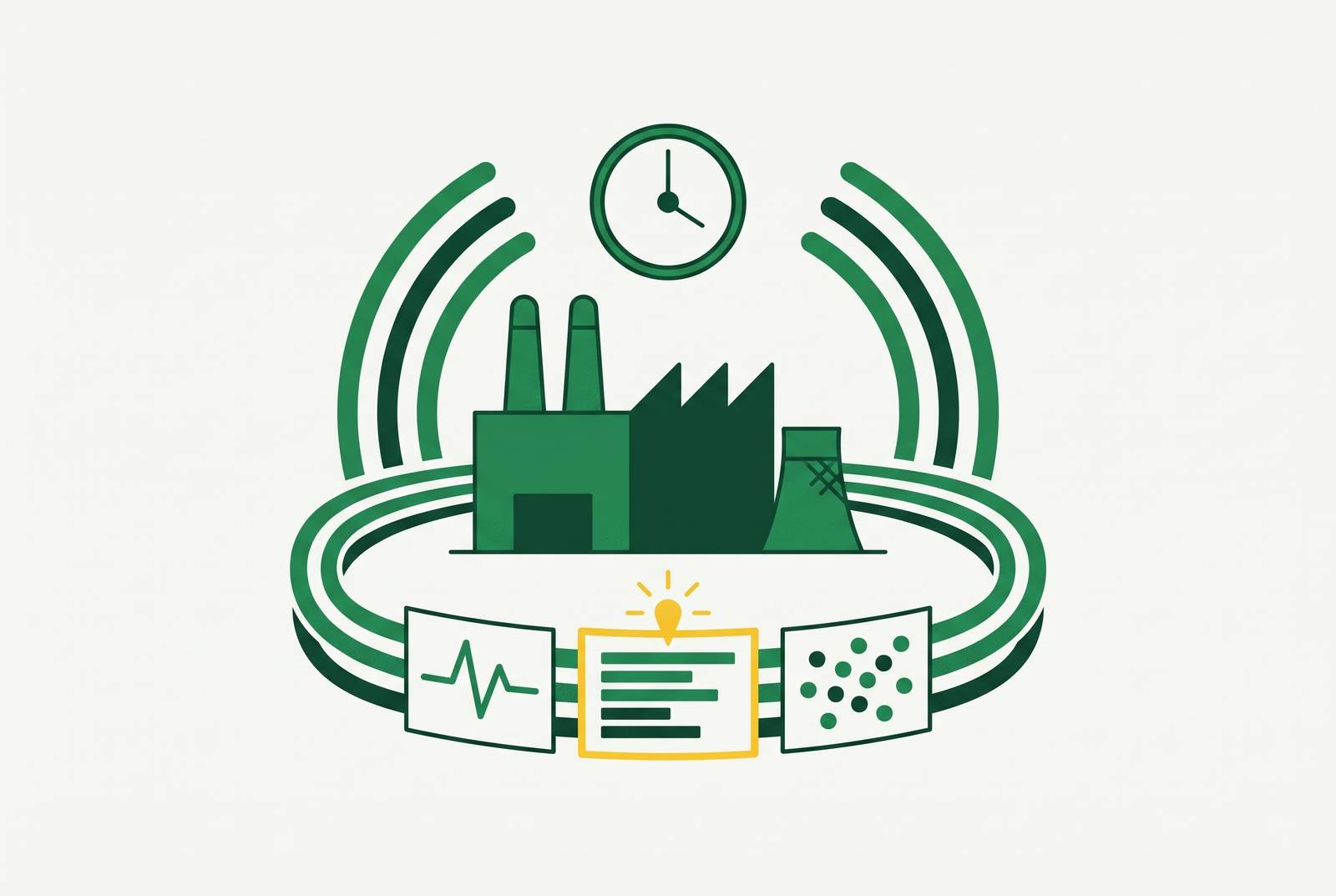
Real-time plant signal platforms should be compared by how well they match operational events to industrial sales outreach timing. Permits and capex announcements show early investment plans, equipment additions show that evaluation is underway or about to start, and leadership changes open a brief window to build relationships. Hiring signals reveal capability builds. These signals become commercially useful only when they also show what the facility runs and which products it needs.
Why the buying window is not a moment but a sequence of observable operational events
A CRM tells a rep what a customer already bought. It does not necessarily show what the plant is doing now that creates a reason to call. A facility can exist in a database for years without needing a particular product, then begin an operational change that creates demand over the following months.
The window opens before the formal buying process. Permits, equipment purchases, hiring, certifications, and leadership changes can become visible before an RFP or vendor evaluation appears. These events do not all indicate the same readiness, so treating each as an instruction to pursue an immediate sale loses the sequence. Calendar cadences and uniform cold outreach treat all these events alike, reaching accounts regardless of where they are in their operational cycle. A useful platform must distinguish an opening window from a decision approaching peak urgency.
Why industry codes fail to capture where a plant actually is in its operational cycle
NAICS and SIC codes describe industry membership. Classification follows primary revenue activity rather than the mix of production processes inside a facility. A plant running five surface treatment lines can sit within the same code as a plant running none. The code therefore provides a starting category.
Details about each location can be lost before a campaign begins. NAICS assigns one code per establishment, allowing plants with different activities to receive different codes, but commercial databases that retain one company-level code collapse those distinctions. A single old SIC record can also split into several NAICS codes, especially in plastics, metalworking, electronics, and medical equipment. Keyword-based classification adds another source of imprecision when a distributor or consultant described as “providing industrial solutions” receives a manufacturing code.
Every plant in the segment receives the campaign, whether it uses the product or is approaching a purchase. Adding a recent event leaves any errors in the underlying segment in place. Plant Scaler frames the remedy as facility-process classification, which supplements codes with what each plant actually runs and buys. That changes the segmentation layer from industry membership alone to production activity at the location.
The four signal types that actually map to stages in the industrial buying window
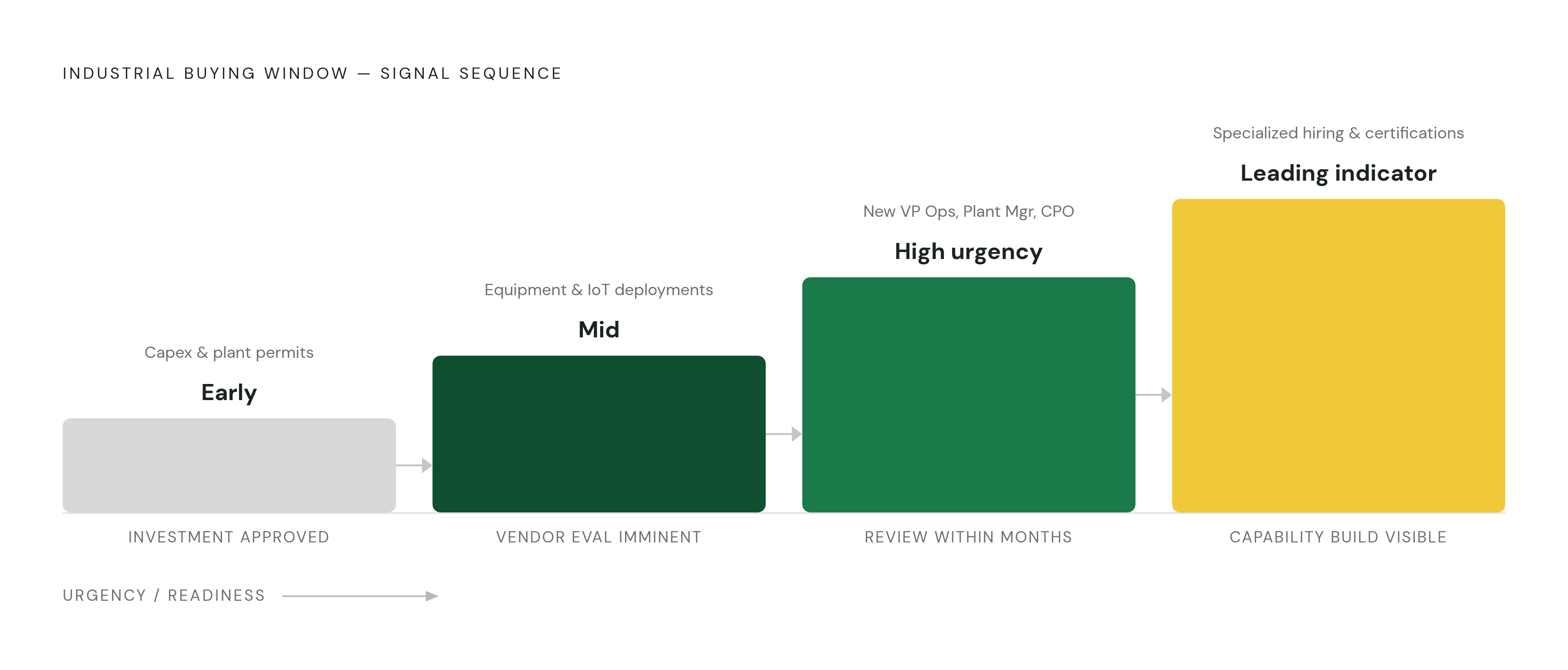
Capex announcements and new-plant permits are early-window signals. They show that investment has been approved while procurement talks are still months away, so they help build the pipeline while it is too early to push for a close. A semiconductor equipment manufacturer planning a major campus expansion in Tualatin, OR and a construction equipment manufacturer planning expansion and equipment upgrades in Lafayette, IN illustrate this class. Both make project plans public before vendors are chosen. Their commercial value lies in the lead time.
Mid-window signals include equipment additions and automation investments, such as robotics deployments, IoT platform rollouts, and Industry 4.0 technology adoptions. These indicate that the operational need has been scoped and budgeted, with vendor evaluation underway or imminent. Product relevance becomes more concrete at this stage. For consumables and specialty chemicals, the equipment type directly shapes demand for fluids, coatings, or additives. An equipment signal therefore indicates both a stage in the investment cycle and a basis for identifying associated purchases.
High-urgency signals include a new VP of Operations, Plant Manager, or CPO joining an account. New operations leaders bring prior supplier preferences and are likely to review vendor relationships within months of arriving. The opening is relational as well as operational. At a prospect, the change can create access for a supplier the incoming leader already prefers. At a customer, it can expose an established relationship to review, making the same event a retention concern.
Leading indicators include a jump in hiring for specialized plant engineering, automation, and process chemistry. These show that a plant is building new capabilities before everything it will need to buy becomes clear. Job postings for fluid systems engineers or coating line technicians point to processes that will need consumables and technical support. Workforce certification filings provide a related view of chemicals, processes, and hazard categories. Plant Scaler identifies those filings as signals of chemical procurement needs and the likely buyers involved.
These categories are stages of readiness. Hiring can reveal a developing requirement, while an equipment addition makes the relevant product need more specific. A supplementary layer comes from earnings calls and public procurement commentary, through which publicly traded manufacturers can disclose capex plans quarters in advance. That layer shows more of the early investment plans, though evidence from each facility is still needed.
What platform categories exist and what each one is built to surface
Manufacturing account intelligence platforms focus on facility expansions, supply chain shifts, and capital expenditure signals. Their manufacturing-specific talking points connect those events to capacity utilization, automation investment, and supply chain strategy. The emphasis is operational account context. This category helps reps discuss why a manufacturing business is changing through business-specific sales messaging. Its value depends on whether the surfaced change reaches the facility and process relevant to the supplier.
Broad B2B intent platforms read a different layer. They use machine learning to identify accounts anonymously researching industrial equipment, replacement components, or factory automation solutions, potentially before an RFQ appears. Anonymous research and a facility permit can both be useful, but they answer different timing questions.
Industrial supplier ecosystems and procurement networks show intent when buyers use their platforms to source products. A manufacturer searching for a certified supplier provides a high-specificity indication of purchasing interest. Coverage is bounded by participation in the network. Facility-first intelligence platforms instead profile equipment, permits, certifications, and processes, then match that operational profile to a supplier’s portfolio. They can size opportunities in gallons, pounds, or units rather than relying on company revenue as a proxy for demand.
How to match a platform category to the signal types your commercial motion actually requires
The choice of platform starts with the kind of sales work it needs to support. For new logo prospecting in specialty chemicals, coatings, and industrial fluids, the relevant branch is early-window detection combined with process-level profiling. Permits and capex announcements indicate an opening, while the process profile identifies the product that belongs in the conversation. Manufacturing account intelligence and facility-first intelligence are categories to evaluate against that combination. Without the process layer, a timed alert can reproduce the same targeting waste as an industry-code campaign.
If the objective is to reach accounts already researching or sourcing, the relevant comparison changes. Broad intent platforms show what content accounts consume, while procurement networks show what buyers on their networks are sourcing. The distinction is between research and active sourcing. Neither should be treated as proof of the plant’s equipment or process mix. Their suitability depends on whether that stage of expressed demand is the one the commercial team needs to reach.
For existing customers, the signal priority shifts inward. ERP transaction patterns and order-mix changes are more reliable indicators of cross-sell opportunity or churn risk than external events because they describe the current supplier relationship. A coatings manufacturer consistently ordering one resin type can present an opportunity for complementary additives or upgraded formulations. That opportunity is visible in purchasing behavior. An account-management tool needs to be judged on more than the external events it covers.
A new operations VP at a prospect creates an opening, while the same appointment at a key customer calls for fast re-engagement before vendor review begins. Along with reporting a changed contact, the platform must help the team respond in the way the account needs. Most commercial teams consequently need external operational signals for prospecting and internal transaction signals for account management. Few platforms cover both layers in equal depth on their own.
Why plant-level process profiling is the prerequisite that makes signal timing actionable
If the rep knows that a facility is expanding but not what it runs, the conversation may begin with the wrong product. Timing has solved access. Facility-process classification fills in what is missing by showing the equipment, the materials a plant processes, its certifications, and the industries its customers are in. It turns an expansion notice into a basis for a specific product recommendation.
The distinction is particularly sharp for specialty chemicals and consumables. A metalworking plant adding a CNC machining line needs different fluid chemistry from one adding a stamping line. Both events may indicate investment, but they do not justify the same offer. The company name and industry code cannot resolve that difference. An accurate process profile can. Facility specificity therefore belongs in the platform evaluation rather than being left entirely to the rep after an alert arrives.
Plant Scaler describes this shift as moving from firmographics to process fingerprints. Prospects are matched by machining operation, surface treatment, or fluid system, allowing product fit to be established before outreach is written. The same logic extends to existing customers. Installed equipment and facility-level consumable purchasing patterns can expose processes the rep did not know the customer ran. Those gaps can reveal product lines bought from a competitor even when the supplier already has an established account relationship.
What to audit in a signal platform before committing to it for industrial outreach
Does the platform surface permits and capex at the plant rather than only at the company, and can it distinguish a new line from a minor renovation. The next test is process depth, including whether the profile identifies equipment, processes, and certifications or stops at revenue, headcount, and NAICS code. With an alert linked to a broad company profile, the rep still has to do the main work of qualifying the account.
The audit should check whether operations leadership changes prompt an account review or only an update to a contact record. Hiring coverage should show the specific engineering and technician skills a plant is hiring for as well as its overall headcount growth. These are different levels of evidence. One shows that employment is changing, while the other helps identify the operational capability being built.
Account context is another test of usable timing. A permit filing at a current customer should support a cross-sell review. The audit should check whether external events are linked to the account's internal history. It should also test whether opportunity sizing uses gallons, pounds, or consumable units relevant to the supplier. Company revenue alone does not tell a rep which SKU to lead with.
Coverage and delivery complete the evaluation. Strong coverage of large public manufacturers can conceal gaps among mid-sized and smaller facilities, where much of the addressable market for specialty chemicals and industrial fluids sits. Workflow access is equally consequential. A useful signal does little good in a tab that reps rarely open. The commercially useful definition of a real-time plant signal platform is therefore a system that maps an observable operational event to the right buying-cycle stage, at the relevant facility, with enough product context for the rep to act.