Lead Scoring Models for Industrial Prospects Using Facility Signals
Facility-level signals, not company size, predict when manufacturers are ready to buy.

A much larger distributor can have flat revenue and a ten-year-old website, but it can still sit higher in a generic lead scoring model than a much smaller precision shop that just replaced its entire CNC fleet and posted three openings for maintenance machinists. Generic lead scoring was built to track SaaS buying behavior: trial signups, pricing page visits, email opens from a named contact inside a company that fits a revenue bracket. None of that maps cleanly onto how a manufacturer actually decides to buy. Industrial sales depends on machinery type, plant size, CAD file downloads, breakdown events, and engineering involvement, and none of those variables show up in a template built for software funnels. The mismatch is not something a weighting adjustment can fix. A model scoring company-level attributes has no way to see facility-level conditions, and facility-level conditions are what actually drive industrial purchase decisions.
What facility signals predict in industrial purchasing
Plant-level conditions, not company-level firmographics, are what tell you whether a manufacturer is in an active buying cycle and how much urgency sits behind it. The same logic applies to a cluster of manufacturing-specific signals that generic databases don't track at all: equipment purchases, plant expansions, new facility announcements, and hiring patterns for technical roles. These behave as high-intent indicators because they reflect decisions already made inside the plant, not interest expressed toward a vendor. A facility that just promoted a new VP of Operations or announced a capex investment is far more likely to engage with a sales outreach than a randomly chosen plant of similar size and industry. Compliance activity carries the same weight: certification renewals and ISO audits mean a plant has entered a structured evaluation process, and vendors who can meet that plant's evaluation criteria have a narrow, real window to get in front of it. Fit signals answer whether an account belongs on the list at all, and they change slowly, while activity and trigger signals answer whether a rep should work that account this week, and they need to refresh constantly to stay useful.
Firmographic fit scored at the plant level, not the headquarters
Firmographic fit still forms the base layer of any scoring model, but it has to describe the individual facility, its production process, its certifications, its equipment profile, rather than the parent company's headcount or consolidated revenue. Industry classification is the first filter to apply. Target accounts cluster in specific NAICS ranges: 333xx for industrial machinery and equipment, 336xx for transportation equipment, 237xx for heavy and civil engineering construction, 331xx for primary metal manufacturing. Rolling them up to the enterprise erases exactly the distinction the model needs to make.
Revenue alone can't give you this layer of resolution, but certifications can. A facility running AS9100, holding ITAR registration, or carrying NADCAP accreditation operates under regulatory and quality constraints that shape what it's permitted to buy and from whom, which makes certification status a direct input into fit, not a footnote. Geographic proximity belongs in this layer too: industrial buyers expect service response measured in hours, and a facility sitting outside a vendor's service radius represents a real commercial disqualifier rather than a minor inconvenience to note and move past.
Generic firmographic databases were built for company-level targeting, not to look inside a plant, so they can't resolve any of this. Platforms built specifically for industrial sales teams, like Corvus, index plant-level signals across more than 500,000 manufacturing facilities and track more than 60 data points per plant, which is the resolution needed to tell two plants in the same corporation apart rather than treating them as a single account with a single score.
Equipment age and production activity as the model's readiness layer
Equipment profile and production activity tell you if a high-fit account sits in a replacement or expansion cycle, or just sits idle. Fleet age stands out as one of the strongest predictors in the entire model: a facility running equipment near or past its expected replacement window is in active replacement mode whether or not it has shown any digital intent signal to a vendor. Direct equipment age data isn't always available, but it can be inferred from maintenance contract filings, equipment auction listings, and job postings that reference specific equipment model numbers, each of which leaves a trail a scoring model can pick up.
Technographic signals round out the readiness picture. Production volume and capacity utilization matter for the same reason: a plant running near maximum utilization is working through a different set of problems, and a different timeline, than a plant with slack capacity to spare.
CNC machining adoption and facility expansion both leave detectable signals: job postings for maintenance machinists or CNC operators, equipment permit pulls, and public facility expansion announcements. All of these are scorable, and all of them matter particularly to sellers in metalworking fluids and adjacent categories, where the equipment a plant runs determines the product it needs. This is the layer where a platform like Corvus earns its place in the model, since indexing what equipment a plant runs and what it's currently producing is precisely the data this scoring layer depends on, and it's not data most CRMs hold on their own.
Operational triggers that compress the buying cycle
Buying triggers carry the highest urgency weight in the model because they signal an external event, not gradual wear or a planned refresh cycle, and that event has compressed a plant's timeline. Equipment breakdowns, capacity shortages, compliance deadlines, and sudden vendor failures all raise buying intent immediately, and a plant facing any of them no longer has the luxury of a long evaluation process. A facility heading into a safety audit or dealing with an equipment failure needs a solution now, and a scoring model that catches these triggers catches sales-ready leads at the exact moment they're ready to act.
RFQ submission stands as one of the clearest trigger signals available. Leadership change belongs in the same tier. A new VP of Operations or a new plant manager tends to re-evaluate existing vendor relationships when they set their own operational priorities, so a recent leadership change at a target facility is worth scoring as a trigger on its own, apart from whatever fit score the account already carries.
Weighting behavioral signals from industrial buyers differently from SaaS engagement
CAD file downloads reveal the clearest difference between industrial buyer behavior and SaaS engagement. In industrial sales, gating CAD file access behind a short form that captures role, company, and project details turns the download into a qualifying event, because an engineer pulling a CAD file is doing project work, not browsing. If you treat that download the way a marketing automation platform treats an ebook download, you throw away the information packed into it.
Website behavior carries a similar distinction, though a smaller one. The more consequential difference appears in who is doing the engaging. An account where an engineer, a procurement contact, and a plant manager have all engaged separately represents a different buying state than an account where one contact has engaged five times, and the model should treat multi-function engagement as a multiplier rather than adding the two together as if they were equivalent.
This distinction also protects the model against a failure mode specific to industrial content: high-volume engagement that carries no purchase intent, and the fix isn't counting engagement volume but weighting by role and by action type, so that a single RFQ submission outscores a dozen anonymous spec sheet downloads.
Assembling and weighting the five signal layers into a working model
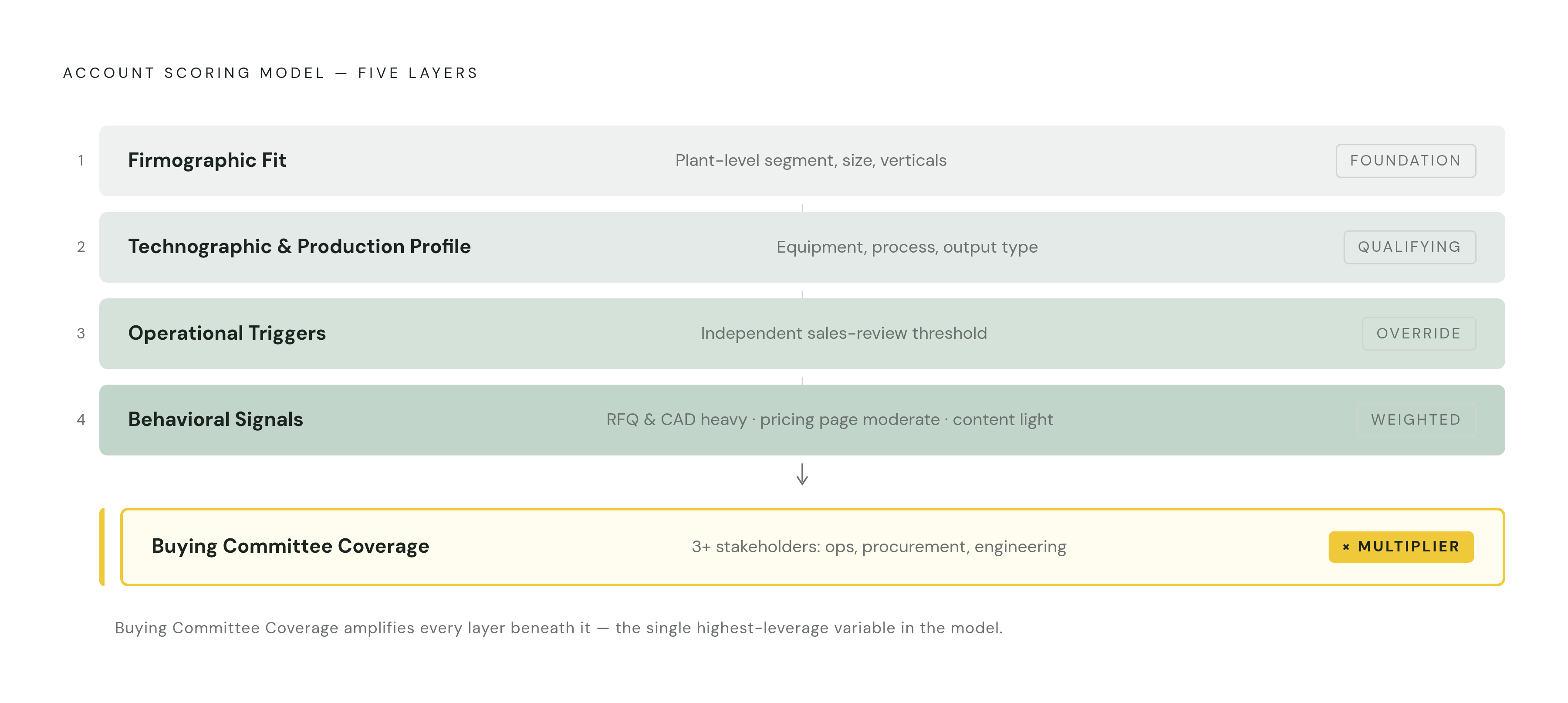
A working model stacks the five signal layers in a defined hierarchy rather than treating them as a flat list of points to add up. Firmographic fit at the plant level comes first, followed by the technographic and production profile, then operational triggers, then behavioral signals, with buying committee coverage applied last as a multiplier across everything beneath it.
Triggers need to be able to move independently of fit. If a plant faces a compliance deadline or a sudden supplier disruption, it shouldn't need a flawless firmographic profile first; it should get elevated into sales review. On top of that sits the behavioral layer: RFQ submissions and CAD or spec sheet downloads carry heavy weight, pricing page visits carry moderate weight, and general content engagement carries light weight. Buying committee coverage multiplies everything beneath it. Three or more, spanning operations, procurement, and engineering, represent the highest readiness state the model can observe.
Two structural mechanisms keep this architecture from decaying into a stale point tally. A plant that posts 40 engineering job openings shouldn't outscore a plant that posted a single opening alongside a facility expansion announcement, because the second plant shows breadth across signal types, and breadth is what correlates with a real buying motion, not just a single hiring push.
Research on predictive lead scoring backs this directional shift: models that use data mining and machine learning to weight signals consistently outperform traditional rule-based scoring on sales performance measures. The architecture described here is a rule-based starting point: it's built to run on day one, and it refines itself into something closer to predictive scoring as conversion data accumulates. None of it works without a defined numeric MQL threshold that's documented and applied automatically, so the marketing-to-sales handoff happens the moment a score crosses the line, not whenever a rep gets around to a subjective judgment call. And none of it works without data at the plant level to feed it: this is where commercial intelligence platforms built for industrial sellers, Corvus among them, do the groundwork of tracking equipment type, certifications, technical hiring, and capex announcements at a scale no sales team could replicate by hand.
Matching score tiers to rep actions and territory capacity
A score only changes behavior if it tells a rep what to do differently on a Monday morning. Without that link, you get a ranked spreadsheet, not a sales motion. Score tiers need to map to explicit coverage frequencies: top-tier accounts (A) get frequent direct contact, mid-tier accounts (B) sit on a monthly cadence, and lower-tier accounts (C) move to quarterly or nurture-only outreach. The whole point of tiering is capacity allocation, because rep time is the scarcest resource in the system. A single industrial rep managing a large account base can't work every scored account with equal attention, so the model has to rank accounts by probability, not just filter out the ones below a cutoff.
The scoring model only delivers value if the handoff process around it holds up. When manufacturing sales lead management systems align sales and marketing around shared lead stages, clear handoff rules, and joint KPIs, they cut down on dropped leads and improve pipeline velocity, but a well-built score run through a broken handoff process still loses opportunities. Existing accounts should take up most of a rep's working capacity, with a defined slice reserved for new business, and the scoring model needs to apply to both sides of that split so that account growth opportunities surface right alongside new prospects.
Geographic proximity scoring feeds directly into territory design. Full points go to accounts inside a serviceable response radius, partial points to accounts at the edge of coverage, and a high-scoring account sitting outside the service radius is a disqualification waiting to happen. Buying committee coverage should trigger a specific, defined rep action, not just a bump in priority ranking, because multi-stakeholder engagement calls for a coordinated response across functions, not a single rep making a cold call into a three-person buying committee alone.
Data quality as the prerequisite the model cannot compensate for
A facility-signal scoring model built on incomplete or stale plant-level data misranks accounts just as reliably as the generic model it was built to replace. Data quality is the condition the model depends on to function. NAICS codes, headcount, and revenue are not enough on their own. They need to be enriched with production process data, equipment profiles, certifications, and activity signals before any scoring logic can run against them with accuracy.
Single data providers tend to cover only part of the manufacturing landscape, so if you cascade a search through multiple providers until a valid data point turns up, waterfall enrichment materially increases both coverage and accuracy compared to relying on one source. Fit scoring and trigger scoring also run on different clocks: fit data can refresh quarterly without losing much value, but trigger data needs to refresh daily to be useful, since a breakdown event or an RFQ submission loses its relevance fast. If a platform updates plant-level signals near real time, it serves the trigger layer in a way an annually refreshed database can't.
Building the equipment profile this model depends on at scale means cross-referencing equipment databases, job postings that name specific equipment roles, and maintenance contract records, work that isn't realistic to do by hand across hundreds or thousands of accounts. And even accurate scoring fails if it stays trapped in a spreadsheet: the scored output has to land inside the CRM view reps already work from, or it won't change what a rep does on a given day. This is the layer where a platform like Corvus matters most directly: it indexes plant-level data across more than 500,000 manufacturing facilities and more than 60 data points per plant, and it's matched into the CRM tools sales teams already use, not delivered as a separate report to check. The scoring architecture described across this piece is available to any sales organization willing to build it. The model works only as well as the quality of the plant-level data feeding it, and that data quality is the investment the model cannot substitute for.