Equipment Upgrade Signals in Metal Fabrication Plants
Cutting equipment upgrades reveal the real purchase cycle months before an RFQ appears.

Nobody buys a laser cutting system on a whim. The cycle from first internal conversation to purchase order can run the better part of a year, and the plant manager is rarely the only signature required. Operations VPs, procurement directors, finance, whoever owns the capex-versus-opex call on that particular purchase; all of them hold a piece of the approval chain, and where the money lands on the books often decides who has to sign off and how fast the thing moves.
Metal fabrication plants upgrade equipment mainly to stay competitive and cut labor cost, not because a machine wore out. Upgrade timing tracks competitive pressure and labor availability more tightly than it tracks depreciation schedules. The internal cycle from first conversation to purchase order can run the better part of a year, moving through operations, finance, and procurement before any formal request appears; by the time a plant issues an RFQ, it has usually already defined what it needs and quietly built a short vendor list. Credit access and payback uncertainty can still kill a deal in committee, but the real investment decision typically happens months before anyone outside the plant sees it.
It plays out badly on a regular basis. A plant engineer wants a machine, finance wants a three-year payback story, and somewhere in between the request sits on a VP's desk for six weeks because nobody flagged it as urgent. The Federal Reserve Bank of Chicago has studied manufacturing investment patterns, and one finding is worth repeating here: plants upgrade mainly to stay competitive and cut labor cost, not because a machine wore out. Upgrade timing tracks competitive pressure and labor availability more tightly than it tracks depreciation schedules. Credit access and payback uncertainty still kill plenty of deals in committee, sure. But by the time a plant clears those internal hurdles, it has usually already defined what it needs and quietly built a short vendor list, which means the real decision happened months before anyone issued a formal request.
Show up after the RFQ drops and you're bidding against a spec a competitor probably helped write.
What equipment categories do metal fabrication plants invest in most often?
Cutting equipment sits at the top of the list, and it isn't close. Laser installations and upgrades happen more often, and touch more of the downstream process, than any other machine category on the floor, mostly because almost everything a shop does afterward depends on what the cutting line can produce.
Robotic welding cells are growing fastest. The reason isn't subtle: shops can't hire enough welders, so they buy capital to replace headcount wherever the math works out. CNC bending and press brake upgrades usually trail behind, arriving once a plant has already added cutting throughput and needs forming capacity to keep pace. MQL conversions, minimum quantity lubrication, are their own animal. A shop moving off flood coolant needs new plumbing, needs new fluid specs, needs new application hardware, and needs it all roughly at once instead of staggered in over a year.
There's a bigger structural shift underneath all of this, and it runs toward cells: several machines wired together into one integrated unit instead of a single swapped-out tool. A multi-machine cell creates a tangled consumables and service need that a one-for-one replacement never does. People underrate how much that matters commercially. Consolidation among welding and automation equipment makers is also reshuffling who a plant buys from, forcing a fresh look at compatible consumables even when nothing on the floor has physically changed yet.
What each type of upgrade actually signals about what a plant will need to buy
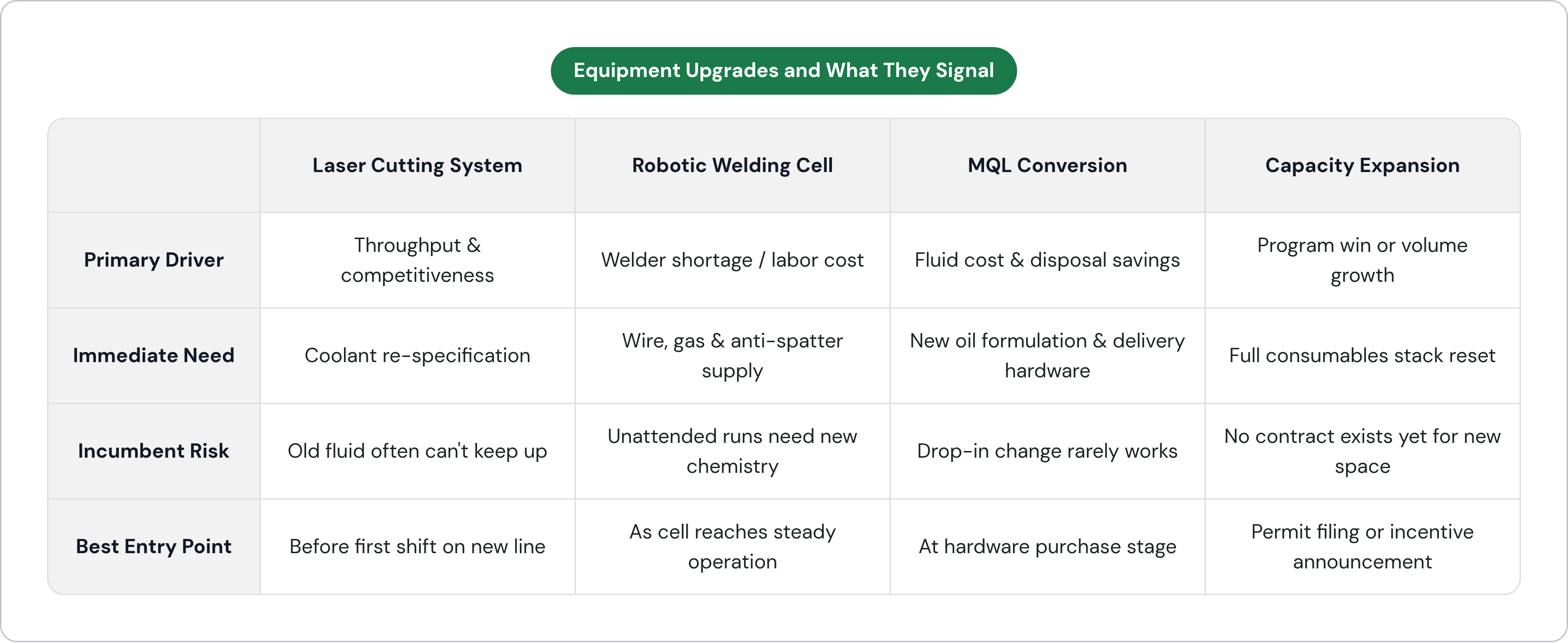
A new laser cutting system never arrives alone. It forces a coolant re-specification almost immediately, since cutting parameters and heat profiles on new equipment rarely match whatever ran before, and old filtration or swarf handling often can't keep up. Cut aluminum or high-nickel alloy fast enough and the fluid chemistry has to be tuned for that exact job; a generalist supplier usually can't support it.
Robotic welding cells pull in a different direction. Throughput climbs, and wire, gas, and anti-spatter consumption climb with it on a schedule a rep can project once the cell settles into steady operation. Unattended runs also need weld-line cleaning chemistry built for a cell nobody is standing over. The plant isn't swapping a torch for a robot here. It's building a small ecosystem, and whoever understands the whole cell, not just one piece of it, earns a different kind of trust than a parts supplier ever gets.
MQL conversions carry their own weight. The switch from flood coolant isn't a drop-in change. The oil has to match the specific operation, new delivery hardware goes in as a capital purchase separate from the fluid contract, and the payoff, lower fluid consumption and lower disposal cost, gives a technical rep a clean ROI story to bring straight to the plant engineer.
Material mix changes force the same reckoning from a different angle. A shop moving into aerospace-grade aluminum or high-nickel alloy usually discovers its general-purpose fluid doesn't hold up, and tool wear shows the pain fast, often before anyone drafts a formal quote request. Specialty suppliers with formulations built for titanium or hardened steel grinding can knock out an incumbent right at that transition, sometimes within a single quarter.
Capacity expansion resets the whole consumables stack, since nothing is under contract yet for the added square footage. Permit filings and economic development announcements, the kind of disclosure agencies publish when a facility takes an incentive package, surface well before the plant ever runs a shift. Show up at the permit stage and you get specified into the initial setup. Wait, and you spend the next three years trying to displace whoever got there first.
Where the signals actually appear before a competitor finds them
Most reps never open a building or environmental permit filing. That's a mistake, and it's an avoidable one. A new paint or blast shop, a high-amperage welding hookup, a compressed air upgrade: all of it needs a permit filed before a single wall goes up. Economic development announcements frequently name the equipment type and job categories tied to an incentive package, in plain language, right there in the press release. Trade press and events like FABTECH are another open channel; exhibitor news and facility case studies routinely name the exact equipment a plant just installed.
Job postings tell a parallel story. A listing for CNC operators, robotic welding techs, or automation engineers means the equipment already arrived, or is about to. A posting for fluid management or maintenance staff means a plant is scaling up coolant-intensive work. Plant engineers posting about a new installation on LinkedIn are, whether they mean to be or not, announcing a sales opportunity in public.
Inside existing accounts, the signals get quieter but stay just as real. A customer mentioning overtime, or running equipment harder than usual, is describing a capacity crunch before they ever call it one out loud. A request to qualify a new alloy usually trails an upstream program win that's about to change the plant's whole machining profile. A gripe about fluid performance on a new part is often the first verbal trace of a process change that happened weeks earlier, one nobody thought to mention until it started causing problems.
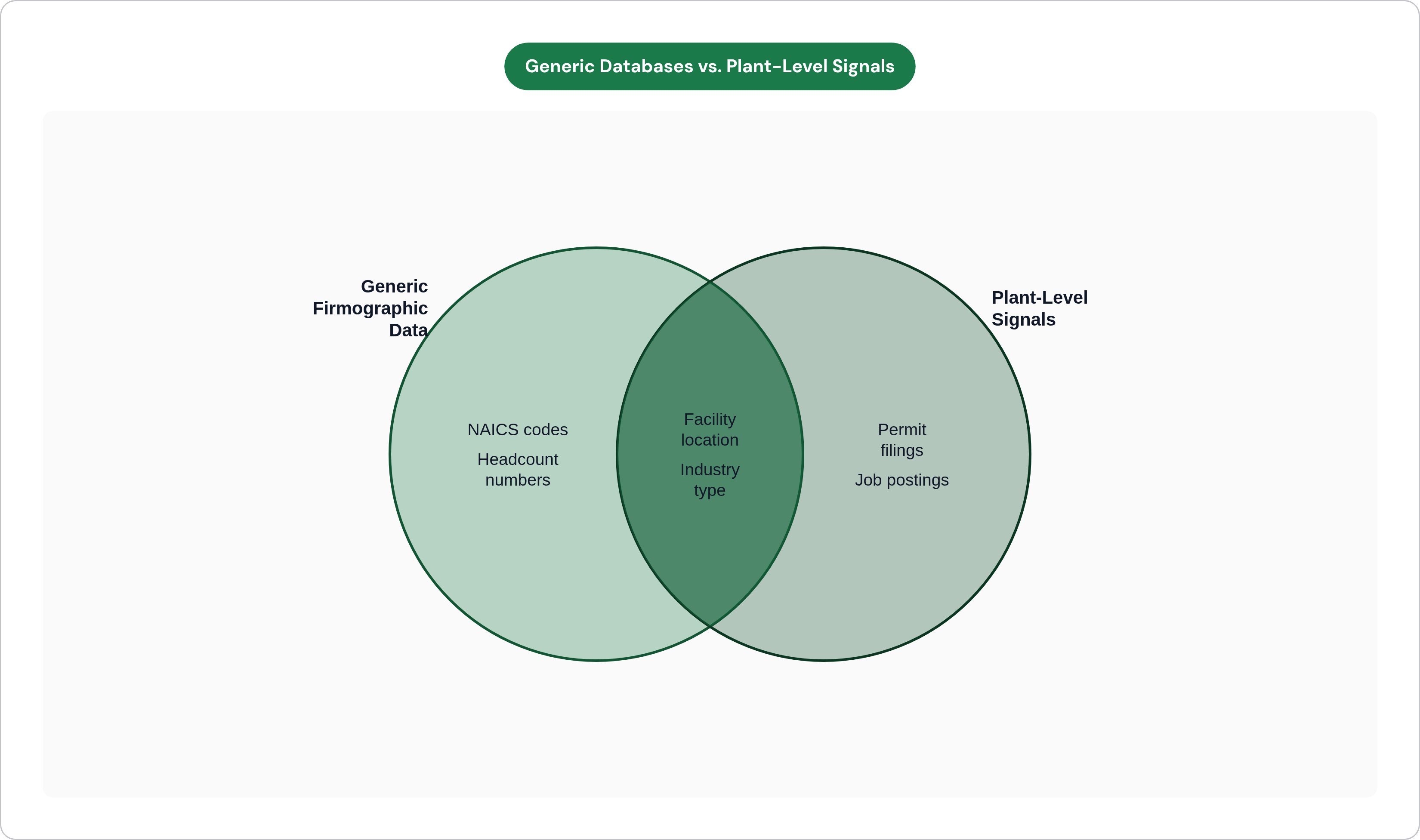
Generic firmographic databases miss all of this, by the way. A NAICS code and a headcount number tell you a facility does metal fabrication. They say nothing about whether it just installed a five-axis laser cell or converted two machining centers to MQL last quarter. Plant-level production data, tracking actual equipment profiles and real-time activity, turns detection into something a rep can act on instead of guess at.
Turning a signal into a first conversation before the plant is in the market
The signal should decide how the conversation opens. A rep who knows a plant just installed a new laser line has no business leading with a pitch. The better opening question is about material mix and the throughput the new cell is running. Before the first call, homework should cover what the plant makes, what it now runs, what materials pass through it, and what that combination means for fluid chemistry.
The person on the other end of that first call is usually a plant or process engineer, not a procurement buyer, so the conversation should sound technical, not transactional. Risk aversion drives almost everything at this stage, and for good reason: a bad fluid choice on a brand-new line can halt production, wreck tooling, or void an equipment warranty outright. Framing the call around reducing that risk consistently beats trying to dislodge an incumbent supplier on price.
One opening line works better than the rest: "We work with shops running this kind of equipment on this material, and a few fluid specification decisions come up consistently at this stage. We can walk you through them before you're locked in." That's an offer to de-risk a decision the plant hasn't finished making yet, not a pitch. And the advantage compounds, because the rep who specs fluids for the first new line becomes the automatic call when the second one goes in.
How to build a territory-level signal-reading practice, not just one-off deal chasing
No single rep tracks permit filings, trade publications, job postings, and utilization patterns across hundreds of accounts by hand. Not reliably, anyway. That kind of monitoring only works at scale if someone structures it, rather than leaving it to whoever remembers to check a permit site on a Tuesday afternoon. Territory plans built around what equipment a plant actually runs, and which facilities are mid-expansion, look nothing like plans built on geography or SIC codes.
Not every signal deserves equal weight, either. Greenfield or major brownfield expansion, where no consumables contract exists yet, sits at the top. Material mix changes or new process introductions that make an incumbent's fluid obsolete come next. A single-machine swap inside an otherwise stable process is worth watching, but the incumbent still holds the edge there, so it sits lower on the stack.
Account size alone is a bad filter, and this is where a lot of territory plans go wrong. A mid-sized fabricator adding two robotic welding cells and switching to MQL is a better prospect this quarter than a large plant sitting still with no observable change. Most industrial sales teams hit the same wall here: if the CRM record shows nothing but company name, NAICS code, and the date of last contact, the territory plan sitting on top of it is fiction. A CRM is only as good as what feeds it, and most feed it almost nothing.
Some teams solve this by building the research function themselves: permit trackers, alert systems for job postings, a standing habit of reading trade press line by line. It's slow, and it takes discipline most territory reps don't have time for on top of a full pipeline. Some tools do this work at the plant level instead, tracking equipment profiles, production activity, and real-time change signals across a wide footprint, so a distributed sales team isn't stuck with each rep reinventing the same research operation on their own time. Whatever the mechanism, the outcome tends to look the same: teams that build this practice earn something harder to buy than a lead list. They become the first call a plant engineer makes when new equipment lands on the floor, because they already showed up once, before anybody asked them to.