Job Posting Patterns That Reveal When a Plant Is Actively Sourcing New Equipment or Suppliers
Job postings paired with facility changes signal when plants are ready to buy.
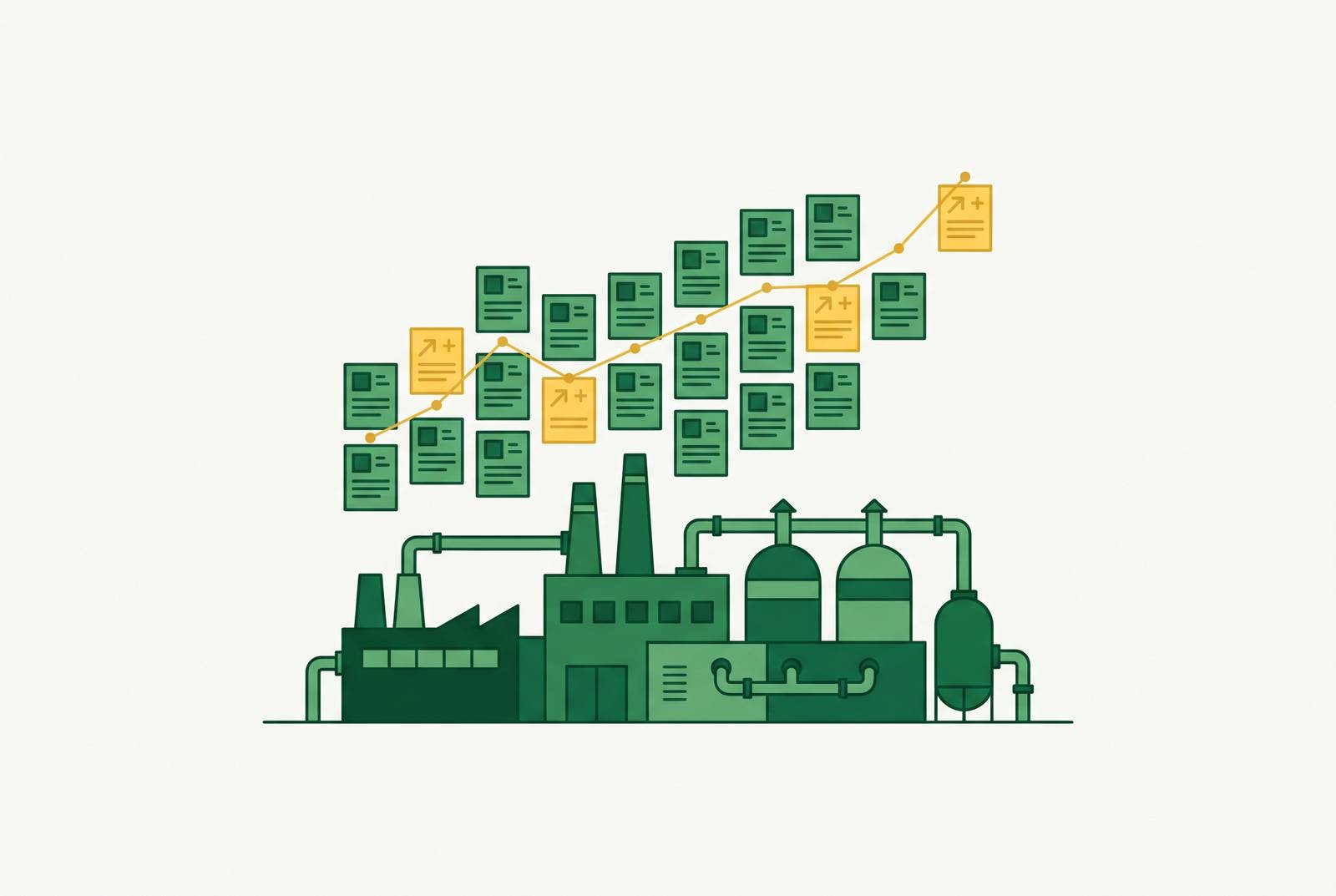
Patterns in job postings show when a plant may be getting ready to source new equipment or suppliers, often before an RFP appears. For industrial sales teams, the strongest timing signal is a relevant technical or procurement posting corroborated by another change at the same facility. Together, they help a seller see what the plant may buy and when to reach out before it builds the vendor shortlist.
Why job postings work as buying signals in manufacturing — and why the timing matters
In manufacturing, a job requisition often precedes the purchase order because a plant needs people to run planned equipment, manage suppliers, or requalify production chemistries. The responsibilities in the posting can therefore expose a buying requirement before it becomes a public solicitation. Hiring reveals preparation. A seller who reads that preparation correctly can enter while requirements are taking shape, rather than after a competitor has already been on-site. The advantage is access to the buying process before the shortlist exists.
That lead time does not make every vacancy a purchase signal. Plants also hire to replace departing employees, and job descriptions can be wish lists without evidence of an approved program. The distinction is essential to sound qualification. A posting can show what a plant may need, and another change at the same facility helps show whether that need is part of a new buying cycle. Job-signal selling therefore depends on reading both the work described and the context in which the plant is hiring.
The macro conditions making plant-level hiring signals more reliable right now
Manufacturing hiring is accelerating in durable-goods and machinery sectors while procurement teams face elevated input costs and supply-chain uncertainty. These pressures create different reasons to source. Technical hiring can point toward added production capability, while procurement hiring can indicate a need to reconsider how a plant buys equipment, services, or consumables. When those activities coincide, a vacancy deserves more scrutiny than it would in a flat market. Sellers need to establish whether the plant is staffing growth, changing its supply base, or doing both.
A supply management organization’s March 2026 Manufacturing PMI release said that supplier deliveries had slowed for four months in a row. A manufacturers’ trade association’s Q1 and Q2 2026 Manufacturers’ Outlook Surveys identified trade uncertainty as a top business challenge for a majority of manufacturers. That backdrop makes sourcing pressure more credible. It does not, by itself, establish that a particular plant is replacing a supplier or approving a capital purchase. The practical implication for sellers is to use market conditions as context, then look for evidence tied to the facility where the purchase would occur.
Five job title clusters and what each one signals about an imminent purchase
The five clusters distinguish buying events. A vacancy in procurement can point to a different chance to sell than a role that commissions an automated cell, even at the same manufacturer. The job description supplies the operational detail that the title alone cannot. For a seller, the useful mapping runs from responsibility to production change to purchase category. Each cluster below should therefore be read as a sourcing hypothesis to confirm.
CAPEX and MRO Buyer / Strategic Sourcing Manager. These roles can cover capital equipment, tooling, facilities services, maintenance contracts, spare parts, and consumables. A posting with that scope, especially a temp-to-perm contract, can indicate that the plant is organizing a new buying cycle. For specialty chemical and MRO sellers, the connection is direct. The mandate explicitly includes categories they sell. Where the new-cycle interpretation is corroborated, the recommended action is to identify the reporting line, which may lead to an Operations Director or VP of Procurement depending on deal size, and reach out before the new hire’s first week.
CNC Manufacturing Engineer / NPI Engineer. An NPI, or New Product Introduction, engineer launches parts through design-for-manufacturability reviews, pilot lots, and tooling and fixture specifications. An automation-leaning version of the role commissions robots, vision systems, and automated cells. When the description points to a new cell, metalworking fluids, tooling, abrasives, and process chemicals may need to be specified from scratch. That is a distinct opening for suppliers. The sale concerns an unselected chemistry or fluid for the new line, rather than an attempt to displace the supplier serving an established process.
Sourcing Engineer / Global Commodity Manager. The strongest variant is a category-specific role covering something the manufacturer has not previously sourced independently. A machined-parts maker posting “Commodity Manager, Specialty Chemicals” illustrates the pattern. The category name is the critical clue. If the manufacturer is newly managing that category itself, the seller has a sourcing gap to fill with no incumbent relationship to displace. The seller needs to check whether the plant is taking over buying for that category or replacing someone in its existing procurement team.
Supplier Quality Engineer (SQE). An SQE posting can signal that an existing supplier has underperformed and that the plant needs new vendor approvals. In that setting, the opportunity is qualification. The plant may be looking for a replacement, with more than a willingness to consider other suppliers. A simultaneous change in quality leadership strengthens the interpretation because incoming quality leaders routinely audit the approved vendor list. For the seller, this combination points toward a technical approval conversation tied to a supply problem, subject to confirmation that replacement qualification is actually under way.
Controls engineers and automation changeovers. A controls-engineering posting tied to an equipment change can reveal a chemistry opportunity as well as an automation requirement. New equipment runs at different speeds, temperatures, and tolerances from the machinery it replaces, so changeovers routinely require requalification of metalworking fluids, coolant concentrations, and surface treatment chemistries. For water treatment, coatings, and specialty chemical sellers, the recommended position is the requalification need. The description must connect the role to a changeover, since the title by itself does not establish one.
How do you know a plant is actively evaluating suppliers rather than just hiring?
A posting becomes a reliable buying signal only when at least one other observable change corroborates it at the same facility. Sellers should match the evidence to the proposed buying event. A permit to install equipment backs up the case for a changeover, while a change in quality leadership can back up the case for a supplier review. Evidence from an unrelated plant does not establish what is happening at the target facility.
Public companies can share capital plans in earnings calls quarters before they hire for that work, and local permitting databases can show new production space or equipment installation. The sequence supplies context for the vacancy. A technical posting tied to an announced expansion gives the seller more to go on than the title alone. For outreach qualification, the seller should connect the planned work, the facility, and the posting before treating them as one opportunity.
Hitachi Energy’s June 2026 groundbreaking on a $457 million transformer facility in South Boston, Virginia illustrates the secondary supply chain that follows a major plant opening. Hitachi Energy described the project as the nation’s largest facility for the production of large power transformers. Chemicals, specialty gases, precision equipment, and substrates must also be sourced locally, creating opportunities for smaller suppliers around the larger project. Hiring at that facility can show which parts of the work the plant is staffing as part of the investment it has already announced.
Repeated or escalating postings offer another quality filter. A plant advertising the same technical title repeatedly over an extended period can be staffing a program. Persistence strengthens the case, but needs context. Volume is most useful when it aligns with the production change implied by the role.
Matching the job title signal to the right buyer and deal size before you reach out
Once the buying event is credible, the next question is who controls it. The person hired for the advertised role may be different from the person who has the power to approve the purchase. Deal size sets the likely decision level. A seller who correctly identifies a new line but approaches someone without authority can lose the lead time gained from the posting. The recommended targeting approach is therefore to use the signal to identify the operational need and the deal scale to identify the buyer.
For smaller deals, the Plant Manager may decide unilaterally, making that role the appropriate target for a CAPEX Buyer signal at a small single-site operation. For mid-range deals, the target is an Operations Director or VP with Plant Manager involvement, as an NPI Engineer posting at a mid-size machined-parts shop may suggest. Larger deals require a broader buying group. At a multi-site manufacturer such as Ingersoll Rand, a Sourcing Engineer or Commodity Manager signal can point toward a VP of Operations and Procurement committee with corporate involvement. For the largest deals, such as a Hitachi Energy-class greenfield facility, targeting must account for C-suite, Procurement, and Engineering participation in a formal RFP process.
The SQE signal is an important exception to that hierarchy. When the plant needs to qualify a replacement vendor quickly, the Supplier Quality Engineer is often the right first contact regardless of deal size. Technical approval comes before procurement can complete its work. Because the SQE owns qualification, that person can bring procurement into the process once approval is secured. Responsibility for the immediate bottleneck is the reason to start there.
Outreach should then reference the operational reality implied by the evidence. A message about a new automated cell and its chemistry requirements addresses the plant’s work. A message about noticing a CNC-engineer advertisement does not. The distinction keeps the conversation centered on the buying requirement the seller can serve. It also creates a consistent standard for the monitoring workflow, which must produce enough operational context to support that conversation.
Building a repeatable job-signal monitoring workflow into territory planning
To track postings, sellers should start with the title clusters that fit what they sell. The recommended workflow is to supplement NAICS codes with saved searches or alerts by geography, sub-vertical, and title keyword. Those codes miss the operational specificity that makes a plant a prospect. A fluids seller needs to find manufacturers that need fluids for a new cell or a changeover.
The next requirement is a defined review cadence. Job-change and hiring signals lose value within weeks, so sellers need to review them at least weekly, as a monthly review is too slow to give them the intended head start. Confirmed signals should go directly into the CRM as trigger events tied to the account record, with both the posting and the corroborating data point attached.
The supporting tools have distinct roles in this process. Saved searches and alerts find vacancies, earnings calls and local permitting databases show what investments are planned, and leadership pages can show changes that matter for supplier qualification. The CRM connects those signals to territory activity. Sellers still need a facility profile that says what the plant makes, what equipment it runs, and its production volume. Those details help the rep judge whether the posting points to a purchase of what the rep sells.
A territory plan built on headcount estimates and NAICS codes cannot make that operational distinction with the same precision. The first call can address the equipment change, new line, or sourcing gap while the plant is still shaping its requirements, rather than waiting for an RFP that announces the opportunity to everyone else.