Splitting Metro Territories When Three Plants Share the Same Zip Code
Assign co-located plants by process and product fit, not postal code.
Territory planning tools for manufacturing sales teams need plant-level accounts, weighted opportunity, and workload data alongside postal maps. When three plants share a ZIP code, ownership should follow what each facility runs, makes, and buys. Splitting metro territories by those attributes ties each account to a rep whose products fit, while balancing revenue potential with how much work and travel the rep can handle.
Why ZIP codes fail as territory boundaries when industrial plants cluster
Three plants share one postal code and one rep. The first runs machining operations, the second operates a coating line, and the third assembles products with adhesives. A postal rule sends every account to the same owner, regardless of the technical knowledge or coverage each requires. The map provides an address-based answer, but it cannot distinguish among the buyers. Proximity becomes the assignment criterion by default.
That limitation comes from the boundary’s original purpose. ZIP codes sort geography. A postal route gives a carrier streets to cover. Applied to industrial sales, the same logic makes neighboring facilities look interchangeable even when their demand is unrelated. Geography remains useful for planning travel, but it cannot resolve ownership when the commercial differences lie inside the boundary.
What poor territory design actually costs when plants share a boundary
The commercial loss begins with how the rep spends time. A rep who visits Plant A three times a month because it is the loudest buyer has less capacity for Plant B and Plant C. Yet the territory record gives her no structured way to see what either neighboring plant might need. Existing requests take precedence over unrecognized demand. Cross-sell opportunities and products supplied by competitors remain outside the conversation.
This is not simply a problem of missed visits. Even an already-open account can contain applications the team has never pursued, because the relationship is recorded at the account level, leaving process and product category unrecorded. More attention to the familiar buyer does not necessarily uncover those applications. Without plant-level distinctions, activity can concentrate where the rep already has access, leaving the next opportunity unpursued. The territory becomes reactive despite its convenient travel distances.
The same design also places strain on the rep. A territory with revenue potential significantly above the team median needs capacity that reflects its demands. Otherwise, apparent opportunity becomes a quota-attainment problem. A fair assignment gives the rep a workable way to cover the accounts as well as a large enough share of them. Reps who cannot see the logic behind their assignments have less reason to trust the design or engage with it.
Why industry codes cannot substitute for ZIP codes when plants are dense
Replacing postal codes with NAICS or SIC codes changes the label while keeping the same level of detail. These classifications describe plant categories. SIC was last officially revised in 1987, and an old classification can outlast changes in a facility’s process or product mix. A single old SIC record can also split into several NAICS codes. Plants with different labels can thus have similar processes, while plants with the same label can have different ones.
A broad manufacturing category is no better as an ownership rule. A precision machiner, contract coater, and plastics fabricator may sit under the same broad classification while buying different fluids, coatings, and adhesives. Niche businesses filed under “other” make the distinction still harder to see. Industry codes still help when used with other filters. They do not establish which product to lead with or which rep should own the plant.
What plant-level attributes actually differentiate three plants in one ZIP
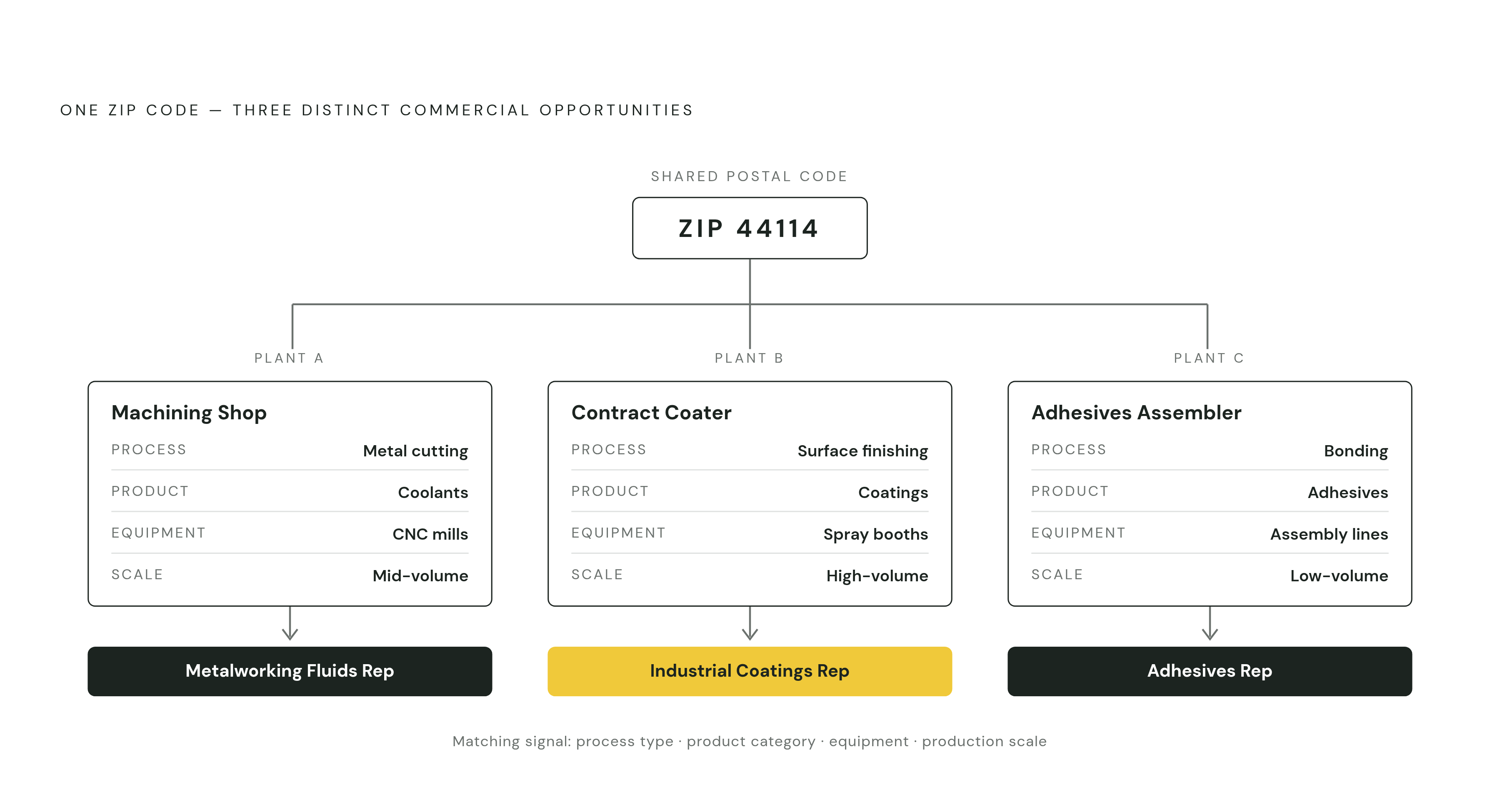
Consider a hypothetical allocation within one industrial park. Plant A is a machining shop buying metalworking fluids, Plant B is a contract coater buying industrial coatings, and Plant C is an adhesives assembler. Their postal address provides little commercial guidance. Their processes, however, map directly to different parts of a supplier’s portfolio. Process type is therefore the first useful distinction, with product category dependency translating that distinction into demand.
Equipment makes the process description more specific. What Plant A cuts, grinds, or forms, and the equipment it uses, indicate the class of metalworking fluid it needs. For Plant B, the application depends on how it runs its coating operations and what surface-prep it needs. For Plant C, the assembly process establishes the relevance of adhesives. Equipment listings, permits, and published plant capabilities make these distinctions observable before a site visit.
A plant running three shifts on a high-volume line presents a different purchasing opportunity from a one-shift specialty operation. Production scale and headcount help distinguish those accounts even when both use the same product category. Existing wallet share adds another dimension. A plant already buying one category from the supplier presents a different sales task from a plant using a competitor’s product throughout.
Change signals help distinguish current demand from future potential. A new production line, a requirement for lower-VOC reformulation, or a commitment to water-borne or UV-curable technologies can indicate active evaluation. Leadership changes in procurement or technical roles can also alter the buying context. Job postings, certification records, and trade press add evidence of how a plant runs and where it is spending money. Together, these attributes describe both the plant’s requirements and the timing of the opportunity.
How to plan sales territory splits when plant attributes replace postal boundaries
The practical method begins with the plant as the account unit. Each plant needs a profile that lists its process type, product category dependency, production scale, and existing wallet share. Those attributes provide the basis for evaluating opportunity rather than treating every address as an equal account. Industry codes can help filter the population, while geography defines the area that field coverage can reasonably serve. Neither replaces the facility-level assessment.
The next step is to match ownership to commercial fit. In the hypothetical industrial park, the machining plant belongs with the rep best positioned to serve its metalworking fluid requirements, while the coater and adhesives assembler require their own product-fit decisions. That does not automatically mean three separate reps. The rule is that ownership follows the relevant application and the rep’s ability to serve it, rather than an obligation to keep all three plants together. Coverage cadence can also vary with the work each plant needs for cross-sell and competitive displacement.
The proposed assignments then need a balance check. Revenue potential, workload, and geographic feasibility must be considered together, because strength in one dimension cannot compensate for an unworkable result in another. No territory should deviate significantly from the team median in revenue potential. Even accounts that fit a rep’s technical skills can be too far apart for the rep to cover them well. Conversely, a compact territory is not fair merely because its plants are easy to reach.
When the largest or most complex plant dominates the local rep’s calendar, that account can move into a named-account or enterprise territory while the remaining plants stay in the geographic area. This preserves the useful travel boundary without preserving the overload. The team still needs clean plant-level data to make that choice. Without it, teams cannot score the alternatives and tend to fall back on the postal fields they already have.
What the rep needs to know before the first visit to any of the three plants
The rep’s pre-call file should include the reasons she was assigned the plant. Process type, equipment, product category dependency, scale, and wallet share explain both why she owns the plant and where the first conversation should begin. The split and the pitch use the same intelligence. For Plant A, that means an application-level discussion about metalworking fluids rather than a general introduction to the supplier’s catalog. For the other plants, the relevant coating or adhesive application sets the starting point.
The file also needs the evidence behind the profile. Equipment types, active permits, process or maintenance job postings, certification records, trade press mentions, and recent facility investment all help the rep understand current operations. A posting for a metalworking fluid technician is a live buying signal. For coatings and adhesives accounts, reformulation requirements and technology commitments provide a similarly specific opening. These signals connect product fit to a reason for speaking now.
Preparation must also account for the buying committee. A complex technical purchase can involve the plant manager who owns the problem, the engineer who validates the specification, the procurement lead who negotiates price, and the executive who approves budget. Each role needs a relevant case. Knowing the process helps the rep make that case around the application, with a pitch that fits each contact’s role in the purchase.
Account history alone cannot provide this preparation. A CRM describes the business the team already has, but it does not by itself reveal a competitor-supplied application or a process change that creates a new specification requirement. Field activity adds another gap, because manufacturing reps spend time visiting plants and touring floors, leaving less time for desk work. Plant-level intelligence adds context that the account records leave out. The handoff is stronger when that context follows the assignment into the sales conversation.
How demand-intelligence platforms profile plants to support attribute-based splits and rep preparation
Profiling a few facilities manually is different from supporting territory design across hundreds of thousands of sites. The latter requires an intelligence layer built around manufacturing operations. A demand-intelligence platform profiles what plants make, the equipment and permits they use, and changes at each facility. It then matches those profiles to a supplier’s portfolio and sizes opportunity in gallons, pounds, or units. Those are inputs for both account scoring and product selection.
Geographic territory tools organize coverage by location, while industry-code databases classify businesses and CRMs record existing account activity. Demand intelligence shows the processes that make plants next door to each other different. Broad B2B data alone does not contain the industrial terminology and buying signals needed for that task. For manufacturing sales teams, the useful comparison is therefore not just which software draws a map, but which data makes its assignments defensible.
In the three-plant scenario, completed profiles can resolve the split in minutes, bypassing a manual audit of each site. The platform supplies the distinctions that the shared postal code suppresses. Territory planning can then evaluate product fit and opportunity, while the assigned rep receives the operational context behind the decision. The value comes from using one plant profile across both planning and prospecting.
Tracking changes keeps those profiles useful after the accounts have been assigned. A permit filing, facility expansion, or new line installation can change the profile on which ownership was based. A rep departure can also create a need to review coverage. A coherent, process-consistent set of accounts helps the incoming rep build territorial familiarity, although relationships and product knowledge take months to rebuild after turnover. Plant-level context gives that transition a more useful starting point than a list of addresses.
Keeping attribute-based territories current as plants change
Plant attributes are not permanent, and the design must reflect that. A facility that operated as a machining shop in January may add a coating line by June. Its product category dependency has changed even though its postal code has not. That change may be a reason to give the plant to another rep or change its coverage cadence. The advantage is that the operational shift provides an observable reason to review the assignment.
The review triggers are the same signals used to prioritize prospecting. New lines, expansions, permits for new processes, process-specific job postings, and regulatory changes requiring reformulation can all alter the account’s commercial profile. Rep departures and major account acquisitions can change the coverage requirement as well. These events give the territory manager a basis for reassessing ownership ahead of an annual redesign and before an uncovered application becomes a competitor’s opportunity.
Reps can see which plant attribute changed and why the existing allocation no longer balances opportunity and work. Territory design, pre-call preparation, and prospecting priority then remain connected to the same operational record. The rep responsible for Plant B knows its process, knows which product to lead with, and receives notice when the site changes. ZIP-based territories tend to reveal the problem when a rep complains or quota attainment drops, while attribute-based territories can reveal it when the plant signals it.