What Enterprise Manufacturing Sales Directors Actually Need From Territory Design Software
Production data must precede software selection for territory design.

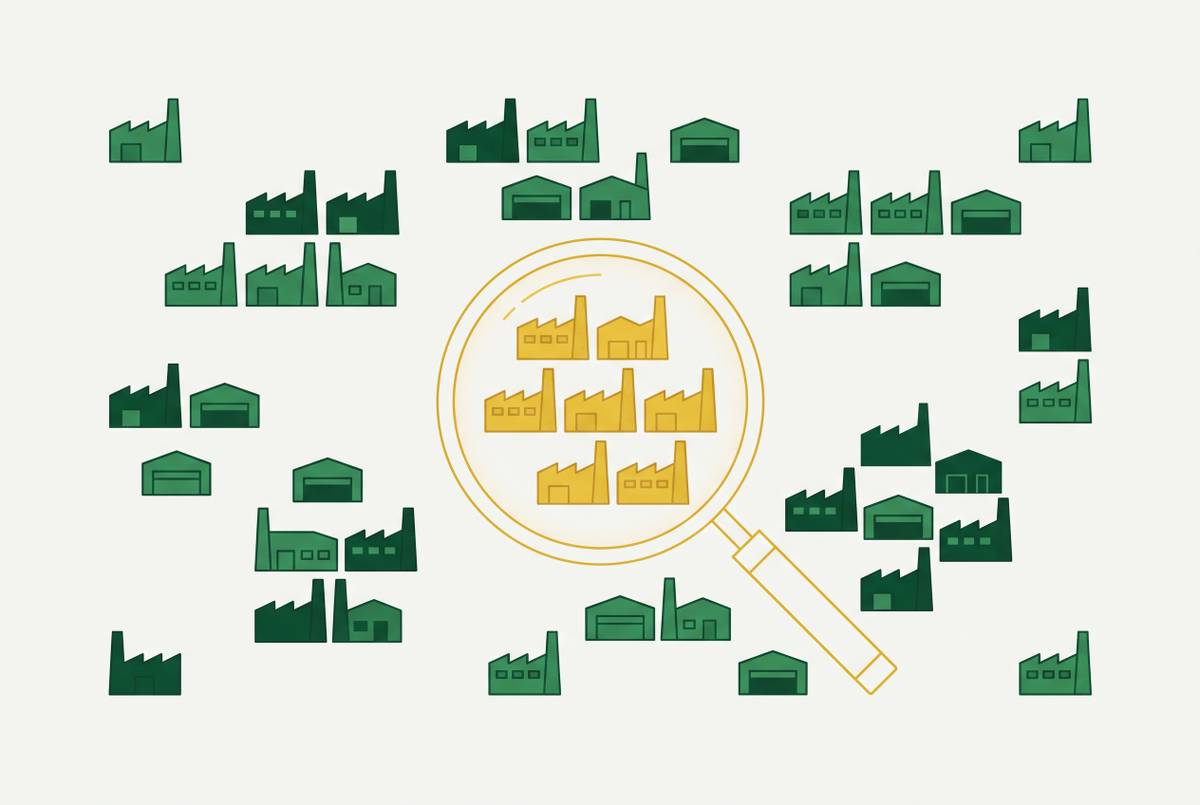
Territory planning tools for manufacturing sales teams need plant-level production intelligence before their maps, balancing algorithms, or routes can support sound decisions. The decisive input is what each facility makes, runs, and buys. Enterprise manufacturing sales directors therefore need to check the demand data behind the software before they compare its features.
Why territory design has become a strategic liability for enterprise manufacturing sales directors
New plants in Ohio, Arizona, and the Carolinas are creating opportunity in places that legacy territory designs treat as thin or empty. A boundary drawn around earlier account concentrations can leave a rep covering established locations while new production sites go unassigned. The cost includes lost pipeline and inefficient travel. Territory structures based on 2019 or 2022 account concentration can also misrepresent which facility types have the strongest near-term buying potential.
The NAM Q1 2026 Manufacturers' Outlook Survey shows that quarterly sentiment is above the historical average for the first time since 2023, with plans for both sales and production up. That creates a mismatch for teams whose coverage still reflects a contraction period. Redrawing boundaries around the same old records cannot correct that mismatch because the missing information concerns where production has moved and what those facilities need.
What territory design software actually does — and where it stops
Territory software performs real work that enterprise teams need. eSpatial supports “what-if” scenario planning and algorithmic territory suggestions based on user-defined metrics. AlignMix serves sales operations teams doing alignment and rebalancing without GIS expertise, while Salesforce Maps generates territory maps and optimizes field routes using live CRM data inside the Salesforce ecosystem. Badger Maps focuses on daily route optimization for field reps. These are distinct uses, so the appropriate comparison depends on whether the immediate job is territory modeling, sales alignment, CRM-based mapping, or daily travel.
But those tools need account data before they can do that work. Mapping draws boundaries, while planning determines account assignment, quota, and rep capacity within them. Optimization goes further by computing balanced structures against workload and potential, but it still depends on how potential is defined. If the software has only company names, headcounts, and ZIP codes to work with, it can balance those records without knowing whether the companies need the products being sold.
Why manufacturing accounts cannot be resolved at the company level
One parent firm can operate a dozen facilities across multiple states, each with its own production line, purchasing manager, budget, and consumption profile. A single parent record hides those differences. For territory planning, it also places the account in one location when the buying opportunities occupy several.
Take a precision-components facility in Georgia whose parent account is filed under Illinois. A rep assigned the Southeast may never see that plant in the territory’s account list, even though it belongs within the rep’s physical coverage. The territory can appear balanced while omitting a relevant buyer. Resolving the parent into its individual plants makes ownership, routing, and potential sizing refer to the same real production sites.
A 40-person plant on one shift buys differently from a 400-person plant on three shifts, and parent-company headcount does not reveal that difference. Shift count and production volume help a specialty chemicals or metalworking fluids rep size an opportunity before the first call. Without them, estimates of product volume, formulation type, and service frequency remain guesses.
What production process data reveals that firmographics cannot
A plant address establishes where coverage is needed, but its production processes establish whether that coverage has commercial value. Cutting, drilling, milling, boring, and grinding operations create fluid contact across a broad production base. The metal being worked, required tolerances, and plant certifications shape the relevant fluid type, concentration, and service cycle.
Equipment adds another layer of product fit. The machining systems a plant runs affect compatible fluid chemistries, expected application rates, and whether it may consolidate suppliers or operate multiple product lines in parallel. NAICS and SIC codes do not provide that detail. An industry classification describes a category, so two plants with the same code can buy very different products on different schedules.
For territory design, the implication is a different measure of potential. Account count and geographic area do not show how closely packed the production processes that match a rep’s portfolio are. A handful of well-matched facilities can offer more value than many facilities sharing a ZIP code. The relevant unit is not simply a manufacturing address, but a plant with a production requirement the team can serve.
How the absence of plant-level data produces the specific failures manufacturing sales directors report
Uneven quota attainment can begin with a false equivalence between territories. Two reps may receive similar account counts and comparable historical revenue, while one territory contains dormant buyers and the other contains active, under-penetrated facilities. The map does not expose that difference. Without production-based potential, the allocation looks fair before selling begins but gives the reps unequal opportunities.
Reps can drive past each other to accounts both believe they own while entire industrial parks remain uncovered because the account data omits recent construction. Uncovered plants become harder to win over time. A facility missed for two years may already have selected a supplier, established a service relationship, and embedded a competing product in its production process.
Changes in production, equipment upgrades, and shifts in volume can change what a plant buys before an order stops, but an account record without production context gives the director little warning. Rep turnover compounds the loss when plant knowledge exists only in the departing rep’s head. The successor inherits addresses without the plant hierarchy or documented operating context needed to understand them. Better boundaries alone would not prevent these failures because the missing information sits inside, and sometimes outside, the account list.
What dynamic territory rebalancing requires that annual planning cycles cannot provide
Even a well-informed territory design loses accuracy as capacity moves and production priorities change. New facilities can create greenfield opportunities while purchasing decisions are still in progress. Timing becomes part of coverage quality. A team that learns about a plant only at the next annual planning meeting may miss the period before supplier relationships take hold.
Facility construction, equipment installation, production line additions, and capacity expansions provide earlier signals that coverage needs review. They reveal changes in the production base rather than changes already recorded in sales results. The reverse can also happen. A facility counted as a viable prospect may shift production and no longer need the product category assigned to its rep, leaving apparent potential in the plan that no longer exists.
Partnerships, joint ventures, and geographic expansions can likewise alter account ownership and local competitive relationships between planning cycles. Dynamic rebalancing gives a team the means to respond, but it does not supply the reason to act. That requires current, production-specific trigger data. A revenue dip in the CRM describes an outcome already affecting the business, while a new production line installation can reveal opportunity before that outcome appears.
How plant-level intelligence changes the cross-sell and account growth calculation inside existing territories
A team selling one product to a plant may not know that the facility operates other processes suited to additional product lines. Without a production profile mapped against the full portfolio, account managers tend to work within the product lines and contacts they already know.
Plant hierarchy data extends that view beyond the served facility. It connects the parent account to sister plants, each with its own production profile, including facilities running related or identical processes that have never been contacted. That changes the account growth calculation. The opportunity is no longer limited to increasing sales at the familiar site, because the account team can see other relevant demand under the same parent.
Facility-level ordering data also helps the team see how to keep those customers. Less frequent orders or a smaller pack size can be signs that a plant has changed a process, is weighing suppliers, or is making less, as well as a shift in run-rate business. Up-to-date CRM enrichment lets the account manager see those signs. Its commercial purpose is to expose a change while intervention is still possible.
How do manufacturing sales teams plan territories around plant-level demand?
A corrected planning process starts with facility indexing. The sales director identifies the facility types that fit the product portfolio by production process, equipment, certification, and output, then maps their concentration. Geography follows the demand analysis. This reverses the sequence in which a boundary is drawn first and every company record inside it is treated as potential.
Demand density then becomes the balancing criterion. Each rep receives a manageable and roughly equal number of well-matched facilities rather than equal square mileage or an equal count of company records. Workload and route planning still have a role. They operate on a more useful account base because the facilities have already been assessed for production fit.
Prioritization within the territory becomes more specific as well. A rep can know before the first call that a plant makes automotive stampings, runs water-miscible coolants, holds IATF 16949 certification, and recently added a second machining cell. That is a different starting point from an address and industry code. It gives the rep production context for the conversation rather than requiring several visits to establish the basics.
The process also needs a way to stay current. Capacity expansions, equipment installations, line additions, and management changes become triggers for in-year adjustments, while plant-level profiles populate existing systems such as Salesforce, HubSpot, and Dynamics 365. The intelligence reaches the point of sale. Coverage can then change with the opportunity instead of remaining fixed until the calendar calls for another review.
The evaluation question enterprise manufacturing sales directors should ask before selecting any territory tool
Before comparing mapping, balancing, or routing features, a manufacturing sales director should ask what the system knows about what customers’ plants actually make and where that knowledge comes from. A tool may be highly capable at optimization while relying on company records that omit the facilities, processes, or activity signals relevant to the sales team.
The practical test is a known industrial corridor. A vendor should be able to show the facilities operating there, with current production context, rather than a set of company addresses that happens to fall within the boundary. Familiarity with that corridor gives the director a concrete basis for judging omissions and mismatches.
For teams selling to manufacturers, the starting point is therefore facility intelligence organized around what each plant makes, runs, and outputs, and the signals that indicate active buying. That intelligence must also be available inside the CRM and territory tools the team uses. Mapping features, scenario modeling, and algorithmic balancing are still useful once teams have that data. The evaluative principle is whether the data describes real industrial demand at the facility level.