Matching Field Reps to Factory and Plant Manager Accounts by Site Complexity Not Account Count
Weighting plants by complexity gives reps workable territories.

Territory planning tools for manufacturing sales teams should balance the workload and opportunity at each plant instead of giving each rep the same number of accounts. A workable model weights each site by its processes, equipment, qualification requirements, stakeholders, and buying signals, then adds travel burden. This gives field reps achievable books of business while directing proportionate attention to the plants with the greatest potential.
Why account count fails as a unit of territory design in industrial selling
SPOTIO's 2026 State of Field Sales survey found that most field sales organizations grew revenue in the past year, yet only roughly a third had most of their reps consistently hitting quota. In manufacturing, that gap exposes a weakness in treating company growth as evidence that territory assignments are workable. A territory with multi-process plants, layered buying committees, and months-long qualification cycles needs a different level of coverage from one with simpler production sites. Aggregate revenue does not reveal that imbalance.
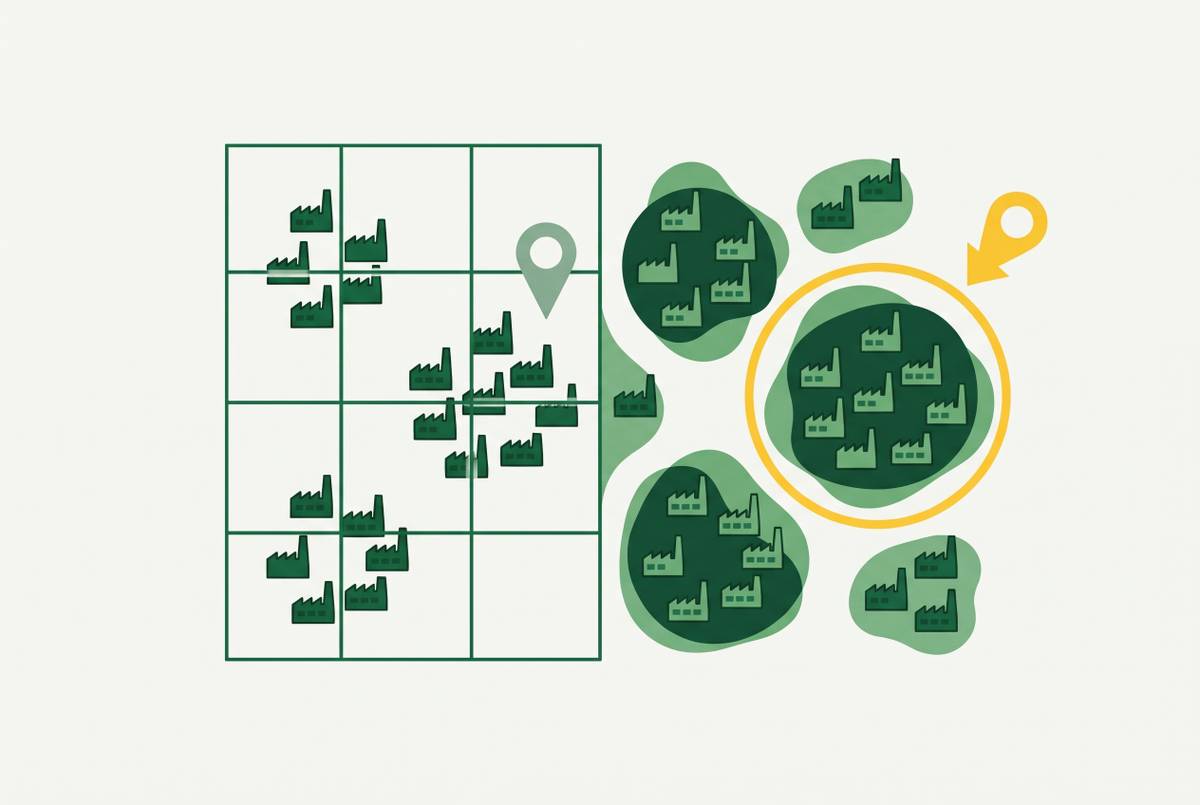
Count-based territory design rests on an assumption inherited from geographic carve-outs. Draw a boundary, divide the accounts inside it, and the resulting books appear balanced. But a single-line food packaging plant and a multi-process specialty coatings facility can share a zip code and headcount band while requiring very different technical engagement. The accounts are not interchangeable units of work. A rep with fewer accounts may have more work to do, even as the longer account list looks overloaded on a manager's report. Treating that difference as a performance problem leaves the territory design untouched and the source of the workload hidden.
What actually drives rep workload at a manufacturing site
Rep workload begins with what happens on the production floor. In manufacturing, a purchase may need engineering sign-off, procurement review, budget approval, and compliance verification before a purchase order can be issued. Even when a rep works harder, each approval stage still has to happen, and each stage can involve a different function with its own requirements. Company revenue and headcount reveal little about how much coordination that sequence demands.
Technical qualification adds a separate layer of work. For coatings, adhesives, and metalworking fluids, engineering and quality functions must approve a supplier's product before volume flows. The rep must shepherd that plant-specific process, which repeats at each site rather than disappearing after a corporate introduction. Plant count is therefore an independent workload multiplier. A multi-site chemical or food-and-beverage account can behave like an enterprise buyer even when its corporate headcount resembles that of a single-plant business.
The cost of visiting sites goes beyond what qualification stages or corporate records can fully show. Field reps tour production floors, check process conditions, and travel across territories that span hundreds of miles. A visit has both a journey and a duration. When technical preparation, stakeholder coordination, and time on site accumulate, the workload difference between two nominally equal accounts becomes structural.
Defining site complexity as a scoreable, comparable variable
Site complexity is a composite of operational characteristics that can be scored consistently across a plant portfolio. Its purpose is to measure the work an account demands going forward, rather than reward the revenue recorded under a previous territory owner. The useful dimensions include process breadth, equipment installed base, regulatory and certification load, stakeholder count, and demand trigger activity. Each describes a different claim on rep capacity. Together, they distinguish a plant's technical and commercial demands from its size.
Process breadth measures how many distinct production processes the rep must understand, while equipment variety shapes product suitability and preparation for visits. Permits, certifications, and OEM qualification requirements mean reps must stay in touch over time and work within windows when vendors are evaluated. Stakeholder count captures relationships across engineering, procurement, operations, and EHS at the site itself. Demand triggers add a time-sensitive dimension. New lines, capital permits, and hiring in process roles can place a plant in a buying window that warrants more frequent coverage.
Consider two hypothetical plants with identical revenue and headcount. One runs a single process, while the other runs surface treatment, blending, and coating application and holds a certification relevant to the supplier's product. Their size matches, but their sales motions differ. The second plant requires broader technical preparation and a distinct qualification pathway. Scoring each dimension in weighted bands puts the plant in a composite tier with a set visit cadence and product priority, so teams can compare differences that revenue alone cannot explain.
Why industry codes cannot substitute for site-level complexity data
Industry codes describe site categories. The 20 manufacturing SIC major groups support broad market sizing, but they compress distinctions that determine field workload. In OSHA's official SIC Manual, both Sheet Metal Work and Industrial Valves are in Major Group 34, Fabricated Metal Products, Except Machinery And Transportation Equipment. That shared classification does not make their buyers interchangeable. A sheet-metal enclosure shop and a precision valve manufacturer have different quoting cycles, tolerances, and product requirements.
NAICS gives more detail in its classification, but teams still need data on how a site operates. It classifies establishments, which are usually individual physical locations within companies. That distinction reinforces the need to plan around plants. A corporate account can have sites in several complexity tiers, even when those sites share the same code. Automated code assignment from website keywords can also misclassify distributors or industrial services firms as manufacturers, adding accounts with no production floor to visit.
Before building a campaign around a code cluster, a team should establish the equipment types, materials processed, certifications, customer industries, and example parts. These details distinguish a single-process job shop needing one visit per quarter from a multi-line OEM supplier needing monthly technical calls and process audits. The code identifies a market category. It does not specify the coverage obligation.
How do you plan sales territories for an industrial manufacturing account team?
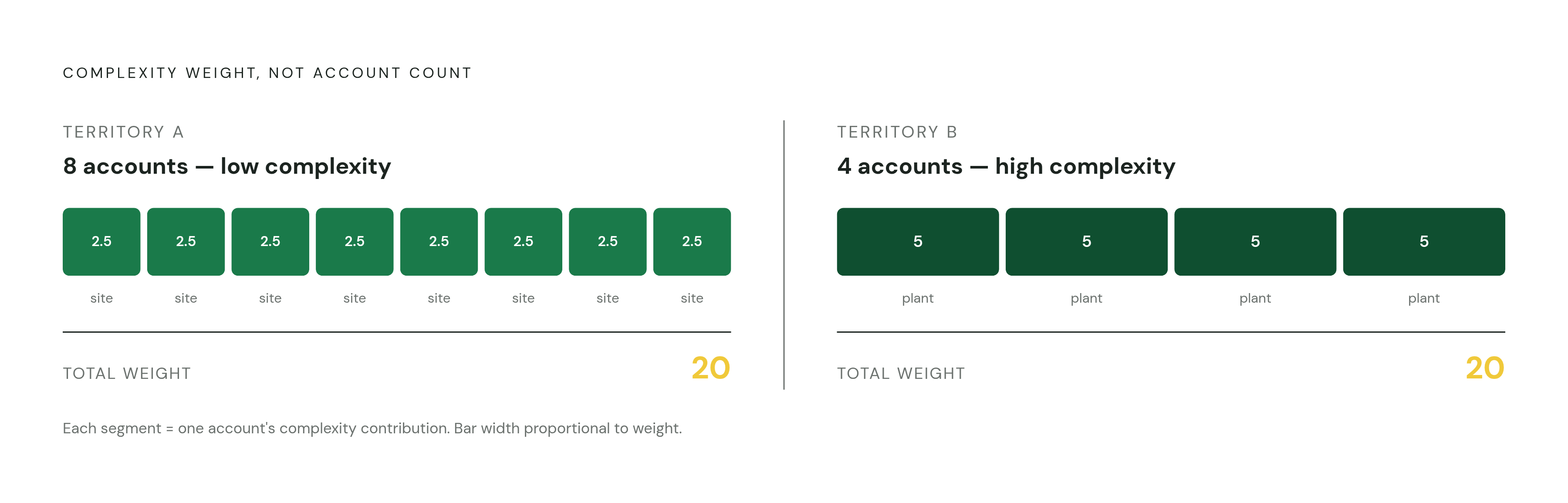
Territory balancing begins by assigning more weight to high-complexity plants than to mid-tier or transactional sites. A rep managing several enterprise-tier plants can have a full book even when the account count looks modest. In a hypothetical comparison, one territory has many low-complexity sites and another has fewer high-complexity plants, but both have the same total complexity weight. The model treats them as comparable account workloads before adding travel demands, rather than assuming the longer list requires more capacity.
High-complexity plants with active qualification cycles or open demand signals need frequent, structured visits with technical agendas planned in advance. Stable, lower-complexity sites with single-product relationships can often receive coverage through inside channels or partner nurturing. Geography remains a separate constraint. Equal complexity totals do not create equal working weeks when one territory requires substantially more driving, so travel burden must sit on top of the account workload calculation.
For teams selecting territory planning software, the relevant criteria follow from that design. The tool needs to do more than distribute map pins: it must support accounts at the plant level, weight workload and opportunity, set coverage by tier, and account for travel burden. Data availability comes first, however. Equipment, process, and qualification information rarely sits entirely in the CRM, while siloed ERP, CRM, and HR data complicate territory modeling. The operational data foundation must be resolved before scoring can produce dependable assignments.
Using plant-level signals to keep complexity scores current
A complexity score loses usefulness when the plant changes but the record does not. Revenue, headcount, and industry codes change slowly and rarely show when a buying window is about to open. Operational signals are more immediate and can precede purchasing activity by months. A new facility is especially urgent because it may not yet appear in the rep's book or CRM. Construction and building permits then give time-stamped evidence of plans for electrical upgrades, HVAC changes, or changes to a building's structure that support investment in equipment.
New production lines and equipment RFPs provide direct evidence of expanding process complexity and an open buying window. Certification activity points to another kind of change, as renewals bring periods of audits and new certifications may call for different materials or formulations. Leadership changes can also alter vendor discussions. A new plant manager, VP of Operations, or COO may be evaluating current suppliers, making current site knowledge particularly useful. These events can change both the complexity tier and the coverage a plant warrants.
Standard B2B contact databases index profiles and websites, limiting their ability to capture these signals from regulatory filings and permit records reliably. Timing is especially consequential for specialty chemical and coatings suppliers. Once a competitor's product is qualified into a process, displacement requires a full requalification that the plant will resist. Demand intelligence platforms that track equipment, permits, and process activity and flag changes give teams a way to update the model. They allow territory assignments to respond to operational changes before the next annual redraw.
Where cross-sell opportunity concentrates inside a complexity-scored account base
Process breadth can show room for growth that sales of current products may hide. A plant running surface treatment, conversion coating, and topcoat application is a logical buyer for a broader coatings portfolio than the single line through which a supplier entered the account. Its other processes already require products from somewhere. A complexity score shows those adjacent applications, while the sales record shows only the relationship the supplier already has.
That opportunity remains specific to the plant. An expansion at one site can raise need and intent for an adjacent product while another site under the same corporate parent remains entirely unworked. The engineer who approved the original product may also have no control over the adjacent application. Realizing the opportunity requires a mapped stakeholder network across the relevant functions, which adds workload as well as revenue potential.
This changes where growth capacity should be allocated. High-process-breadth sites are likely to buy adjacent products from competitors, making the gap between current sales and the site's full requirements particularly significant. Yet reps also spend time on travel, preparation, internal meetings, and account confusion. Complexity-weighted assignments make room for the technical and relationship work that broader coverage demands. Without that capacity, the largest opportunities inside an existing account base can remain underdeveloped simply because the territory treats each plant as one more name.
Making the transition from count-based to complexity-weighted territory assignments
The transition begins with data, but it also changes ownership and expectations. Plant equipment, process certifications, permit activity, and stakeholder maps must be assembled from available external sources and account knowledge before they can support scoring. A complete model need not be the first step. An initial sort into high, mid, and transactional tiers, based on process complexity and buying committee depth, provides a more useful starting point than raw count. It also exposes high-complexity plants that receive too little coverage because they sit among many lower-tier accounts in overloaded territories.
The next step is a regional pilot, with company-wide reassignment deferred. Testing the change in one region allows quota attainment and pipeline velocity to be measured against a comparable control. Lower-complexity, transactional accounts can move to inside or partner channels to give field reps more time without adding headcount. Ownership changes will still encounter resistance. Reps who lose accounts they think of as theirs need a clear explanation of why the change is fair, and teams need to give data quality and tool integration as much attention as scoring.
Success must extend beyond quota attainment alone. Coverage fairness shows whether high-complexity sites get visits at the specified visit cadence, and pipeline velocity at high-tier sites shows whether opportunities are moving forward. Rep retention provides another measure of whether the book is workable, particularly when manufacturing expertise is expensive to replace and competitors actively recruit it. Regular reviews tied to permits, new lines, and leadership changes keep assignments in step with what is happening at each plant. The strategic shift is from allocating names to allocating commercial capacity, giving the highest-potential sites proportionate attention and each rep a credible, achievable book of business.