Using Production Shift Data to Prioritize Whitespace Accounts
Production shifts reveal which whitespace accounts are ready to buy.
The ISM Manufacturing PMI hit 55.6% in July 2026, the highest reading since May 2022, with the Production Index climbing to 58.5% and the Employment Index crossing 52.8% after 33 straight months of contraction. That's a real expansion landing unevenly. It's landing in specific segments, specific states, specific plants, and tax incentives under the One Big Beautiful Bill Act, including 100% first-year bonus depreciation, are reshaping equipment decisions at the facility level rather than across a whole sector. A prospect list built six months ago has a different rank order today: plants that looked dormant are humming, and some that looked hot have gone quiet. The question every industrial sales team should be asking is simple: if dozens of plants in the territory count as whitespace, which ones are actually ready to buy right now?
What whitespace means at the plant level, and why most sales teams are looking at it wrong
Whitespace, in the standard telling, is the gap between what a customer already buys and everything else a supplier could sell them. Fine as far as it goes. But in manufacturing, that gap isn't one thing, it's four.
There's product whitespace: a plant buying one fluid or chemical category and sourcing the adjacent ones from someone else. Plant whitespace: a supplier has won one facility in a five-site manufacturer and is absent from the other four. Application whitespace: a rep serving the machining line but with zero presence on the forming, heat-treat, or cleaning operations sitting in the same building. And volume whitespace: a supplier covering one shift's worth of consumption at a plant that has since added a second or third shift.
The economics here aren't controversial. Selling to an existing account costs roughly a tenth of what it costs to land a new one, and a whitespace deal moves through contacts who already pick up the phone. A greenfield account starts from zero: no champion, full acquisition cost, cold call.
So where's the failure? Most teams find the gap once, then rank it by account size or by how warm the relationship feels. Neither of those tells a rep when the gap turns into pressure. Size doesn't move week to week. Warmth doesn't either. What does move is the plant's operating reality, and that's the piece missing from most territory plans. A gap that has been dormant and a gap on the verge of becoming an active purchase look identical on a spreadsheet sorted by revenue. They are not identical opportunities. Production shift data is what tells the difference.
What "production shift data" is and where it comes from
Production shift data draws on several public and semi-public signals stitched together into a single inference. It's an inference: several public and semi-public signals are stitched together to say whether a plant's operations are changing in scale, scope, or character.
Start with hiring. A job posting for a CNC operator implies something different than a posting for a maintenance technician, and both imply something different than a batch of production supervisor listings appearing at once. Then there's facility activity: construction permits, lease filings, EPA expansion filings, a press release announcing a new line. Equipment moves appear in UCC financing statements tied to new machinery, in auction listings that flag a plant divesting old equipment, and in attendee lists from trade shows tied to a specific process category. Leadership changes matter on their own: a newly hired plant manager or VP of Engineering was brought in to change something, not to keep the lights exactly where they are. Regulatory filings round it out, since an OSHA inspection record or a new state environmental permit for a production line implies a process that already exists or is about to.
None of these signals alone proves much. Together, they describe a plant in motion, and that's the point: a rep who waits for a formal RFP is arriving after the shortlist has already been drawn up somewhere else. Shift data, read early, gets a supplier into the room while the need is still forming rather than already decided.
This should be separated from "intent data" in the website-tracking sense, cookies, page visits, downloaded whitepapers. Shift data comes from the physical world of the plant itself: permits filed, machines financed, people hired to run new lines. That's why it tends to surface earlier and carry more specific information about what a plant will actually need to buy. No single source captures all of it. Plant-level intelligence platforms exist to fuse these threads into one account profile a rep can act on without running a research project first.
How specific shift signals map to predictable purchasing needs
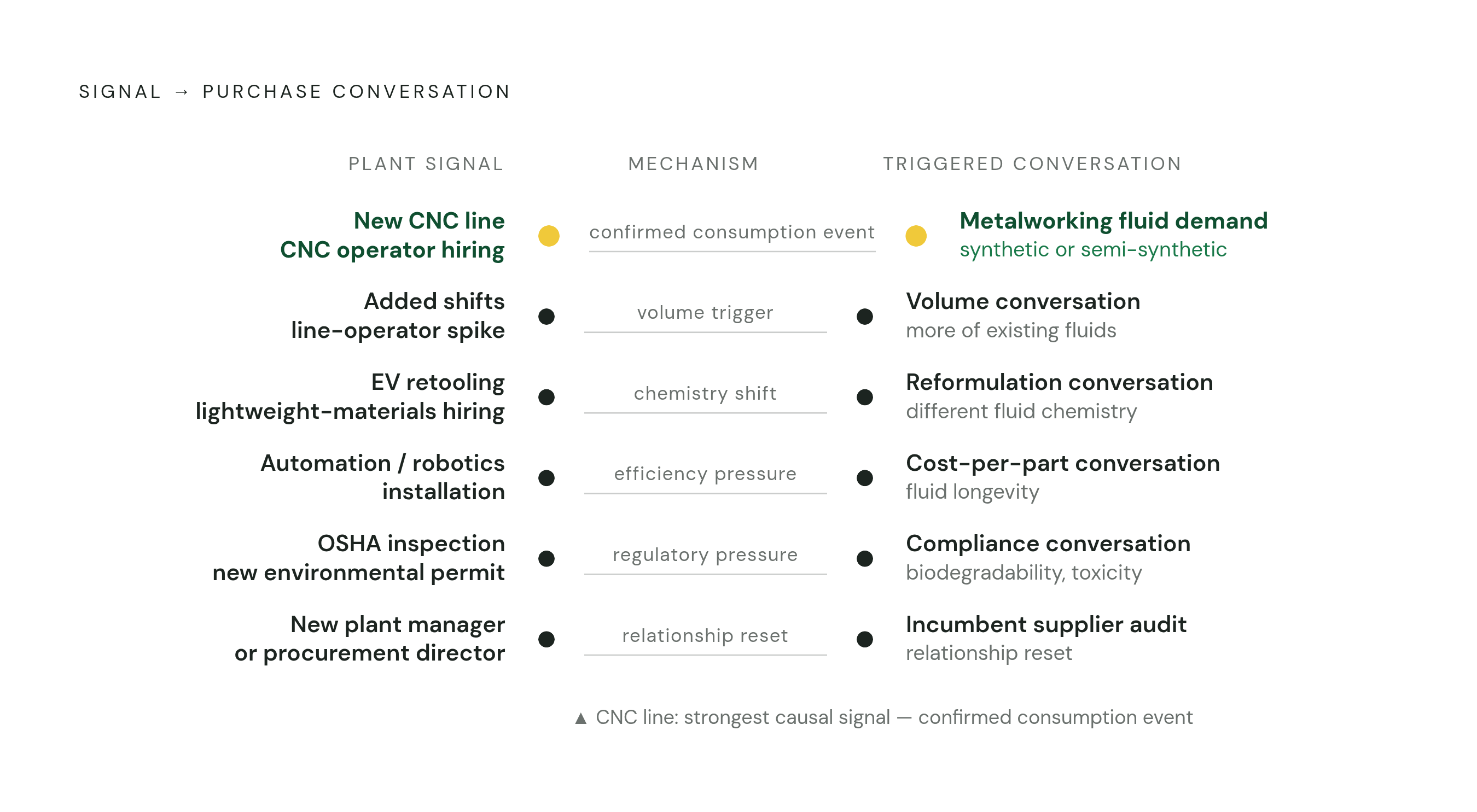
The value of shift data lies in specific signals mapping to specific, foreseeable purchasing needs, following a documented pattern rather than a guess. It's that specific signals map to specific, foreseeable purchasing needs, and the mapping isn't a guess.
A new CNC line, or a cluster of job postings for CNC operators, is close to a guaranteed trigger for synthetic or semi-synthetic metalworking fluid demand. These fluids support the broad machining operations a CNC line runs, where cooling and lubrication both matter, so a new CNC line is a confirmed consumption event. It's a confirmed consumption event, full stop.
Added shifts, or a sudden spike in line-operator hiring, point somewhere different: a volume conversation, not a new-product pitch. A plant running a third shift isn't adopting a new fluid category, it's burning through more of what it already buys, and since water-based cutting fluids already dominate machining centers, that ramp compounds demand in a category that's already large.
An auto supplier retooling for EV components, or hiring specifically for lightweight-materials processing, signals something else again: a specification change. Aluminum and magnesium parts for EV platforms need different fluid chemistry than legacy internal-combustion work, which makes this a reformulation conversation rather than a renewal. Automation and robotics installations shift the conversation once more, from price per drum to cost per part, because automated lines raise the bar on fluid longevity and uptime protection. A fresh OSHA inspection or a new environmental permit flips the topic to compliance: biodegradability and toxicity documentation suddenly matter to a buyer who, three months earlier, only cared about performance. And a new plant manager or procurement director, even absent any operational change, is a relationship reset on its own, since new leaders tend to audit incumbent suppliers early in their tenure.
Cutting applications, spanning automotive, heavy machinery, aerospace, and general industrial manufacturing, account for a major share of metalworking fluid use, so this mapping has its highest-volume home in exactly the sectors most active right now. The same logic extends past metalworking fluids too: a new process line at a plant triggers needs across water treatment, coatings, adhesives, and cleaning chemistry just as reliably. The signal categories don't change by vertical. Only the product on the other end does.
What changes for the rep is the opening line. Instead of "we sell metalworking fluids," the pitch becomes "saw you're adding a CNC cell, here's what that line is going to need." That's a different conversation, and a more credible one.
Building a shift-data scoring framework to rank whitespace accounts
A territory full of whitespace accounts that all look roughly equal on firmographics is a territory with no real priority order. Shift data fixes that by scoring urgency directly.
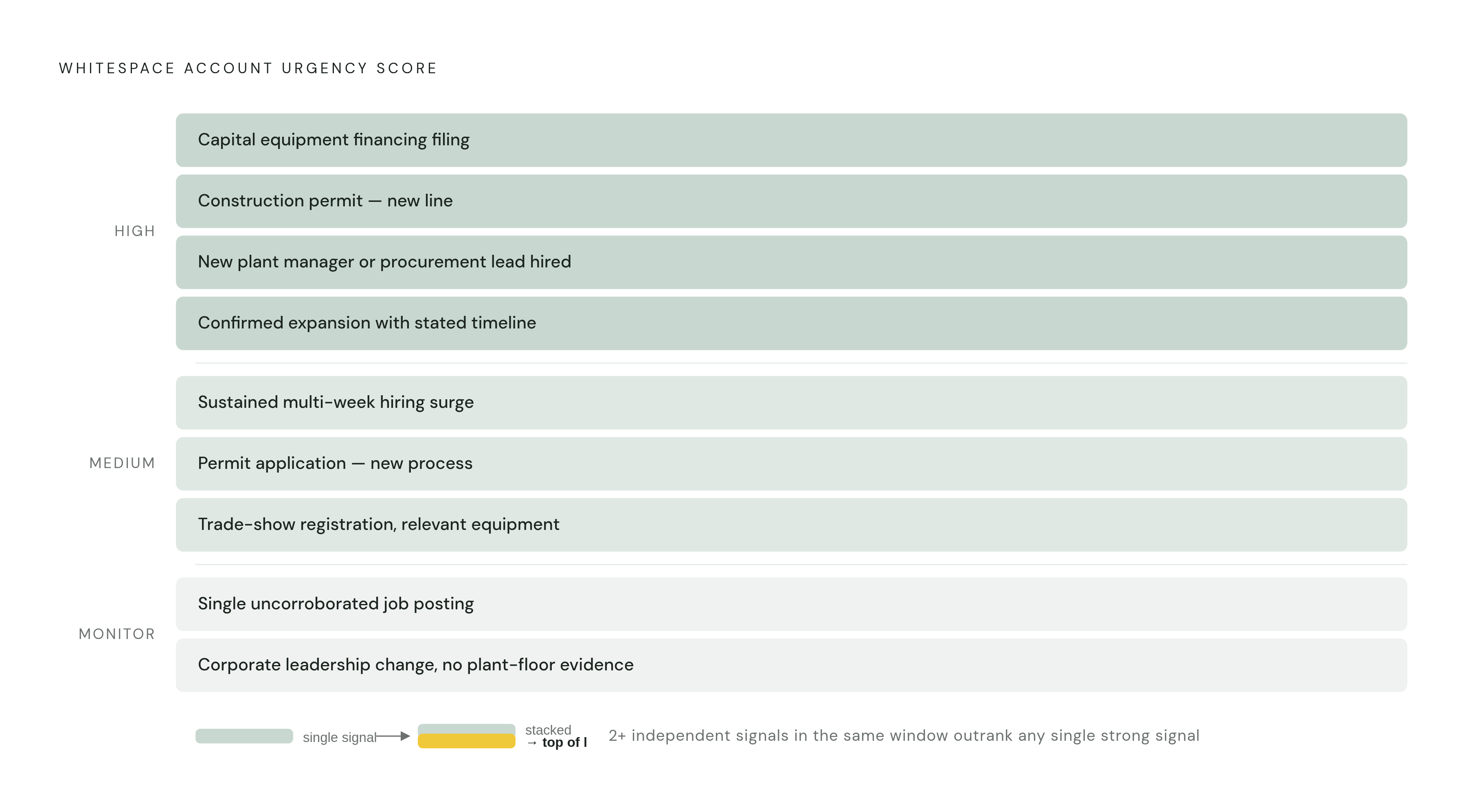
High urgency covers accounts with a capital equipment financing filing, a construction permit for a new line, a recently hired plant manager or procurement lead, or a confirmed expansion announcement with a stated timeline. Medium urgency covers sustained hiring surges across several weeks, a permit application for a new process, or trade-show registration tied to relevant equipment. Everything else, a single job posting with no corroboration, a corporate-level leadership change with no sign it's reached the plant floor, goes into a lower tier to monitor rather than chase.
Signal stacking raises the score further: an account showing two or more independent signals in the same window deserves more attention than one showing a single strong signal, since a real operational shift tends to leave marks across more than one type of evidence. Whitespace type should sit on top of urgency too. A high-urgency account where the entry point is application whitespace, with no incumbent at all in that category, outranks a high-urgency account where a competitor already owns the relationship. Both are worth calling. They're not the same call.
Multi-site accounts need their own adjustment. Manufacturers commonly run several plants, and a shift signal at one facility can preview a rollout that touches the whole footprint, so these accounts should score against total addressable whitespace across every plant, not just the one location currently showing activity.
The output, done right, is a ranked call list that tells a rep who to call, the signal that triggered the ranking, the whitespace type behind it, and a plausible opener. Calling the fifteen accounts actually worth the drive this month beats calling everyone in the territory in alphabetical order. None of this needs a data science team. It's a structured way of reading signals that any rep or sales ops function can run once the underlying feed exists.
Where this data lives and how sales teams are accessing it today
Most sales teams selling specialty chemicals, metalworking fluids, or adjacent industrial products don't have a systematic feed for any of this. Signals get caught ad hoc, through trade press, a LinkedIn scroll, or a customer mentioning something on a call, so the rep hears about it after the fact, often after a competitor already has.
A few platforms have built around this gap directly. FacilitiesFinder tracks over 600,000 US industrial facilities and a large number of decision-maker contacts, building each facility record from satellite imagery, mapping data, company websites, EPA filings, and public records, fused by AI into a profile covering products made, capabilities, headcount, and compliance status. It links each site back to its parent company, so a single search surfaces every location a manufacturer runs rather than just the address on a corporate filing, and it includes semantic search built for field reps rather than analysts. IndustrySelect takes a different angle, letting sellers plot manufacturers by region, industry, or company size to spot concentrated buying zones, plan territory routes, and catch pockets of opportunity that don't show up on a standard account list.
Research groups tracking industrial capital projects run their own version of this. One such platform, built to flag companies planning major capital investment, whether new construction, expansion, relocation, equipment modernization, or plant closure, confirmed more than $500 million in disclosed capital investment across just five of thirteen tracked projects in June 2026 alone. That number tells a rep a wave is coming before the RFP does. A separate vendor in this space, targeting by process, plant size, and vertical, positions itself around reaching buyers earlier in the purchasing cycle.
The same requirement drives all of it: a platform built specifically for teams selling to manufacturers, profiling facilities from the ground up by production type, equipment, output, environmental footprint, and activity signal, feeding straight into a CRM. The value is the data arriving pre-aggregated at the account level, so a rep opens an account view instead of starting a research project. It's the data arriving pre-aggregated at the account level, so a rep opens an account view instead of starting a research project. Anything used for this purpose needs facility-level resolution, not company-level averages, signals tied to actual production process rather than headcount and NAICS code alone, and a direct line into the CRM the rep already lives in. Teams that try to build this in-house from raw public sources tend to find the upkeep unsustainable. The sources update on different schedules, use different formats, and need constant normalization just to stay usable.
Acting on shift-triggered whitespace accounts without wasting the signal
Shift signals expire. A plant manager who hasn't yet reviewed incumbent suppliers is an open door, but the same manager eight months into the job has already made the calls a rep wanted to influence. Speed is most of the value of catching the signal early, and a lot of that value evaporates on a six-week internal approval cycle before the first call goes out.
How the rep opens matters almost as much as when. Leading with the data source reads as surveillance: "saw your job posting for a CNC operator" tends to put people on guard. Leading with the pattern reads as expertise: "our team focuses on facilities running CNC machining" opens the same door without naming how the door was found.
The angle should follow the whitespace type. Application whitespace at an account already on the books gives a rep standing to expand without competing against a relationship already in place. Something like, "already supporting the machining line, wanted to flag what the new forming operation is going to need," works because it's additive. Plant whitespace works through the peer introduction: a rep already trusted at one site can lean on that history when a sibling facility starts ramping. Pure greenfield whitespace is where the signal earns its keep as a filter rather than an opener. A plant throwing off multiple high-urgency signals justifies full discovery. One with a single weak signal, or none, stays in the queue and waits its turn.
None of this holds together without the signals flowing straight into account records in the CRM. A ranked list that lives in a spreadsheet gets checked once and forgotten. A ranked list that updates the account owner, the urgency tier, and the trigger event inside the system reps already work in every day turns a one-time report into a working pipeline.