Production-Signal Gaps That Leave Industrial Reps Guessing What a Prospect Actually Makes
Plant-level production signals show what a facility makes, not just who owns it.
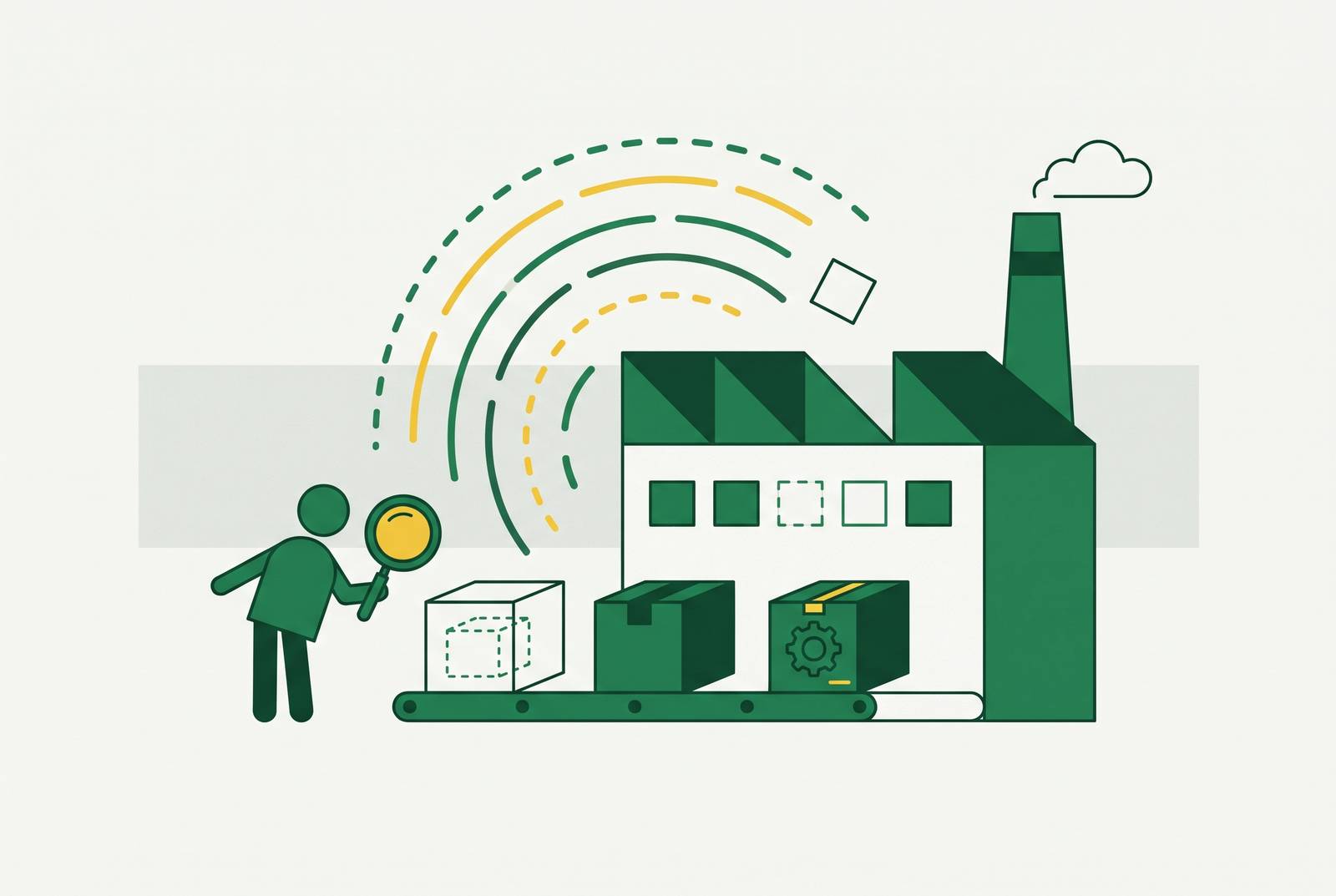
Plant-level manufacturing intelligence for industrial sales teams is data about what individual facilities make, run, and change, rather than what their parent companies look like on paper. Industrial reps need this production evidence to connect a prospect’s operations to the products it could buy.
Why company-level data leaves industrial reps working blind on the plant floor
A rep prepares for a call with a NAICS code, a revenue band, and a contact name, but no idea what the facility actually runs. Those records serve useful purposes. Firmographics help group businesses, contact databases show who the people are, and intent signals show what a company reads online. None of those facts establishes whether the site operates manual equipment, runs five-axis machining, or has added grinding capacity. The rep can identify the account without being able to qualify its production needs.
The mismatch begins with the object the data describes. Generic B2B intelligence tools built for SaaS and technology buyers sort information by company, job title, and topic interest. Industrial buying triggers are often visible elsewhere, in environmental permits, bills of lading, and efforts to hire automation engineers. Those records remain fragmented across disconnected databases, leaving facility profiles unassembled. More diligent call preparation cannot compensate for an input that describes the wrong unit of demand.
How the precision machining segment shows how wide the gap between a facility's label and its actual requirements can be
A job shop that machines mild steel on a manual lathe and a medical device contract manufacturer that makes titanium implants on a five-axis CNC can both have the precision machining label. Their metalworking fluid requirements are very different. For a metalworking fluid supplier, the useful distinction is what each facility machines, on which equipment, to what tolerance, and under which compliance regime. A segment label conceals those differences precisely where qualification needs to expose them. The same opening pitch therefore treats unlike production environments as interchangeable prospects.
Material choice changes the fluid specification directly. Titanium, nickel-based superalloys like Inconel, and high-strength steels produce more heat and put more stress on tools than mild steel or aluminum, so they need different fluid chemistry. The equipment also makes a difference, including whether a site uses CNC or manual operations and multi-axis or three-axis machining. Grinding introduces a separate requirement. Its sustained heat over long contact arcs calls for anti-weld and anti-burn additives that cutting operations do not need, so a facility adding grinding capacity is also making coolant decisions.
Certifications help the rep work out the specification tier before the first conversation. AS9100 for aerospace and ISO 13485 for medical work indicate documentation demands that filter out lower-performing products. They provide partial guidance on specifications. Read together with materials and equipment, they give the rep a technical basis for qualification that a NAICS code cannot provide. Job postings, equipment permit activity, certification records, and trade press can expose these distinctions, even when contact databases and intent feeds do not.
What production-level signals actually look like and where they come from
Production signals are observable facts about a facility’s operations and recent changes. Many are public but scattered and unstructured. Equipment and process signals describe machinery, materials, and operations through job postings, equipment listings, and published capabilities. A published machining capability, for example, can establish the presence of five-axis equipment rather than merely identify a business as a machine shop. Permit signals add evidence of change, with environmental and construction filings indicating new lines, expansions, or process changes before a press release appears.
A new or lapsed AS9100, ISO 13485, or IATF 16949 certification indicates the tier at which a facility operates and the documentation its suppliers may need. Customs and trade records provide a different view. HS codes, shipment frequency, and volume changes reveal imports and exports, exposing feedstock choices and customer relationships. These signals answer different questions, so a shipment record is not a substitute for an equipment profile or a certification record.
Ownership changes add a commercial trigger to the operational picture. A private equity acquisition of a specialty chemicals business puts incumbent supplier relationships at risk and can open a window for competitors. Deloitte’s 2026 chemicals outlook notes that several companies have announced intentions to move from basic petrochemicals into specialty chemicals or expand into adjacent specialty chemicals to capture higher margins. Those shifts can change which plants need which inputs without automatically notifying their suppliers.
What it costs when reps operate without production signals — in mispriced quotes, missed timing, and territory plans built on stale proxies
The same data-access problem has an inward-facing form inside the selling manufacturer. When sales cannot see current inventory, production capacity, or lead times, reps quote from memory or last quarter’s numbers. The commitment may already be unrealistic when made. Operations then inherits a delivery promise it cannot meet, while the customer experiences a failure the rep had no live information to prevent. More conservative quoting does not fix that access problem and can lose deals to competitors who respond faster.
Territory plans based on headcount, NAICS codes, and last year’s call notes overlook plants whose equipment, certifications, ownership, or end-market exposure has changed. Proximity cannot reveal those changes either. New capacity can offer greenfield accounts without an entrenched supplier, but a static territory list does not identify when that capacity comes online. The missed opportunity is therefore not just a poorly ranked account but a buying window that passes unnoticed.
A facility buying one formulation may qualify for adjacent products, but the rep needs to know what else the plant runs to identify that fit. An order history cannot supply that knowledge. When a facility has multiple decision-makers, a rep with a single contact may miss decisions made elsewhere in the plant.
Why the CRM makes the gap worse rather than smaller
A CRM is useful for recording relationships and sales activity. Calls logged, quotes sent, and orders closed create a history of commercial engagement. Those records need a plant-level data model and a source that feeds in production evidence to show equipment additions, permit filings, or ownership changes. A well-maintained account can still lack the facts needed to identify its next buying requirement.
The resulting pipeline view can look more complete than it is. Leaders see activity at accounts they know while missing an unfamiliar plant that is adding a production line. Maintaining the CRM more carefully improves the records already present, but it does not discover the five-axis machine just installed or the expansion permit filed last month. The gap is structural. Treating the CRM as a substitute for production intelligence makes relationship coverage look like market coverage.
How production signals change the sales motion — from territory design through the opening call
With production evidence, territory prioritization can shift from revenue bands or drive time to plant density, production intensity, and recent change. When a facility adds grinding, files expansion permits, or goes through ownership transactions, the rep has reasons to look into it. Timing becomes part of account selection itself. Instead of revisiting a familiar list, the rep can identify sites whose operating conditions now fit the supplier’s portfolio. Permit and equipment data also bring new capacity into view before it appears in established sales relationships.
A facility holding AS9100 and machining titanium on five-axis equipment presents a different metalworking fluid opportunity from a manual mild-steel shop. The rep can start the call with a product tier that fits the plant in mind, rather than spend the first part asking for basic production facts. These signals help with qualification, but a full technical specification is still needed.
The opening conversation changes with that preparation. A permit filing, certification achievement, or new line indicated by hiring activity gives the rep a concrete operational subject to replace a generic capability statement. The discussion begins with the facility’s work. Quaker Houghton’s September 2024 launch of QH FLUID INTELLIGENCE illustrates the technical endpoint, offering a platform for real-time monitoring and control of fluid performance. That operating-level focus is distinct from prospecting intelligence, but it shows why a fluid conversation benefits from knowing the production environment.
What tools help sales teams understand plant-level operations rather than company-level firmographics
For teams evaluating tools, the first criterion is whether the platform maintains individual facility profiles, making the plant its unit of analysis. Corvus is one example, keeping plant-level profiles on a broad range of manufacturers covering what each site makes, what equipment and utilities it runs, what permits it holds, and what is changing there. It matches that picture to a supplier’s product portfolio with visible supporting evidence, addressing qualification and cross-sell questions that company-level enrichment leaves unresolved.
Whether those profiles help with industrial qualification depends on how much the signals tell the rep. Equipment, processes, materials, permits, and recent changes offer a different basis for fit than employee reading activity. Portfolio matching is the next test. For specialty chemical and industrial distributors with large portfolios and territories that span several states, the output needs to match specific products to specific plants so reps do not have to make every match by hand using spec sheets. Facility-level coverage also gives leaders a basis for replacing territory anecdotes with a plant-by-plant count of market opportunity.
Currency and transparency distinguish an actionable signal from an unexplained recommendation. An expansion permit or ownership transaction is useful partly because of when the team receives it. The evidence must also remain visible. A rep needs to know why a facility was flagged and which operational fact supports the proposed product fit. Together, plant-level coverage, signal depth, portfolio matching, trigger currency, and fit transparency form a practical evaluation framework.
Other tool types address narrower parts of the workflow. Signal-based outreach platforms that track customs filings and procurement notices can help teams time their outreach, but they usually have too little detail about each facility for qualification and portfolio matching. CRM-ERP integration tools expose internal production capacity and inventory, leaving prospect operations to other tools. AI lead-scoring tools within CRM platforms improve prioritization among known accounts without supplying intelligence on plants absent from those records. These functions complement one another by addressing distinct data gaps.
How to audit your current data stack for production-signal gaps before the next territory plan is set
The practical next step is to test the current stack against four diagnostic questions before setting the next territory plan. First, check how reps obtain current production capacity and inventory when building quotes: from the system or from memory. This tests the inward-facing gap. Second, examine whether each top-tier account has known equipment and processes attached to its facility record, rather than only a company revenue band and primary NAICS code. A detailed contact record does not count as an answer to that production question.
Third, check when an expansion permit, ownership transaction, or new certification reaches anyone: before a competitor acts or when the customer eventually calls. Fourth, check whether every plant in the territory can be ranked against the supplier’s products with the supporting evidence in view, or whether a rep has to cross-reference spec sheets against CRM notes by hand.
The answers identify which structural repair comes first. If capacity and inventory are unavailable during quoting, CRM-ERP integration is the first priority because quote accuracy is already exposed. If the team lacks equipment knowledge, a way to detect change, or evidence to rank plants against its portfolio, a plant-profile platform can fill the outward-facing gap that contact enrichment and stronger intent feeds cannot close. Before territories are set, production signals can help teams choose which accounts to pursue, rather than just help reps prepare for calls to accounts already chosen.