Primary Metals Manufacturing and What Plants in That Sector Buy
$15.1 billion in new investment is reshaping where primary metals plants buy supplies.
NAICS 331 covers smelting, refining, alloying, and forming metals into ingot, billet, slab, coil, and rod, the intermediary shapes that feed the rest of manufacturing. A plant's purchasing behavior is determined by factors beyond the three-digit code. It's the specific process running on the floor, and that process is set by what the plant makes and how it makes it.
The sector's economic scale and the current investment wave reshaping where plants are located
The numbers put primary metals in a strange spot: big enough to matter to national GDP, small enough that most people outside the industry couldn't name a single mill. The US sector added $91.7 billion to GDP in 2023. Canada's version, smaller by scale but no less concentrated, added CAD $11.1 billion the same year. US employment was 374,000 in 2023, up 2.6% from 2022, though still short of where it stood before the pandemic hit.
Ontario offers a useful close-up. Primary metals manufacturing made up 6.0% of the province's total manufacturing GDP in 2024 and 5.9% of its exports, with more than 78% of those exports crossing into the US. The Hamilton-Niagara Peninsula alone holds 39.8% of Ontario's primary metals employment, home to Stelco and ArcelorMittal Dofasco, and stands as one of the densest steel manufacturing clusters anywhere in Canada.
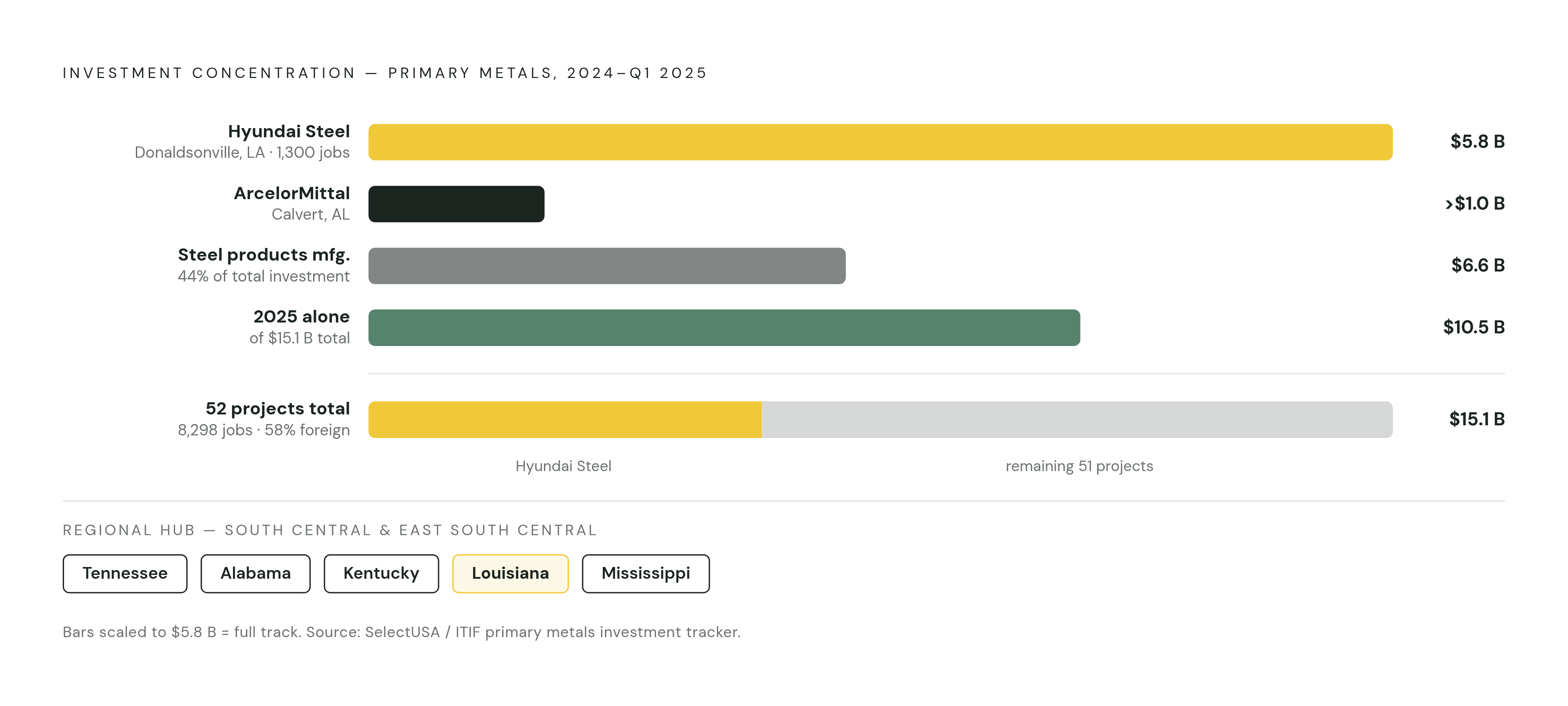
The bigger story right now is where new capital is landing. Between 2024 and the first quarter of 2025, the sector saw 52 announced projects worth $15.1 billion in investment and 8,298 jobs, with $10.5 billion of that total announced in 2025 alone. The single largest project on the list is Hyundai Steel's plant in Donaldsonville, Louisiana: $5.8 billion in capital spending, 1,300 direct jobs, and roughly 4,100 indirect jobs on top of that. ArcelorMittal's expansion in Calvert, Alabama, adds another data point in the same direction, an investment north of a billion dollars that reinforces the South as an active growth zone. Steel products manufacturing led all activity, accounting for 44% of total primary metals investment, and foreign firms, including several European and Asian producers, drove 58% of all announced projects. Per the 2025 GLS Insights Report, the South Central and East South Central regions, Tennessee, Alabama, Kentucky, Mississippi, are emerging as the country's top hubs for this kind of investment.
None of this converts to purchasing volume overnight. A greenfield steel plant takes several years to go from groundbreaking to full operation, which means today's announcement is tomorrow's account, not today's. Sellers who show up early, before the plant is running, are the ones positioned to win the business once it starts buying at scale. Freight data backs up the geography argument too: trucking moves 303 million tons of primary metals product, more than four times what rail carries at 67.6 million tons, with multi-mode transport adding another 51.8 million tons. That's a road-heavy, regionally bound supply chain, and it argues for territory planning built around geography rather than a flat national rollout.
The price and tariff environment that shapes how primary metals plants buy right now
Import prices for primary metal manufacturing rose 12.0% in 2024, the sharpest single-year jump since a 24.0% spike in 2021. At the same time, the producer price index for the sector fell 21.7% over the three years ending December 2024. Put those two numbers together and the picture is a squeeze: mills paying more for what comes in the door while getting less for what goes out. That kind of margin pressure changes how a purchasing department behaves. Price still matters, but total cost of ownership starts mattering more, because there's less room to absorb a bad batch of refractory brick or an early lubricant failure.
March 2025 brought a 25% tariff on steel and aluminum imports, reinstated without carve-outs for major trading partners. Domestic mills and smelters welcomed it, since it pushes buyers toward domestically produced metal. But it also raises costs for everyone downstream, automotive, construction, energy, and those industries are the ones buying from primary metals producers in the first place. Since new domestic capacity takes several years to come online, the near-term effect is tighter supply, not more of it.
Aluminum shows the imbalance most clearly. US demand hit 4.3 million tonnes in 2024, up 3.6% from the prior year, while domestic production covered just 670,000 tonnes of that, a sliver of global output. Nearly half of US aluminum consumption depends on imports. Secondary aluminum production, the scrap-based and recycling side of the business, grew meaningfully over the same period, a sign that recycling capacity is picking up share as primary smelting struggles to keep pace. Ontario's producers feel this tariff pressure directly too, given how much of the province's output, more than 78%, is bound for the US and how central primary metals is to Canada's export relationship with its southern neighbor.
For anyone selling into these plants, the lesson is straightforward: buyers under this kind of margin pressure are going to ask harder questions about service life, changeout frequency, and downtime. A supplier who can prove a product lasts longer or fails less often has a real argument to make. One who can only compete on unit price is fighting a losing battle in this environment.
Energy: the cost that dominates every primary metals operation and drives purchasing behavior more than any other single input
Four categories eat most of the energy budget in a primary metals plant: process heating, electrochemical processes, drive power, and HVAC. Process heating wins by a wide margin, and it shows up differently depending on what the plant makes. In iron and steel, heat homogenizes and processes raw material, and electric arc furnaces have become a central piece of equipment doing that work, especially in scrap-based mini-mills. Aluminum runs on a completely different energy logic. Smelting depends on the Hall-Héroult process, an electrochemical reaction that consumes electricity directly rather than heat in the same sense a blast furnace does.
Energy procurement, the electricity contracts and natural gas supply agreements that keep these plants running, sits above nearly every chemical or consumable line item in total dollar spend. It's arguably the single biggest recurring purchase a primary metals plant makes, and high energy costs are a persistent structural challenge for the sector, and domestic aluminum in particular faces ongoing difficulty competing on the world market.
This matters for anyone selling process chemicals, lubricants, or fluids into these accounts, because energy efficiency claims carry weight here in a way they might not elsewhere. A lubricant that reduces heating cycles, or a fluid that needs replacing less often, has a dollar value a plant manager can calculate on the spot. The shift toward EAF-based steelmaking, driven by scrap-based mini-mills, changes the energy mix from what an integrated blast furnace uses, and it changes the consumables list too: graphite electrodes and slag conditioners become the key process consumables rather than the materials a blast furnace operation would require.
Industrial gases, refractories, and ferroalloys: the process-critical inputs that define a steel mill's or smelter's purchasing calendar
Industrial gases run through nearly every stage of steel production. Oxygen feeds basic oxygen furnaces and cutting operations. Hydrogen and nitrogen handle annealing and cooling. Acids and solvents clean metal and support electrolysis. Air Liquide, Linde, Air Products, and Messer are major players in this space, and the relationships tend to run on long-term contracts. Displacement opportunities are rare here, but when a contract does come up for renewal, the volume involved makes it worth the wait.
Refractories are where the sheer scale of primary metals becomes tangible. Blast furnaces, EAFs, and continuous casting lines all consume enormous quantities of alumina, magnesia, silica, zirconia, and carbon, materials chosen specifically because they hold their shape above 1,000°C without melting or deforming. Basic refractories, magnesia and doloma and chromite, dominate in steelmaking because they stand up to basic slags, while neutral refractories like chromia, carbon, and zirconia get used where conditions swing between acidic and basic. These show up as brick, castable, and monolithic forms depending on the application. The market for refractories has been projected at $49.5 billion in 2025 and forecast to reach $118.2 billion by 2035, a durable and expanding category. Purchasing behavior here is shifting too: plants increasingly buy on service life and total cost rather than unit price, and performance guarantees are becoming a standard part of the conversation, an opening for any supplier who can back up a claim with data.
Ferroalloys round out the picture. Steelmakers buy nickel, chromium, manganese, and vanadium to hit specific alloy grades, and fluxes like limestone and magnesium pull impurities out of the melt. Ferro silicon acts as a deoxidizer, preventing blowholes by stripping oxygen from the molten metal. Silico manganese adds toughness and shows up heavily in structural steel. Ferro manganese counters sulfur's damaging effects during the melt. None of this is optional or interchangeable: the specific alloys a mill buys map directly onto the grades of steel it produces, which means knowing a mill's product line tells you its ferroalloy purchasing pattern before a sales rep ever picks up the phone.
Graphite electrodes deserve their own mention, because EAF-based steelmaking consumes them continuously as the arc melts scrap. Supply constraints in this category have caused real production disruptions in the past, which makes it a high-stakes purchase category for any mini-mill. GrafTech is a key name here, and as EAF production keeps gaining share from integrated blast furnace operations, this line item keeps growing along with it.
Lubricants, hydraulic fluids, rolling oils, and metalworking fluids: the consumables that run continuously and signal the most accessible sales opportunities
Fluid products in a primary metals plant tie directly to specific process steps, and each one exists for a reason. Fire-resistant hydraulic fluids are a safety requirement anywhere hydraulics operate near molten metal or high-heat zones. Release agents keep continuous-cast steel or aluminum from sticking to molds and rollers as it solidifies. Rolling oils cut friction and manage temperature during hot and cold rolling while protecting the roll surface itself. Straight lubricants keep the heavy mechanical systems moving, drives, bearings, gearboxes on rolling mills and tilting ladles. Sawing lubes handle the cutting operations on billets and slabs.
Volume here is large simply because the operations never stop, and unplanned downtime on a continuous process costs real money fast. That's the edge a supplier gets by guaranteeing on-time delivery and a consistent spec: reliability beats a marginally lower price when a mill's real fear is a line going down.
The broader metalworking fluids market gives some sense of scale, though estimates vary by research firm. One estimate from GMinsights puts the global MWF market at $13.6 billion in 2025, with projected growth through 2035, though other firms land on notably lower figures, so it's worth treating any single number here as a range rather than gospel. Removal fluids, used in turning, drilling, and grinding, held the largest share of that market, and they apply broadly across both steel and aluminum finishing work. Major suppliers active in this space include Quaker Houghton, TotalEnergies, Chevron, ExxonMobil, LUKOIL, FUCHS, Idemitsu Kosan, BP, Saudi Aramco, Sinopec, and Chem Arrow, now a Motul subsidiary. Demand tracks closely with transport equipment manufacturing, metal fabrication, and heavy machinery, all downstream customers of primary metals, so MWF volume rises and falls with those industries' fortunes.
Qualification cycles run long in this business. Once a fluid or lubricant clears a plant's approval process, though, it tends to stay in place for years, so the real sales pitch has to address the risk and time cost of getting qualified in the first place, not just how the product performs once it's in.
How sub-segment determines purchasing profile: matching the right inputs to each type of primary metals facility
An integrated steel mill running the blast furnace and basic oxygen furnace route buys a very different basket of goods than an EAF mini-mill down the road, even though both fall under the same NAICS code. The integrated mill needs coke and coal as feedstock, iron ore, oxygen for the BOF, basic magnesia refractories at high turnover, ferroalloys, fire-resistant hydraulics, rolling oils, release agents, casting lubricants, industrial gases, and energy locked into long-term contracts. These operations run large and continuous, purchasing decisions get centralized, and incumbent suppliers tend to be deeply entrenched. If a mill is running a BOF, that alone tells a seller it's buying oxygen by the truckload and cycling through basic refractories fast.
EAF mini-mills and steel recyclers run a different playbook. Scrap is the raw material instead of ore or coke, graphite electrodes get consumed continuously as the arc does its work, and electricity is the dominant line item on the cost sheet. These mills buy ferroalloys to hit grade specs, slag conditioners, hydraulics, and rolling oils, much like an integrated mill, but the proportions and priorities shift. EAF-based steelmaking has been gaining share from integrated blast furnace operations, and steel product manufacturing has seen meaningful recovery alongside the broader sector's employment gains. For an EAF mill, graphite electrodes and scrap are the two biggest spend categories after power itself, full stop.
This is exactly the distinction that a generic NAICS 331 label erases. A foundry and an integrated steel mill share a three-digit code and almost nothing else on their purchasing list. A sales team working off sector-level data alone is flying blind on the one variable that actually predicts demand: what the plant makes and how it makes it. Facility-level data platforms, including Corvus, exist specifically to close that gap, indexing plants by their actual output and equipment rather than a code that lumps a copper refinery in with a rebar mini-mill. Knowing a plant's sub-segment is essential before a sales call. It's the whole basis for knowing what to bring to the table.
Sources
- Sectoral profile - Primary Metal Manufacturing: Ontario 2024-2026 - Job Bank
- Recent Price Trends in the Metal Industry
- The Future of Metal Manufacturing in America: Forging Ahead
- Workforce Snapshot: Primary Metals Manufacturing Sector | CWB Group
- US primary metals industry: challenges and opportunities
- worldsteel.org
- eia.gov
- gminsights.com