New Facility Announcements and Greenfield Plant Sales Strategy
Sellers who wait for purchase requests lose greenfield deals to those who engage during design.

A greenfield plant announcement is one of the clearest buying signals in industrial sales, and it runs on a clock that most sellers misjudge. Once the new facility starts up and its first vendor list locks in, that list almost never changes again. The win goes to whoever shows up before the plant makes its first product, not after, and the sellers who wait for a request for quote have already lost.
Brownfield and retrofit work looks nothing like this. Incumbent suppliers already hold the account, switching costs run high, and category budgets are already spoken for. Expansion projects sit somewhere in between; an existing customer relationship often just extends to the new line. Greenfield is different: there are no incumbents. Every category, from process chemicals to metalworking fluids to packaging, is an open decision, and someone new is going to win each one.
The window for that decision is short, and it does not come back. Purchasing calls for nearly every input category get made in the months before commissioning, and once operations start, those patterns set hard. A supplier absent from that early conversation almost never displaces whoever showed up first. Compare that to a normal account, where a missed quarter just means trying again next quarter; greenfield timing doesn't renew. Miss it, and the opportunity is gone for the life of that plant.
What makes the announcement itself valuable is what it confirms about the buyer. Capital has already been committed, so this isn't a speculative lead sitting in a nurture campaign somewhere. Procurement, engineering, and operations teams are actively working through vendor lists in real time, and the plant's process choices, equipment, and production model are still being decided rather than inherited from a prior operator. A seller who shows up early gets a real shot at shaping those decisions instead of just bidding against them later.
The opportunity, in other words, is large. It's also narrow, and it rewards only the sellers who find the signal early and know exactly what to do with it once they have it.
The volume of new plant announcements currently in motion across U.S. manufacturing
The current wave of plant construction in the U.S. is not a normal cycle. Private construction spending on manufacturing has roughly tripled since early 2021, and manufacturing's share of all private construction spending has more than doubled over that same stretch. That's a structural shift in where capital is going, not a seasonal bump, and treating it like one is the mistake most sales organizations are currently making.
Three forces are driving it. Tariff pressure and supply chain disruption are pushing companies to build domestic capacity they would have offshored a decade ago. Government incentive programs, including the CHIPS Act and IRA manufacturing credits, are giving projects the capital cover to pencil out faster than they otherwise would. And foreign direct investment is flowing into U.S. plants as companies look to lock supply chains closer to home.
The sectors leading this build-out tell sellers exactly where to look. Semiconductors carry the highest capital intensity, with large clean-room facilities and specialized chemical and materials needs concentrated in Arizona, Texas, Ohio, and New York. EV and battery plants in Georgia, Kentucky, Tennessee, and Michigan are driving heavy demand for specialty coatings, metalworking fluids, water treatment, and plastics. Automotive assembly plants in South Carolina, Alabama, and Tennessee need metalworking fluids, lubricants, and coatings at scale. Pharma and food and beverage companies are reshoring active ingredient production, and that brings its own water treatment, specialty chemical, and packaging needs.
The scale involved is easy to underestimate until specific projects come into view. Rockwell Automation announced a greenfield campus in southeastern Wisconsin in November 2025, part of a $2 billion investment program and designed to be, at more than a million square feet, potentially its largest manufacturing campus anywhere. Amkor Technology's Arizona site is a $7 billion investment with 750,000 square feet of clean-room space and roughly 3,000 skilled jobs at one location, supporting Apple and NVIDIA as key customers. AstraZeneca's drug substance facility in Virginia is part of a $50 billion U.S. manufacturing and R&D commitment through 2030, and the company has called it its largest single manufacturing investment anywhere in the world.
Projects at this scale don't generate one deal. They generate cascading supplier demand across dozens of categories over a multi-year build and commissioning timeline. A greenfield win isn't a transaction; it's the start of a relationship with an organization that is, by definition, still growing.
How purchasing actually unfolds during the greenfield construction and commissioning timeline
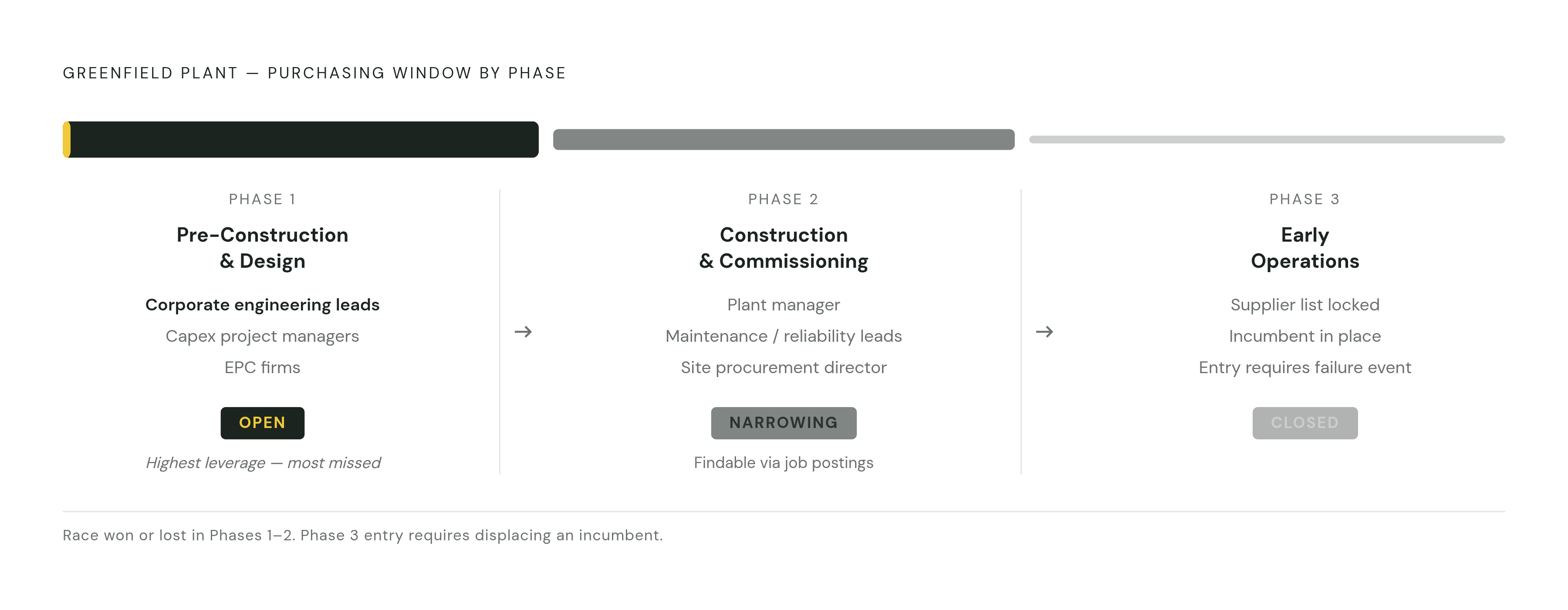
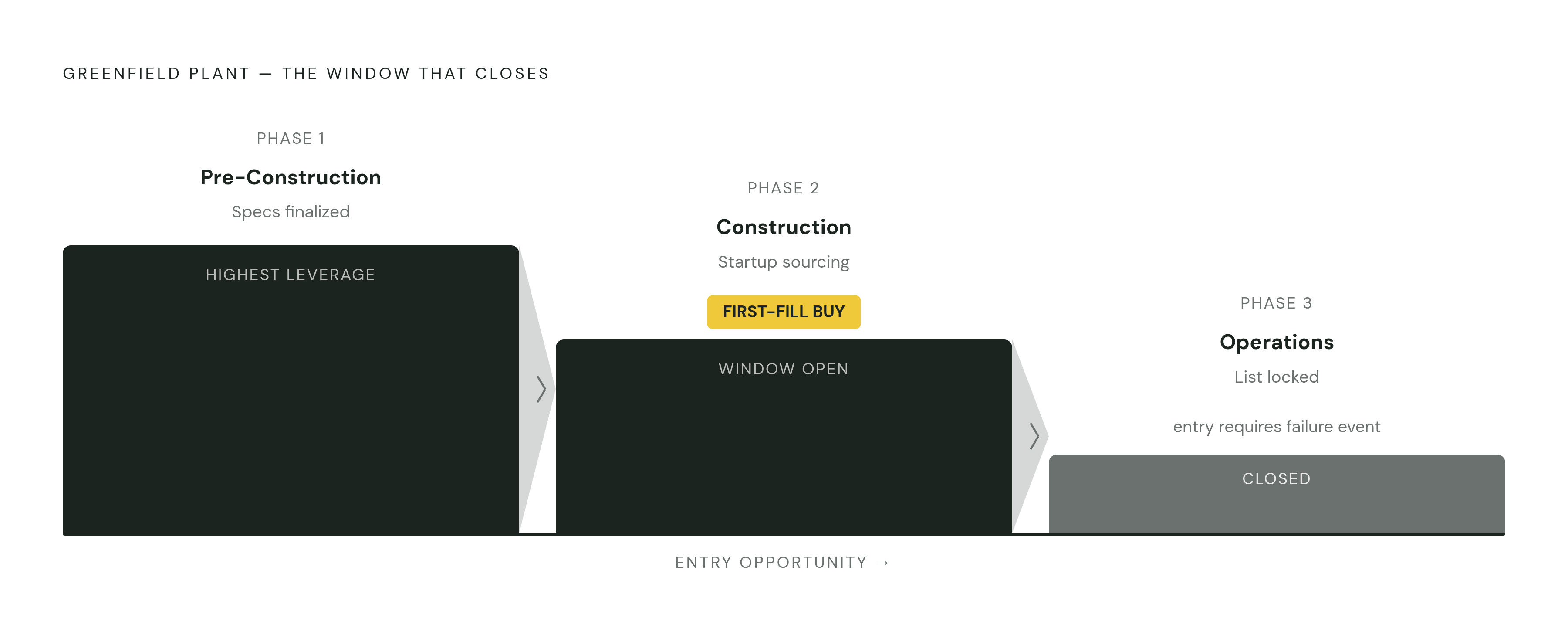
Most sellers treat the whole build as one long window. It isn't, and that single misconception costs more deals than pricing or product fit ever will. Greenfield purchasing runs through three distinct phases, each opening a different door for a different kind of seller. Showing up in the wrong phase with the wrong pitch wastes the one advantage a greenfield account offers.
During pre-construction and design, process engineers decide what equipment, chemicals, and consumables the plant will need for its entire operating life. This is the highest-leverage entry point there is, and it's also the one most sellers miss, because the contacts here often aren't plant employees at all. They're corporate engineering staff, capex project teams, and EPC firms working off a spec sheet, months before anyone at the site itself exists.
During construction and commissioning, procurement teams start actively sourcing vendors for startup inventory: specialty chemicals, fluids, coatings, consumables. EPCs and contractors often weigh in here alongside the plant owner's own team. By the time the plant reaches early operations, the supplier list has mostly locked in. Displacing an incumbent at that point takes a failure event or real dissatisfaction with the current vendor, which is a much harder sale than simply being first.
The buying committee changes shape across these phases too. Pre-construction contacts sit at the corporate level: engineering leads, capex project managers, EPC firms. By commissioning, the plant has its own plant manager, maintenance and reliability leads, and often a procurement director hired specifically for that site. These are frequently brand-new job postings, which makes them findable months before any press release goes out.
Manufacturing buying cycles run long, often spanning many months from first contact to first purchase order. Industrial buyers, per Sagefrog's 2026 B2B manufacturing trends report, complete the large majority of their evaluation before ever contacting a supplier. By the time a buyer picks up the phone, the shortlist is often already set. Pre-commissioning is the only phase where a seller shapes that shortlist instead of just competing against it, and any sales process built around inbound inquiry alone will keep arriving after the decision is functionally made.
One purchase inside this window deserves particular attention. Before a plant produces a single unit, it has to load every relevant piece of equipment with lubricants, coolants, process chemicals, and specialty fluids. That's a large, one-time, concentrated buy, and winning it often sets the standard for that entire category for the life of the plant. It's the single highest-value moment in the whole timeline, and it's easy to miss if a seller isn't watching for it specifically.
Finding greenfield announcements before they become common knowledge
Trade press and press releases are the wrong place to start looking, full stop. By the time a plant shows up in trade coverage, the EPC has often already been selected and early procurement conversations are already underway. Press releases get written for investors and regulators, not suppliers, so they rarely say anything about what the plant will actually need to buy.
The real signals show up earlier, in public records most sales teams never check. Permit filings and zoning applications get required before construction starts, and they surface before any groundbreaking announcement. Public companies must disclose material capital expenditures in SEC filings, which sometimes include facility details that haven't made it into press coverage yet. When a project owner awards an EPC contract, that firm typically announces it, a strong signal that construction is close. New job postings for a plant manager, maintenance director, or procurement lead often run months ahead of any public announcement, and those titles are distinctive enough to search for directly. State and county economic development agencies frequently publish plant siting deals before the company itself does.
None of this works as an occasional check. A rep who looks every few weeks will always be behind. Catching a project while it's still in pre-construction, before the shortlist even forms, takes a monitoring process that runs continuously rather than one that gets picked up when someone happens to remember.
This is where plant-level intelligence tools separate themselves from generic business databases. A database built around static NAICS codes and headcount figures has no way to flag a plant that hasn't started producing yet, because it isn't tracking construction status at all. A tool built specifically for industrial facilities, one that indexes pre-commissioned plants alongside operational ones and lets a seller filter by project phase, industry, and geography, surfaces greenfields that would otherwise take days of manual digging per account.
Reading a greenfield announcement to determine what the plant will need
An announcement gives a seller a starting point, not a shopping list. What usually gets disclosed: location, owner, the announced investment figure, a general sector or product category, projected job count, and a rough timeline. What usually doesn't: specific processes, equipment choices, production volumes, or the chemical and consumable requirements that decide whether a given product actually fits.
Getting from sector to specific need takes some inference, but the inference holds up because processes within a sub-vertical don't vary that much. A semiconductor fab implies chemical mechanical planarization fluids, ultra-high-purity water treatment, and specialty gases, predictable requirements even before the building has a roof. An EV battery gigafactory implies metalworking fluids for cell casing, specialty coatings, thermal management materials, and wastewater treatment for electrode slurry. A pharmaceutical API facility implies strict water treatment standards, specialty solvents, and cleanroom-compatible lubricants and coatings. Food and beverage plants imply NSF-rated lubricants, sanitary coatings, water treatment chemistry, and specialty packaging.
Equipment announcements narrow the picture further. When a plant names its automation platform or equipment vendors, that often locks in compatible consumables; a specific CNC platform, for instance, implies specific coolant compatibility requirements. Rockwell Automation's Wisconsin facility explicitly announced advanced automation and robotics systems as part of its build, which tells an industrial supplier something concrete about the performance tier of product that facility will need, well before anyone from the plant answers a phone.
Production model matters just as much as process. Make-to-stock, make-to-order, and engineer-to-order plants consume consumables at different volumes, frequencies, and specification tolerances. A high-volume continuous production plant is a very different customer, in size and consumption pattern, than a job shop running short batches. Put these pieces together, sector, equipment, and production model, and the result is a specific, testable hypothesis about what the plant will buy, when, and in what volume. That hypothesis is what makes the first outreach relevant instead of generic.
Building the outreach sequence for a pre-operational plant
Standard outbound sequences fall apart against a plant that doesn't have a procurement team yet. A normal contact list search returns nothing, or it returns the wrong people entirely. Worse, the usual pitch depends on referencing an existing pain point, and a plant that hasn't started operating has no pain point to reference yet, only anticipated ones. Add a sales cycle running for months, and a sequence built for a 30-day close will burn out long before the purchasing window even opens.
The right entry contact changes with the phase. Pre-construction means corporate engineering or capex leads and EPC project managers, people building the spec rather than buying anything. Mid-construction brings in the newly hired plant manager, maintenance and reliability engineers, and a site procurement director. Near commissioning, the operational team is fully assembled and actively sourcing startup inventory, the highest-urgency window in the whole cycle.
None of this works if the first message leads with product features. It has to lead with process knowledge instead, showing the buyer that the seller understands what the plant will make and what operating challenges that creates. Referencing comparable facilities served before, same sub-vertical, similar process, similar scale, stands in for the operating history this plant doesn't have yet. Framing the first conversation around commissioning planning rather than an immediate sale, offering to help think through startup chemistry or fluid specs, positions a seller as a technical partner before procurement even opens the category.
A single contact is a fragile bet in a plant like this. Roles are still forming, people shift between the project team and the operational team, and one no from one person can close the door on the whole account. Selling into engineering, operations, procurement, and finance separately, with a message suited to each, is the only way to keep the opportunity alive if one thread goes cold.
Timing should follow construction milestones, not the calendar. Permit approval, groundbreaking, structural completion, equipment installation, and the commissioning announcement each mark a point where outreach should escalate. A seller tracking those milestones can raise contact frequency exactly as the commissioning window approaches, instead of guessing at when to push harder.
Turning a greenfield win into a multi-plant account
A company building one new plant almost never has just one plant. It has an existing network of operating facilities, and winning the greenfield project hands a seller something rare: a live reference account inside that same organization. Those other sites become immediate cross-sell targets, and the greenfield win stands as proof of performance that procurement teams elsewhere in the company can check against their own criteria.
That's the real return on getting to the greenfield early. The one plant was never the whole opportunity; it was the entry point into everything the company builds next.