How to Read Multiple Plant Signals Together for a High-Confidence Capital Purchase Prediction
Combine independent signals to predict which plants will buy equipment next.

Real-time plant activity signals improve industrial sales outreach timing when independent evidence converges on the same facility, production need, and buying window. A permit, job posting, or CapEx disclosure alone is not enough. Reps can predict capital purchases with more confidence when clusters link money already committed to pressure on operations, while changes in the organization help show whether it is a good time to speak with a supplier.
Why single signals fail as the basis for capital purchase action
A rep acts quickly on a construction permit for what turns out to be a roof replacement. Another dismisses a filing and later learns that a competitor has already helped shape the equipment specification. Both errors begin with an incomplete interpretation. A signal can be accurate without supporting the purchase hypothesis attached to it. Reps need to decide which explanation fits before spending sales time on it.
Increased CapEx could fund IT infrastructure, fleet purchases, or facilities. An automation-engineering vacancy could replace a departing employee. Even a warehouse addition may have no need for new production equipment, so a plant address alone cannot show whether a product fits.
Manufacturing research habits make this ambiguity harder to resolve through digital intent alone. Buyers rely on trade shows, peer consultations, and spec sheets while also researching vendor websites and technical content. Online and offline channels have roughly equal weight. Platforms built around how people buy software therefore show only part of the demand in manufacturing. Misreading that view can mean arriving after requirements are fixed, when price is the only conversation left.
How converged signals work: each additional signal eliminates an alternative explanation
At first, a CapEx increase could mean the money is going to any of several uses. A construction permit at a specific plant address narrows the inquiry to that production site, although the project could still concern infrastructure. Job postings for end-of-arm tooling designers and PLC automation programmers at that plant then point toward production-floor automation. When an earnings call mentions capacity expansion in the same product line, it adds a view from the board level and a sense of when the work might happen. Each addition removes an alternative explanation.
Independence gives this sequence its predictive strength. An SEC filing, municipal permit, job board, and facility announcement each show a different side of the investment. Several accounts of the same announcement do not provide equivalent corroboration, because they can repeat the same underlying error. The useful cluster consists of separate signals that agree on the facility and the operational change.
That agreement supports a more specific reason for contact. Rather than mentioning a permit alone, the rep can discuss an automation ramp and the production requirements it creates. This remains a prediction. Its value is that fewer competing explanations remain, and the first conversation can test a defined need.
A three-tier signal hierarchy organized by how committed the capital already is
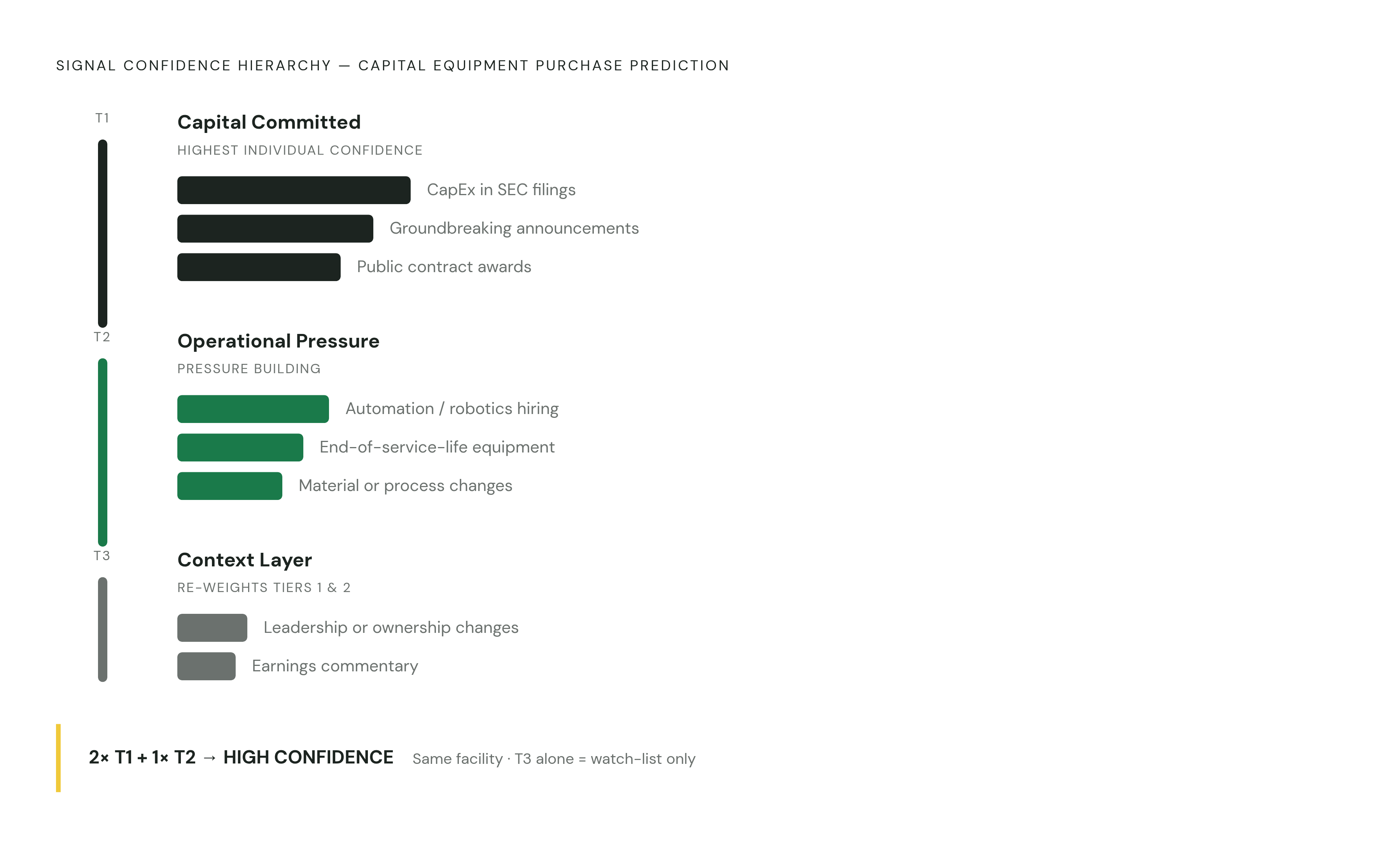
Tier 1 is capital already committed, with the highest individual confidence. CapEx disclosures in quarterly and annual SEC filings establish financial commitment, though not necessarily its destination within the business. Groundbreaking announcements tie investment to a facility. Public contract awards bring requirements for the work that follows when a supply program calls for new tooling dimensions, faster cycle times, or different material specifications. These signals establish that money or a contractual obligation is in motion.
Tier 2 is operational pressure building ahead of spending. Hiring for PLC automation programmers, robotics integration engineers, and tooling designers can indicate preparation for automated workcell installation. Equipment nearing the end of its service life presents another replacement window as spare parts become scarce and legacy controls lose support. Material changes provide a third route. A shift to post-consumer recycled content, bio-resins, or new process chemistries can require equipment modification or replacement before the new process can run.
Tier 3 is context that changes the weight of the first two tiers and the accessibility of vendor relationships. New plant managers or operations leaders can open a review window, while ownership changes reset financial priorities and contracts. Earnings commentary can help show where money will go and when it will be spent before a formal filing gives the details. None is a standalone purchase trigger. A leadership change strengthens the case for investigating an existing cluster.
How can a rep tell whether a manufacturing facility is actively evaluating new equipment?
The practical sequence begins with a facility. Consider a hypothetical precision machining plant in a manufacturing region, where a CapEx increase, automation hiring, and a new aerospace supply contract may point toward the same investment. Step one identifies the plant the evidence concerns and establishes what it produces. Geography alone is not enough. The parent company’s spending must connect to the facility before it can support a plant-level conclusion.
Step two checks Tier 1 evidence first. The rep reviews the latest 10-Q or 10-K for a year-over-year CapEx change, searches municipal permits by plant address, and looks for facility announcements or contract awards. In this example, the aerospace supply contract provides a production requirement against which to interpret the spending increase. The connection must remain explicit. A corporate budget increase and a contract elsewhere in the group would not establish the same cluster.
Step three checks whether the money is likely to go to the production floor. Job searches filtered to the plant’s city and relevant engineering roles can connect automation hiring to the contract requirement. Material qualification announcements or sustainability filings may instead show that a process is changing. Step four adds relationship context through recent leadership changes, ownership changes, or earnings commentary about the product line or region.
Step five scores the cluster. Two Tier 1 signals and one Tier 2 signal pointing at the same facility constitute a high-confidence cluster under this method. A Tier 3 event on its own stays on the watch-list. Before outreach, the rep should be able to state what the plant is doing, why it needs to buy in the next window, and how that affects the product conversation in one sentence. If the sentence depends on speculation, further corroboration is needed.
Why the macro environment in 2026 makes signal-reading more urgent, not less
AMT’s August 2026 analysis reported that the first half of 2026 set a U.S. manufacturing technology order-value record for a half-year period since data collection began in 1998. Aerospace and power generation equipment were particular concentrations of demand. Aerospace manufacturers also set records for both the value and the number of units of manufacturing technology they ordered during that period. For machining subcontractors and specialty input suppliers, those orders show what is happening in the sector as they look into which plants are expanding. They do not identify an individual buyer by themselves.
The GBI Finishing Index reached 54.2 in September 2026, with a majority of respondents planning near-term equipment purchases and planned spending climbing nearly fifteen percent. That reading strengthens the operational-pressure context for finishing accounts. The timing window is also becoming less forgiving. Manufacturers in high-impact equipment categories are buying sooner to lock in prices before the cost increases they expect from tariffs.
For sales teams, the consequence is a need to distinguish active facilities sooner. Strong sector demand can coexist with an account that has no relevant project. Convergence separates the two while there is still time to influence requirements. A rep who waits for an RFP may find the specification already shaped around another supplier’s equipment, leaving price competition in place of application-led selling.
How product type and plant type shape which signals to weight most heavily
For metalworking fluids and specialty lubricants, the plant’s process profile determines the relevant product class. What it machines, at what volume, and with which materials guides the conversation before contact begins. The Gardner Business Index Precision Machining reading reached 58.0 in July 2026, with expansion for the seventh month in a row and the highest reading since May 2022. Higher production and new orders provide context for faster fluid consumption and shorter replenishment cycles. Capacity is only one route to a need, however.
Compliance can be the stronger trigger for a fluid supplier. Documented OSHA inspection history involving mineral oil mist exposure or sustainability reporting pressure can make bio-based or low-toxicity formulations more relevant than an expansion announcement. FUCHS announced Boeing BAC 5008 Sections 5-6 approval for ECOCOOL GLOBAL 1000 in July 2026. That approval signal is specific to the named fluid and sections.
A semiconductor fab points toward ultra-pure process chemicals, while an EV battery facility points toward binders, electrolyte materials, thermal management compounds, flame retardants, and specialty coatings. Micron’s Central New York semiconductor campus buildout provides a geographically specific expansion signal. The New York Governor’s office announced the next round of the Green CHIPS Community Investment Fund in October 2026, adding public context to that buildout.
Existing-plant EV retooling requires a different reading from greenfield construction. Equipment qualification hiring, sustainability filings, and material certification announcements can be more revealing than permits for additional square footage. For coatings, adhesives, and water treatment, environmental permits, VOC reporting changes, and discharge standards often lead. Ownership changes can also open relationship-dependent contracts to review. The Windjammer Capital acquisition of MFG Chemical from Platte River Equity in January 2026 illustrates that organizational context, without establishing a particular equipment purchase.
What good cluster data looks like inside a CRM and how to keep it current
A company-level CRM can hide the facility where the evidence converges. One pump manufacturer’s CRM represented a global OEM as a single Chicago account. Adding plant-level data showed eleven plants across five states, including two in the midst of expansion. The opportunity was obscured by the record structure. More company information would not have resolved the missing plant-level view.
A useful plant record describes what the facility makes and at what volume, rather than relying on the parent’s NAICS code or headcount. It also records equipment types and approximate age, environmental permit status, and recent OSHA or regulatory history. Current job postings must connect to the facility. Links to the parent company’s SEC filings and earnings commentary then help the rep see how company spending relates to work at the plant.
Freshness is equally important because manufacturing sales cycles routinely last many months. A static lead list can become stale before a purchase closes, so monitoring must continue throughout the pursuit. Internal purchasing data adds another perspective. ERP records that track order velocity, purchasing frequency, product adoption, and backlog issues can show changes in an account that public signals miss. A material decline in purchases over a rolling six-month window warrants a proactive conversation about retention.
For that monitoring to become routine, signal data needs to appear where reps plan their work. Enriched account and contact fields in HubSpot, Salesforce, or Dynamics 365 make the evidence part of the system of record. The CRM must let a rep see which facility is changing, what supports that interpretation, and whether the evidence is still current.
Turning a high-confidence cluster into a territory priority and an opening conversation
A validated cluster should guide territory priority before drive time does. Plant type, production intensity, and sector activity help identify where demanding operating conditions coincide with strong purchase evidence. Geographic proximity can make a route convenient, but it cannot establish that an account has a relevant buying need.
The opening conversation should use the cluster as its content. A facility-specific permit, rising parent-company CapEx, and automation hiring support a discussion about ramp requirements and the risk of disrupting current production. The rep can name the operational change and connect it to the product’s application. That is more useful than announcing that a signal was found. Before the RFP, application engineers can help set baseline requirements rather than work from requirements already written around competing equipment.
The same approach applies within existing accounts. Automation hiring and a capacity-expansion permit together can show a chance to cross-sell that is hidden in a parent-company record. When ERP order velocity falls, though, the rep needs to talk about keeping the business. The evidence determines the purpose of contact.
The practical advantage is specific knowledge of the facility’s current situation. A rep with a validated cluster can discuss the plant’s likely requirement, its timing, and the production risk attached to the decision. A generic vendor cannot begin that conversation on the same terms.