Sustainability Commitments as Procurement Triggers in Manufacturing
Public pledges trigger measurable purchasing shifts across manufacturing within months.

Sustainability commitments don't stay commitments for long. Inside most manufacturing organizations, a public pledge turns into a purchasing sequence within months: a certification deadline, an audit, a supplier qualification form that didn't exist the year before. This piece maps which commitments trigger which purchases, so a sales team can find these accounts before an RFP ever gets written.
The old procurement triad, cost, quality, delivery, has a fourth member now, and it isn't going anywhere. Sustainability sits alongside the other three as a core supplier evaluation criterion across manufacturing. Fictiv's 2025 State of Manufacturing Report puts a number on the operations side of that shift: 92% of manufacturing leaders say their company already has actions underway to hit sustainability goals. That's not aspiration sitting in a corporate deck. That's a purchasing sequence already in motion.
The specific commitments that start a procurement clock
Not every sustainability initiative creates buying urgency. The pledge that matters is the one with a deadline, an audit, or a compliance gate attached to it, not the one that reads well in an annual report. Most sustainability language never becomes a purchase order; the fraction that does is the fraction with a clock on it.
Certifications with recurring audit cycles are the clearest example. ISO 14001 for environmental management, ISO 50001 for energy management, IATF 16949 in automotive, AS9100 in aerospace: each one forces a periodic procurement review whether the plant wants one or not. Fictiv's 2025 report found 54% of manufacturers have already put a recognized sustainability management system like ISO 14001 in place, which means the other half is still building toward one, and that gap is where the buying happens. Separately, EU customers increasingly ask for carbon-footprint data on a per-component basis as part of supplier qualification. What used to be a nice-to-have is now a gate a supplier doesn't get through without clearing.
Net-zero pledges follow the same logic. They read as voluntary, but most of the credible ones run on Science Based Targets initiative methodology, which requires absolute emissions cuts of up to 42% by 2030 and 90% by 2050 against 2020 baselines. Milestones like that don't leave room for drift; they force purchasing decisions onto a schedule whether the plant is ready or not.
Regulation adds a layer of its own. The EU's Corporate Sustainability Reporting Directive originally cast a wide net, and the Omnibus revision narrowed it, raising the threshold to companies with more than 1,000 employees and turnover above €450 million. Scope 3 disclosure survived that narrowing intact. Large manufacturers are still squarely inside the requirement, and still buying to meet it.
Then there's the cascade: when a large OEM announces a supply chain decarbonization target, every tier-one and tier-two supplier feeding that chain inherits a version of the obligation, whether or not it ever made a pledge of its own. Scan a manufacturer's public commitments with this lens, and near-term purchasing activity becomes visible long before it becomes an RFP.
Why Scope 3 obligations in particular cascade purchasing decisions down the supply chain
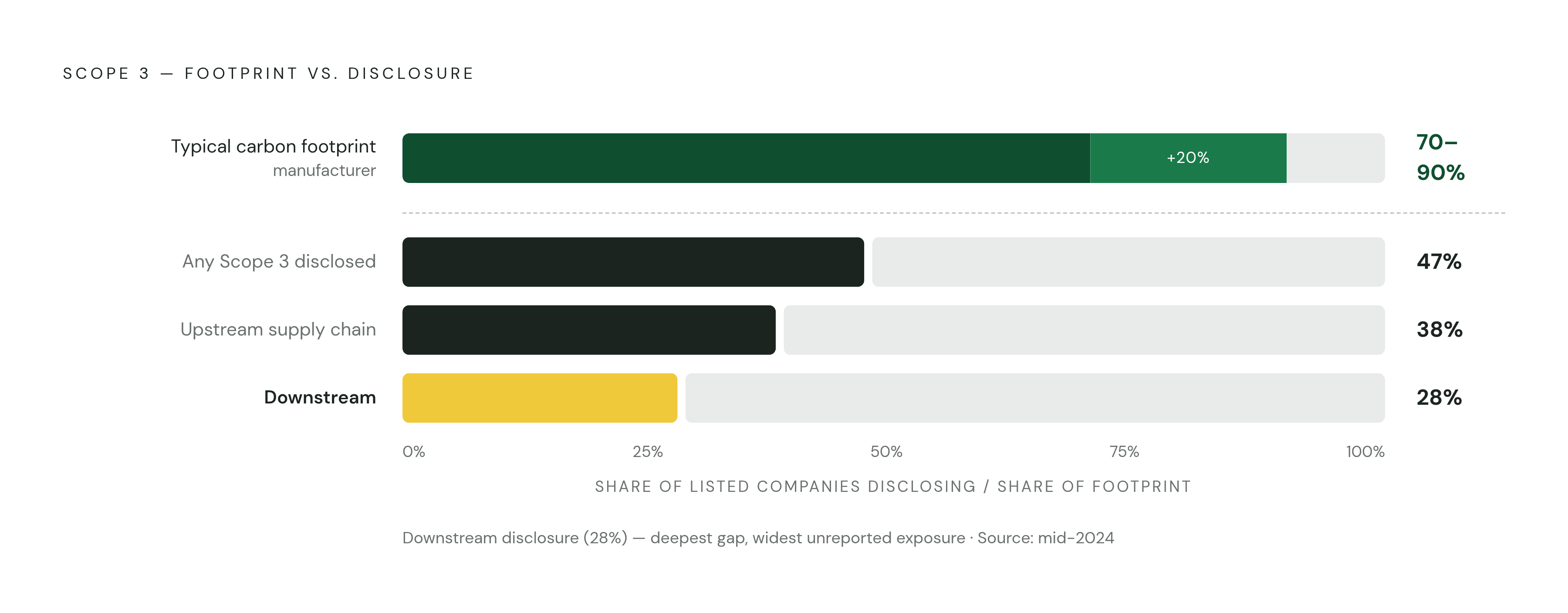
Scope 3 emissions, the ones tied to a company's supply chain rather than its own operations, typically make up 70 to 90% of a manufacturer's total carbon footprint. That ratio is the whole story. A company cannot hit a serious emissions target by changing what happens inside its own four walls; it has to change what it buys, and from whom.
The Omnibus revision cut mandatory data points by 61% overall, yet supply chain emissions data remains a central disclosure focus, a signal by itself. Supply chain emissions data is a floor, not a line item someone negotiates away.
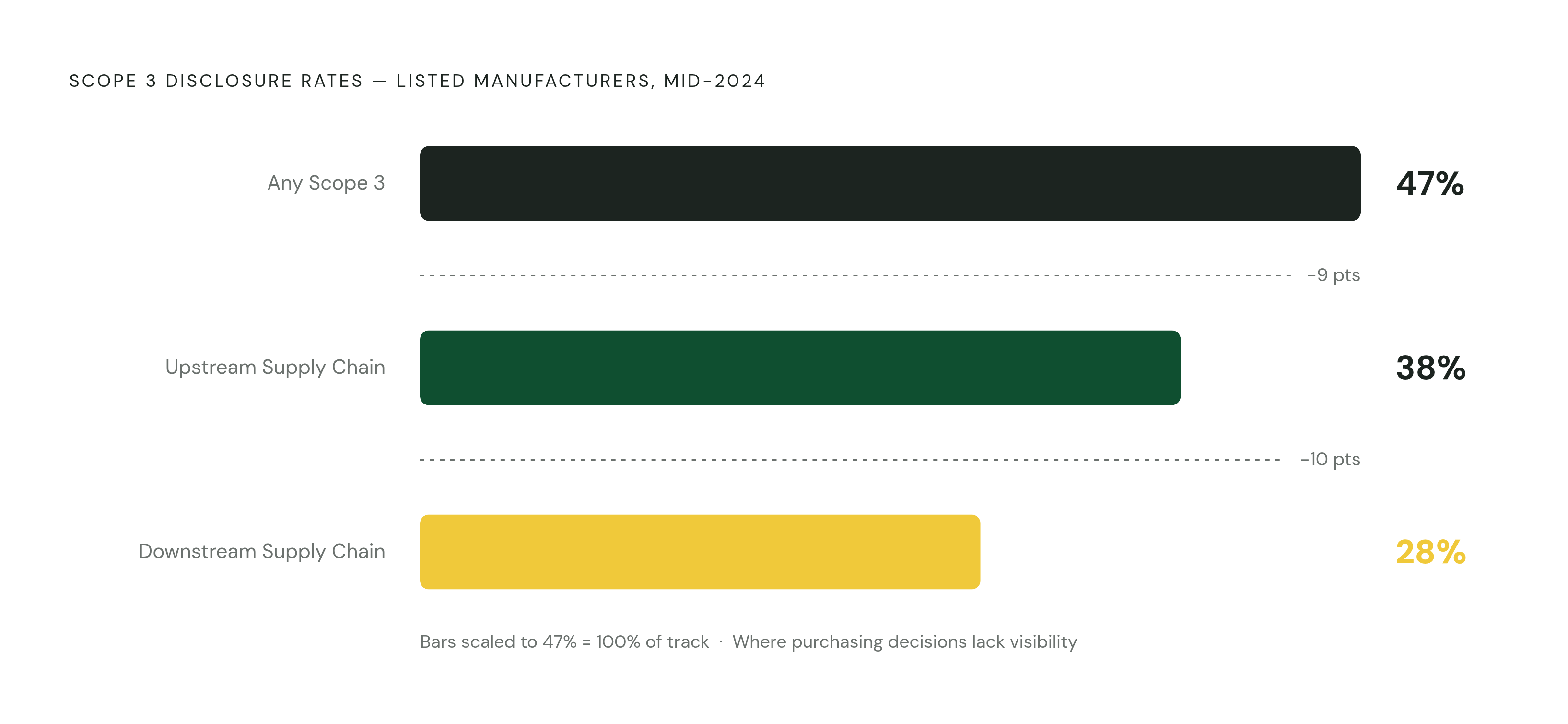
The disclosure gap underneath that requirement is where the commercial opportunity sits. As of mid-2024, only 47% of listed companies disclosed any Scope 3 data at all; upstream supply chain disclosure dropped to 38%, and downstream fell further, to 28%. Most manufacturers are early in this process, and the space between what they're obligated to report and what they can actually report is exactly where purchasing decisions get made.
Picture the cascade on the ground. A Tier-1 automotive supplier under pressure to report Scope 3 has to start collecting emissions data from its own chemical, fluid, and materials suppliers. Suppliers who can't produce verifiable numbers get dropped, a plain supplier qualification event, while suppliers who already have the data gain an edge that has nothing to do with unit price. That capability gap is itself a market: per KPMG, only around 17% of companies have real-time systems to monitor supplier ESG performance, and per Amazon's 2024 State of Procurement Data Report, 85% of procurement teams say finding sustainable suppliers is a real barrier to hitting their own goals. Demand for the data and the monitoring tools behind it is wide open.
How sustainability commitments translate into specific product and service purchases in metalworking and chemicals
Metalworking fluids make the link between commitment and purchase about as direct as it gets. Regulation and internal sustainability goals are pushing reformulation away from mineral-oil-based fluids toward bio-based, biodegradable, low-VOC alternatives. Synthetic fluids are the fastest-growing category in the metalworking fluids market, with a projected compound annual growth rate of 7.3% from 2026 to 2035, a trajectory that coincides with rising ESG pressure across manufacturing.
Product launches track the trigger almost on a calendar. Major fluid suppliers have been bringing sustainability-oriented products to market in direct response to customer ESG demands — mineral-oil-free formulations, biodegradable portfolios, fluids designed for EV component machining. Each launch is a purchasing event sitting in plain sight, waiting for a sales team to show up.
Automotive anchors this end market, holding roughly 45.6% of the metalworking fluids market in 2025. When an automotive OEM sets a sustainability mandate, it doesn't stop at the OEM; it runs straight down to the tier suppliers' fluid purchasing decisions.
Specialty chemicals show a different pattern: a push from internal ESG ambition meeting a pull from customer mandate, and the pull wins. In specialty chemicals, customer pull has emerged as a dominant driver, with OEM and multinational customers treating demonstrated environmental responsibility as a condition of supplier qualification. That creates a dual test every sale has to pass now: will this chemical actually improve the customer's product, and is it compliant with the customer's sustainability commitments? A seller who only answers the first question doesn't close the deal. Investment inside specialty chemicals is also shifting away from broad statements of intent toward initiatives with a measurable return, which means a seller who can quantify environmental performance in real numbers beats one offering general assurances.
Geography concentrates all of this. Sustainability-driven purchasing follows manufacturing density — it clusters where automotive plants and metal fabrication operations are heavily concentrated rather than spreading evenly across a map.
The certifications and compliance gates that function as procurement gatekeepers in 2025–2026
ISO 14001 remains the foundational environmental management certification. A facility holding it, or actively pursuing it, has committed to a structured environmental review cycle, and that cycle creates predictable buying windows for chemicals, fluids, waste management services, and monitoring equipment.
ISO 50001, energy management, is increasingly relevant for facilities with their own ESG-reporting obligations or those supplying customers who carry such obligations. A plant starting down the ISO 50001 path buys energy monitoring hardware, metering systems, and efficiency upgrades, roughly in that order.
Sector-specific gates layer on top. IATF 16949 in automotive is a certification whose audit cycles create recurring supplier review windows that sustainability requirements increasingly accompany. AS9100 in aerospace is a qualification standard whose supplier review cycles are increasingly running alongside environmental performance expectations. ISO 13485 in medical devices similarly carries qualification cycles that environmental disclosure expectations are beginning to intersect.
The signal for a sales team is plain: a facility announcing it's pursuing one of these certifications, or one that just received it, has already made purchasing decisions to get there, and it will make more to stay compliant. By 2026, more than 60% of buyers are expected to require supplier carbon or lifecycle CO₂ data as a condition of doing business. The certification pathway is becoming the price of entry, not a differentiator. With 54% of manufacturers having implemented a recognized sustainability management system, the majority are still mid-journey, which means the active purchasing phase is the norm right now, not the exception.
Reading the signals: how a sales team spots a sustainability-driven purchase before the RFP arrives
Sustainability commitments leave a trail long before they become a formal RFP. Public announcements, net-zero targets, supply chain emissions pledges, new ESG report releases: each marks the start of a purchasing sequence. Certification pursuit is another tell; a facility announcing it intends to get ISO 14001 or ISO 50001 certified will be buying well ahead of the certification date. Regulatory filings matter too: companies inside CSRD scope have reporting obligations that drive sourcing of data and compliance capability. Capital expenditure is a signal on its own, since equipment upgrades tied to efficiency or emissions reduction generate demand for compatible process chemicals and fluids. New production programs, EV component machining, aerospace precision parts expansion, carry sustainability requirements baked directly into the program specification.
Standard prospecting tools miss all of this. A NAICS code and a headcount number describe what a company is. They say nothing about what it's doing, or what it has committed to.
Plant-level data changes what's visible. Knowing what a facility actually produces, what equipment runs the floor, and what its environmental footprint looks like lets a sales team predict which commitments will generate purchasing in their specific product category. A plant running on legacy mineral-oil fluids is a different opportunity than one already running synthetics; the former becomes a conversion candidate when sustainability pressure arrives on its calendar.
Timing is the whole game. The window between a sustainability commitment and the purchasing decision it triggers is finite, and a competitor tracking these signals reaches the account earlier, while specifications are still being written rather than after they're locked. Certifications, production changes, equipment additions: these are the earliest reliable indicators, and they show up months before any RFP does.
What selling into sustainability-driven accounts requires from the sales conversation
The buyer on the other side of the table has changed. Procurement teams now assess a supplier's environmental and social footprint before they'll close, which means a sales conversation built only around performance and price is missing half the qualification criteria. Pitch on price and quality alone and the deal stalls in a review round nobody warned the seller about.
That dual qualification standard shows up in nearly every serious manufacturing sale now: does this solve the technical problem, and does it align with the buyer's sustainability commitments? A rep who only answers the first question loses to a rep who answers both.
Framing has to speak the language procurement actually uses. A product that helps a facility maintain ISO 14001 status or document Scope 3 reductions is reducing audit risk, so frame it as risk reduction rather than as a generic feature. There's a capital argument too: companies with stronger sustainability profiles tend to access capital at lower cost and draw longer-term institutional investors, which means sustainable procurement touches the cost of capital itself, well past an operating line item. Carbon pricing and emissions trading systems add a third, concrete argument: framing a product substitution as avoidance of a future carbon liability is something a CFO can act on directly.
Sales reps in this environment function as boundary spanners, a term from industrial sales research describing reps who translate complex environmental requirements into workable supplier solutions. That job requires understanding the regulatory backdrop, not memorizing a spec sheet.
Before any call like this, three things need to be ready: the specific sustainability commitment the facility has made or is chasing, which products or inputs that commitment forces them to change, and what verifiable environmental data can be handed over to help them document compliance. As procurement teams increasingly turn to data-driven analytics to optimize sustainability outcomes, a seller who can feed verifiable environmental data into those workflows, rather than standing outside them, holds a structural edge inside the account.
Using facility-level data to build a territory around sustainability-driven purchasing clusters
Sustainability-driven purchasing doesn't spread evenly. It clusters: by industry segment, by facility type, by customer base, by geography. Facilities serving multinational OEMs with active sustainability mandates tend to face the most direct and near-term pressure, and regions dense with automotive and metalworking operations represent high-concentration territory for sustainability-triggered purchasing in metalworking fluids specifically.
Territory planning built around facility-level production data, what a plant makes, what equipment it runs, what its environmental footprint looks like, lets a sales team score facilities by how likely they are to make a sustainability-driven purchase in a given category. A cluster of tier suppliers feeding an OEM with an active supply chain decarbonization target represents a territory worth prioritizing, not a name buried in a random prospect list. Facilities running legacy fluid or chemical profiles inside sectors with active ESG mandates are conversion candidates whose purchasing is tied to compliance deadlines rather than discretionary timing.
Generic company databases hit a wall here. A profile reading "metal fabrication, 200 employees" says nothing about whether that facility holds ISO 14001 certification, what alloys it machines, or whether its biggest customer has announced Scope 3 targets, and all three facts determine whether a sustainability-triggered sale is close or far off. Plant-level intelligence that captures production process, equipment class, and environmental activity signals lets territory planning front-load the highest-probability accounts instead of working a list in geographic order. The output that matters is a territory map weighted by concentration of facilities whose production profile and customer relationships make sustainability-driven purchasing near-term and predictable, not one weighted by zip code alone.
The accounts already inside the portfolio that sustainability commitments are quietly making into upsell opportunities
The easiest sustainability-triggered sale is usually already sitting inside the existing account list. A facility that has qualified a supplier once, and bought from them before, is far easier to re-engage when a new commitment creates a new need than a cold account is to open from nothing.
Most sales organizations track these accounts by product category and renewal date, not by which sustainability commitment is about to force a new purchase. That's the gap worth closing. An account that bought a conventional metalworking fluid three years ago, and now sits inside a supply chain facing a fresh OEM decarbonization mandate, has moved past renewal territory into upsell territory, for a bio-based or low-VOC reformulation. The account team that spots the commitment before the customer issues a new spec sheet keeps the account. The one that doesn't loses it to a competitor who read the signal first.