How New U.S. Factory Openings Should Reshape Territory Plans
Manufacturing's reshoring boom is moving buyer locations faster than territory plans can track.
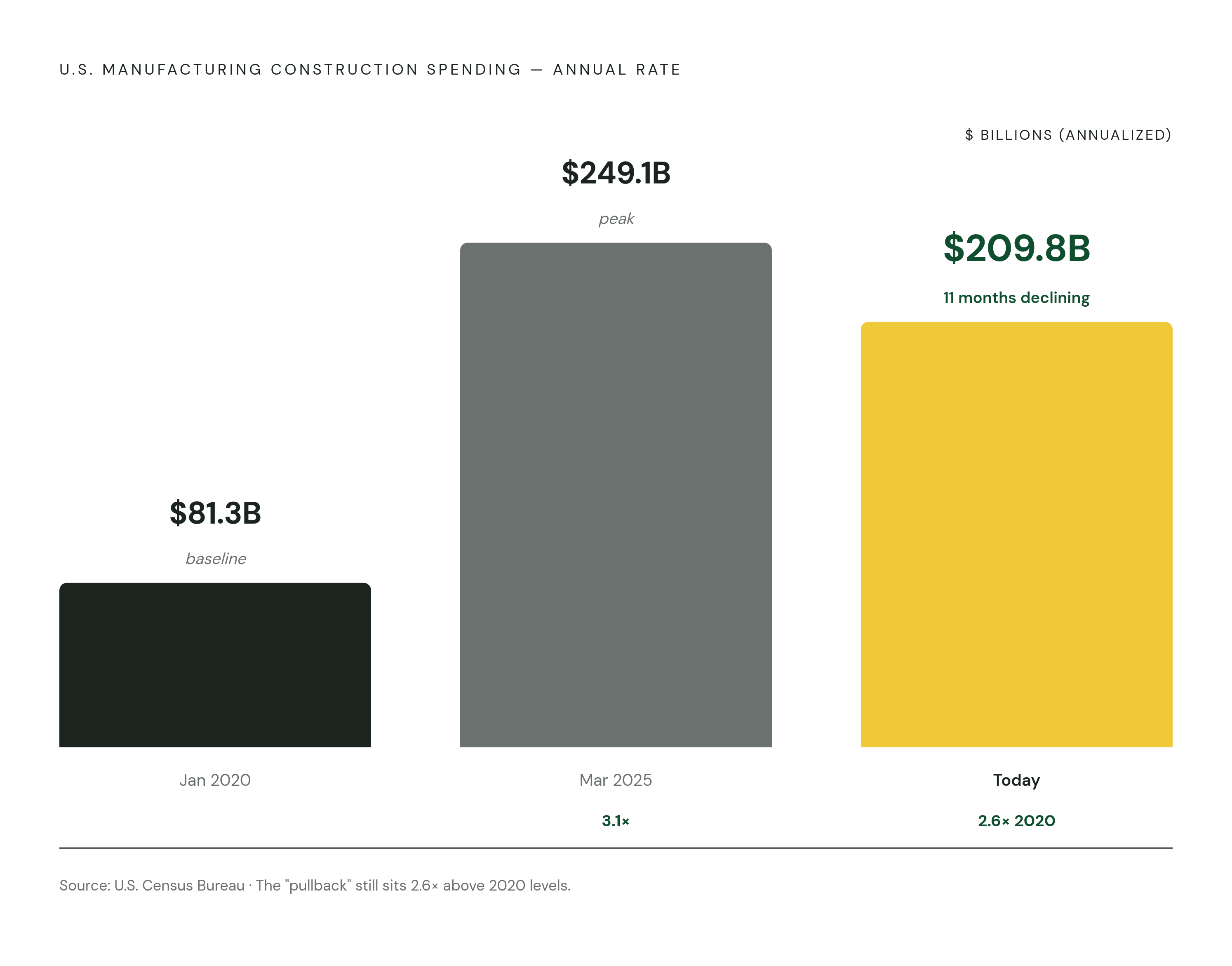
U.S. Manufacturing construction spending more than doubled between 2020 and 2024, hitting a record high on an annualized basis. That figure alone should reorganize how sales leaders think about coverage, because a territory map drawn even three years ago was built on a demand landscape that no longer exists. New plants change where the buyers are, and most territory plans have not caught up.
Spending peaked at $249.1 billion in March 2025 and has since pulled back for eleven straight months, landing at $209.8 billion. That decline reads like a slowdown in headlines, but the number is still 2.6 times what it was in January 2020, when construction spending sat at $81.3 billion. A "cooling" market at this scale still means an installed base of new and half-finished factories that dwarfs anything a 2021 territory plan could have accounted for.
None of this rests on a single policy that could unwind in one election cycle. Five separate forces are pushing in the same direction at once. The CHIPS Act alone has a substantial sum committed across the semiconductor pipeline, and combined with the IRA, federal commitments run to several times that amount across sectors. Tariffs enacted in 2025 have pressured the offshore cost advantage that used to make overseas production the default. Supply-chain risk has become a board-level worry: 77% of OEMs now cite geopolitical exposure as a concern at that level. Total-cost-of-ownership math is also catching up with reality, since logistics, IP exposure, and inventory carrying costs eat 15 to 20% of the savings that offshoring appeared to offer on paper. And automation is closing the labor-cost gap that justified moving production overseas in the first place, with 86.7% of manufacturers now adopting some form of AI or automated production.
The Reshoring Initiative puts cumulative reshoring and foreign direct investment jobs at over 2 million since 2010. That is a decade-long structural shift that persists after supply chains normalize. The ISM Manufacturing PMI hit 52.7 in March 2026, confirming a cyclical uptick, but a cyclical uptick and a boom are not the same thing. Read this as a permanent redrawing of where industrial demand physically sits, and plan accordingly.
Where the new plants are landing, and what each sector signals for sellers
Semiconductors account for 35% of 2024's announced manufacturing jobs, backed by that same sizable pipeline. EV batteries and solar make up another 31%, driven by IRA incentives. Automotive assembly jumped 139% year over year following the 2025 tariffs. Aerospace and defense carries a sizable sum in federal R&D funding behind it, and pharmaceuticals, biotech, and food and beverage round out the rest of the map.
Semiconductor investment concentrates in Arizona, Texas, Ohio, and New York, EV batteries and solar cluster in Georgia, Kentucky, Tennessee, and Michigan, and this geography shapes where sales opportunities form region by region rather than following any national trend line. Semiconductor investment concentrates in Arizona, Texas, Ohio, and New York. EV batteries and solar cluster in Georgia, Kentucky, Tennessee, and Michigan. Automotive assembly spreads across Michigan, Ohio, Kentucky, Indiana, Tennessee, South Carolina, and Alabama. Pharma and biotech gather in North Carolina, Massachusetts, and New Jersey, among other coastal and mid-Atlantic hubs. Food and beverage tracks closer to population centers, with activity concentrated in Texas, California, Pennsylvania, and the broader Midwest.
A few named projects give this some weight beyond the aggregate numbers. GlobalFoundries has put $16 billion into reshoring chip manufacturing. Stellantis has committed $13 billion to domestic manufacturing. manufacturing. Johnson & Johnson pledged $55 billion toward domestic manufacturing in 2025, but the factory-employment effects of that pledge will likely appear around 2030. John Deere is opening a distribution center near Hebron, Indiana, and expanding excavator production at its existing Kernersville, North Carolina campus, reshoring work that used to happen in Japan, with both projects due to open within a year of this writing. And a $700 million, 324,000-square-foot Texas facility tied to the TSMC/Nvidia supply chain is producing advanced Nvidia chips, positioning itself as a key node in the domestic AI hardware buildout.
For sellers of process chemicals and industrial consumables, each sector cluster carries a different purchasing profile. Semiconductor fabs need ultra-pure process chemicals, advanced CMP slurries, and specialty cleaning agents, bought against tight specs with almost no tolerance for variation. EV battery gigafactories run new chemistries with fluid and coating needs that don't map onto legacy automotive supply relationships, and their purchasing committees often have no incumbent vendor. Automotive assembly plants need metalworking fluids, stamping lubricants, and coatings, an established category, but a brand-new plant still means no incumbent and a fresh capex cycle up for grabs. Food and beverage plants need water treatment, sanitation chemicals, and packaging, and because that production sits close to end markets, regional density is compressing fast.
88% of 2024's announced reshoring jobs fell into high- or medium-high-tech manufacturing categories. These are not the assembly lines that left decades ago coming back unchanged. The consumables and equipment profile behind this wave looks nothing like what a plan built purely on NAICS codes and headcount ranges would predict, and a territory strategy that doesn't break demand down by sector and process type will misread even a region that's clearly hot.
The announcement-to-commissioning lag defines the sales team's real opportunity window
Roughly 15% of announced reshoring jobs never materialize, so some discount belongs in any forecast built on press releases. But the 85% that do show up take meaningful time to go from announcement to actual staffing and commissioning. Plants announced back in 2022 and 2023 are only now, in 2026, reaching the point where consumables, process chemicals, and industrial supply purchasing actually starts.
The pipeline behind this involves substantial job numbers, produced by sustained reshoring and FDI activity. Reshoring and FDI announcements totaled 244,000 jobs in 2024, and 2025 is tracking closer to 174,000 as tariff uncertainty slowed some decision-making. Even in a slower year, that is a substantial number of new facilities working through construction and ramp-up at any given moment.
Construction spending peaked in March 2025 and has since pulled back. What follows, hiring, equipment installation, commissioning, is where the purchasing decisions for fluids, chemicals, and supplies actually get made. A sales team that waits for a new plant to show up as a normal account in the CRM is showing up after the first vendor relationships are already locked in.
Plants in active construction regularly begin vendor conversations well before they have a roof, sometimes before the foundation is even complete. The sales opportunity from a new plant isn't opening day, it's the full span of construction and early ramp, and that window belongs to whoever is tracking the announcement, not whoever notices the plant once it's fully staffed.
Budget cycles make the timing even tighter, since capex planning for new facilities tends to run well ahead of commissioning dates. A plant commissioning in mid-2026 was likely approving its first consumables vendors in late 2025 or early 2026. The window closes faster than most annual territory cycles are built to notice.
Why static territory maps fail when new plants open
58% of B2B companies rate their own territory design as ineffective. That's not a fringe failure rate, it's close to the norm, which says something about how disconnected most planning processes are from how demand actually moves.
Static territory models hold for a fiscal year or longer, and that stability is genuinely useful for managing accounts that already exist. It becomes a liability the moment the underlying demand map starts shifting underneath it, because a new factory announcement creates an account that doesn't exist in any CRM yet. Nobody adds it until someone notices, and by the time someone notices, the commissioning window has usually already closed.
The costs compound from there. Reps get assigned according to where market density used to sit, so they burn travel budget and selling hours in areas that no longer reflect where the buyers are. New plants that do get noticed get treated as one-off account additions instead of triggers to rethink coverage and workload across the whole territory. A rep sitting on a patch where three large facilities just broke ground can end up structurally underwater compared to a rep next door with no new activity at all, and annual planning cycles won't catch the imbalance until a full year of opportunity has already passed.
SPOTIO's State of Field Sales survey finds that field reps spend just 43% of their time actually selling. The rest disappears into travel, prep, and confusion over which accounts even belong in a territory. Bad territory design doesn't create that problem on its own, but it makes every part of it worse. Companies that get territory design right report 10 to 20% higher sales productivity and 20% more revenue growth opportunity, and this fix is visible directly on a P&L rather than being theoretical.
Adding a new plant to an existing list and restructuring coverage around a new cluster of manufacturing activity are not the same move. The first is account administration. The second is a commercial decision about where the company's selling capacity should actually sit.
What plant-level data reveals that NAICS codes and headcounts cannot
Firmographic data on industrial companies is generally solid: revenue, headcount, location, ownership structure. What's usually missing is the person who signs off on a capital equipment purchase, who is either absent from the record, listed with no working contact information, or listed with information that's months stale.
NAICS codes and headcount ranges describe a category of business. They don't describe what a specific facility actually produces, what equipment sits on its floor, or what consumables it needs to keep running. A semiconductor fab and an automotive stamping plant can carry the same NAICS code and a similar employee count and still buy nothing alike.
Process type is the variable that actually predicts purchasing. Metalworking fluid needs shift by operation, drilling, grinding, milling, tapping, turning, because each process puts different mechanical and thermal stress on the tooling and the workpiece. A CNC-heavy semiconductor fab and a new automotive stamping plant have almost nothing in common on the consumables side, yet a territory plan that files both under "manufacturing account" will prioritize them the same way. New reshored plants increasingly run on PLCs, CNC machines, and real-time production monitoring, which sets the equipment and consumables profile from the day the line starts up, not months later.
There's also a knowledge gap opening up on the sales side itself. a meaningful share of manufacturers expect a significant portion of their sales and engineering workforce to retire within the next five years, and the institutional knowledge about which plants buy what, on what cycle, from whom, tends to leave with those people rather than get written down anywhere.
What plant-level intelligence actually adds: what a facility produces, not just its classification code, what equipment it runs and at what volume, its environmental and compliance footprint (which often triggers a purchasing need on its own), and activity signals like recent capex announcements, permit filings, and leadership turnover. Contact accuracy is its own separate problem: engineering, maintenance, facilities, purchasing, operations, plant management, safety, IT, the names attached to these roles are frequently missing or out of date in generic databases. A territory plan built on that kind of data will undercount new plants because they haven't been logged yet, mischaracterize existing ones because process type never made it into the record, and misdirect outreach because the contact on file isn't the person who actually decides.
The buying signals that tell a sales team a new plant is ready to engage
Manufacturing intent appears in sourcing behavior and operational change, not in content downloads. An engineer searching a supplier directory, a procurement team comparing specs on an industrial aggregator, a facility expansion permit filed with a local zoning board, these carry more predictive weight than a whitepaper download ever will.
The signals worth tracking, ranked by how predictive they are, start with facility expansions and new construction, the strongest indicator of all, since a plant under construction is already in vendor-selection mode well before it shows up in most databases. Capex announcements and equipment modernization come next, because a public capital commitment means a purchasing cycle has opened somewhere behind it. Robotics investment and Industry 4.0 upgrades signal a shift in equipment profile, which changes fluid and consumables needs even at an existing plant. Compliance deadlines, OSHA rules, ISO 9001 certification, IATF 16949 requirements, are public and predictable enough to build an outbound calendar around directly. Supply chain disruptions send a competitor's customers looking for a new supplier in real time. M&A activity and leadership turnover matter too: a newly hired VP of Operations almost always reviews existing vendor relationships within six months of starting. And forward capex guidance on public manufacturers' earnings calls is often the earliest public signal that a facility decision is coming.
A plant that just brought in a new VP of Operations, or just announced a capital investment, is 5 to 10 times more likely to engage than a plant selected at random from the same industry and size bracket. Lists built around these change events consistently beat lists built on static firmographics.
Industry-specific project intelligence services exist to track exactly this kind of signal, planned expansions, relocations, renovations, equipment modernization, along with the company, scope, and contacts attached to each project. Aggregated search-activity data across thousands of industrial product and service categories offers a different kind of signal, latent buyer intent tracked over rolling windows, and sellers should watch it alongside the event-based triggers rather than instead of them. The real skill here isn't collecting every signal available, it's knowing which ones deserve an automated alert and which ones just need a human checking in periodically.
Restructuring territory coverage when a cluster of new plants opens
When several new plants break ground in the same region within a short window, the territory around them needs to be rebuilt, not patched. Adding those plants as line items to an existing rep's account list does not reexamine whether that rep, or that territory boundary, still makes sense.
Start with the sector mix. A cluster of semiconductor fabs and a cluster of food and beverage plants demand entirely different technical depth from a rep, so a single territory holding both may need to split along process lines rather than pure geography. Weigh workload next: a rep already carrying a full book of existing accounts cannot absorb three plants in construction without either the existing book or the new accounts losing attention, and the resourcing conversation needs to happen before the plants finish commissioning, not after.
Timing has to drive the sequence. Because the construction-to-commissioning window runs 18 to 36 months, and because capex approval for initial vendors often happens 6 to 12 months before a plant opens, territory realignment needs to track the budget calendar of the plants themselves, not the sales org's own annual planning rhythm. A plant approving its first consumables vendors in Q4 needs a rep assigned and active well before that quarter starts.
None of this argues for tearing up territory maps constantly. Stability still matters for the accounts that already exist and already generate revenue. What it argues for is treating a cluster of new plant announcements as a standing trigger for review, the same way a competitor's acquisition or a major account's leadership change would be, rather than letting new plants sit as an afterthought on next year's planning deck. The plants are already there, or will be within a couple of years. The territory plan may or may not catch up before a competitor does.