Rebalancing Industrial Territories After a Major Plant Closure
New manufacturing plants don't wait to be found by legacy territories.

A country loses factories in one direction and gains them in another, and the map changes shape as a result. The Reshoring Initiative tracked roughly 244,000 reshoring and foreign direct investment jobs in 2024, and its 2025 annual report put the number closer to 174,000 as tariff uncertainty slowed corporate decisions. Fewer jobs announced doesn't mean less capital moving. GlobalFoundries alone has committed $16 billion to reshore chip manufacturing, and domestic manufacturing construction spending more than doubled between 2020 and 2024, which is the real proxy for how much new floor space is going up right now.
Semiconductors lead this wave, accounting for 35% of announced reshoring jobs, with EV batteries and solar close behind at 31%, pushed largely by clean-energy tax incentives. Most industrial sellers haven't spent their careers mapping either sector, and that gap is the whole problem. Industry surveys show supply-chain resilience drives 77% of reshoring decisions among original equipment manufacturers. These new plants go looking for domestic suppliers from the day they break ground, not after a shortage burns them once. They are not waiting to be found.
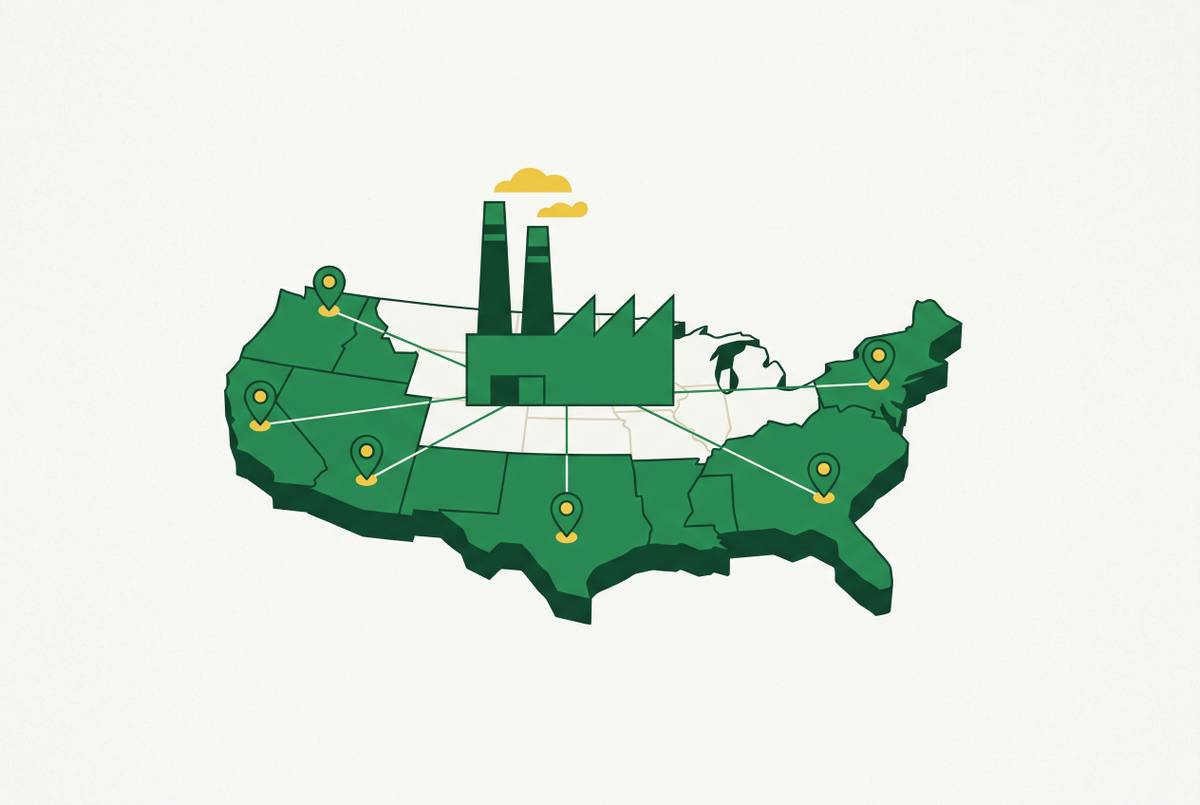
Most territory planning assumes the account that closed and the account that opened sit in roughly the same place. They don't: a rep in central Illinois absorbing the fallout from a plant closure in Freeburg gains nothing from a semiconductor fab breaking ground three states away. A rep in central Illinois absorbing the fallout from a plant closure in Freeburg gains nothing from a semiconductor fab breaking ground three states away. Reassigning the closed account's revenue to a neighboring rep does nothing to point anyone toward where the new demand is actually forming. Closures and reshoring break the map in two directions at once, and fixing only one side of that ledger leaves the new-demand side unmapped.
Why reassigning the closed account's revenue fails
Spreading a lost account's revenue across neighboring reps, or folding it into the regional target, feels like the responsible move. Spreading a lost account's revenue across neighboring reps, or folding it into the regional target, feels like the responsible move, but it solves nothing. The revenue still has to land somewhere, and assigning it by geography recreates the exact flaw that let the closure catch the territory plan off guard.
A closed plant is a signal, not an isolated event. The surrounding industrial fabric, sister plants, upstream suppliers, downstream customers, has already shifted, whether or not any of those names show up in the closure announcement. Reassigning revenue based on the old account's location assigns territory to where a plant used to sit, not to where remaining and emerging production actually concentrates now. Geography and headcount were never good stand-ins for manufacturing demand. A closure just exposes that flaw immediately instead of letting it fester quietly for another few quarters.
The multi-site reality makes this even harder to ignore. Plenty of closed plants belong to enterprises that didn't disappear, they relocated the work. When Hubbell closed its Wiegmann plant in Freeburg, Illinois, the operations didn't vanish, they moved to Aurora, Illinois and Juarez, Mexico. That vendor relationship isn't dead. It moved, and whoever gets there first with the right pitch inherits it.
Industry research has found that 58% of B2B sales organizations already consider their territory plans ineffective. A closure doesn't create that weakness, it just makes an existing crack impossible to ignore. The same research finds organizations with well-optimized territory plans report 10 to 20% greater sales productivity and 20% more revenue growth opportunity. What's needed instead of a reflexive reassignment is an audit built around what facilities in the territory actually produce today, not what the CRM says they produced last year.
The post-closure territory audit: what to map before reassigning anything
A CRM export can't do this work. CRM data reflects historical account activity, and a closure is exactly the moment that history goes stale fastest, sometimes overnight.
Four things need mapping at the facility level before a single account gets reassigned, and skipping any one of them means working off a partial picture. What actually closed comes first: the specific processes, products, and equipment involved, not just the employer's name. A coatings plant shutting down creates a completely different downstream purchasing gap than a valve-machining operation going dark, even if both hit the news the same week.
Where the operations went matters just as much. Closures frequently move production rather than erase it, as with Hubbell's shift to Aurora and Juarez. Those receiving plants are immediate, high-priority targets with known, specific needs, and they deserve the first calls, not the last.
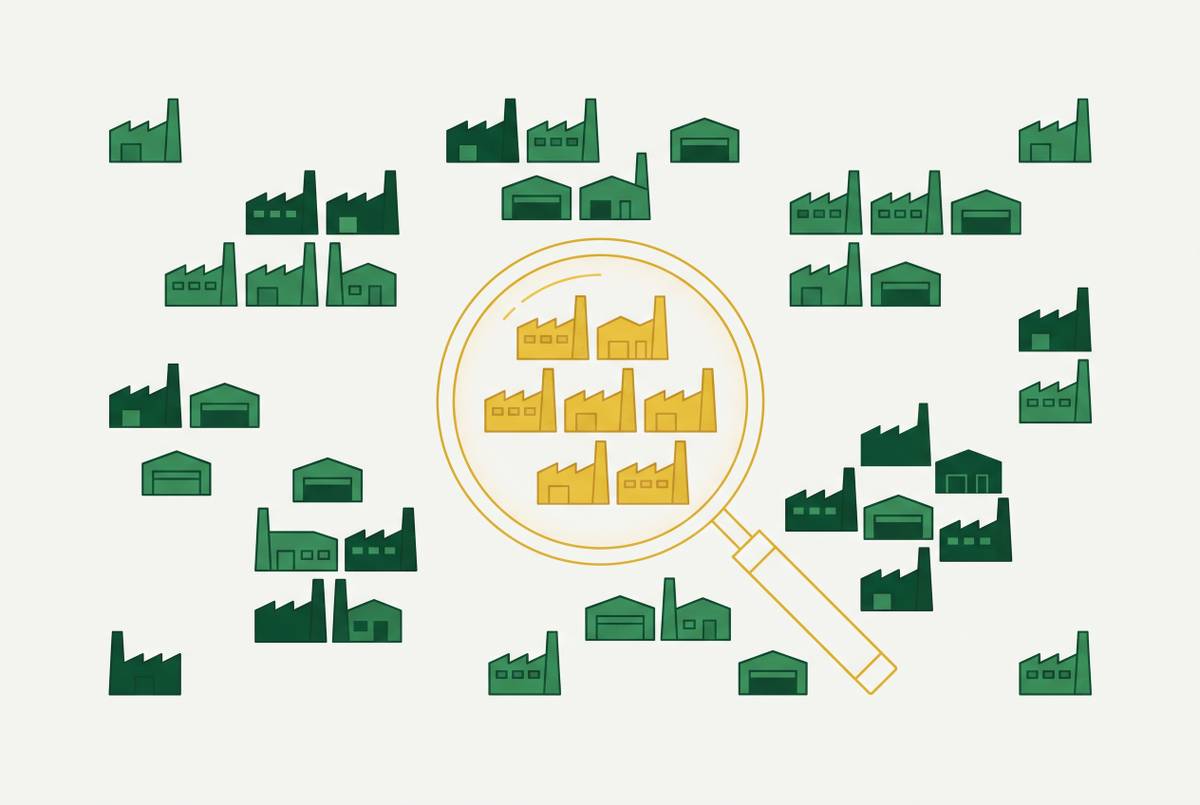
Third: what the surrounding industrial density looks like right now. That means geospatial data on the plants that remain, their process types, their production scale, not a NAICS code and a headcount guess. This tells a sales leader whether the remaining territory still has enough density to hit quota, or whether the boundary itself needs redrawing. Fourth, activity signals across the remaining accounts, new equipment installs, permit filings, production line expansions, tell a rep who to call first and why.
Effective territory planning depends on four data layers every plan needs: geospatial coverage, firmographic detail, intent signals, and documented competitive presence. After a closure, all four need rebuilding at the facility level, not patched. The output should be a ranked list of facilities, scored by revenue potential and fit against what the seller actually sells, not against a generic size-and-industry proxy sitting in a database nobody's updated since the last fiscal year.
Redistributing territory when industrial density has genuinely shifted
Territory boundaries should follow where manufacturing density actually sits, not where a line got drawn five years ago on a map that's since gone out of date. When a closure removes a major anchor account, the remaining density in that zone may no longer justify a full-time rep. Or it may have quietly shifted to a corridor the current rep has no efficient way to cover.
Industrial B2B teams generally run one of four territory models: geographic, vertical, account type, or product focus, and most mid-market and enterprise organizations blend two or more. A closure is the moment to ask whether the underlying model still fits, not five quarters later once the quota misses have piled up and nobody can pin down why.
Three scenarios recur, and each one demands its own specific fix rather than a blended compromise that tries to please everyone. When density remains but has scattered, realign around process type instead of geography: a rep fluent in metalworking fluids can cover a much wider radius profitably if every account in it shares that need, because shared production context does the work that proximity used to do. When density has migrated to an adjacent corridor, the boundary follows the plants, not the legacy rep assignment, even if that means an uncomfortable conversation between two reps who both think they earned that ground. When density has genuinely disappeared, the right move is consolidation, plain and simple: fold the territory down and push capacity toward the reshoring corridors picking up steam, instead of protecting a quota structure built on a plant count that no longer exists.
Sound territory management practice calls for regular rebalancing of workload and coverage, with periodic reviews of ICP fit, quota assumptions, and market conditions. A closure shouldn't wait for that cycle. It earns an out-of-cycle review the day the announcement lands, because any redistribution built on headcount or revenue-per-zip-code logic just recreates the structural flaw that made the closure so disruptive to begin with. The replacement data has to be production-level. There's no version of this that works otherwise.
Recovering lost volume through existing accounts and sister plants
Three paths exist for recovering the volume a closure took away, and they don't pay off on the same timeline, so they need to run in parallel rather than in sequence. Sister plants and enterprise transfers move fastest, and they should be worked first. When one plant in a multi-site manufacturer closes, its remaining facilities are the highest-probability targets in the entire territory: they already know the seller, some are absorbing the closed plant's production outright, and the vendor relationship already exists in some form. These come straight out of the audit.
Wallet share deepening at existing accounts comes next. A surviving plant absorbing transferred production suddenly has new purchasing needs across chemicals, fluids, coatings, and maintenance inputs, categories that didn't apply to that plant a month earlier. That's a cross-sell conversation the closure created directly, not one that happens despite it.
Greenfield reshoring accounts take the longest to close but carry the highest long-term value. These plants build supplier relationships from a blank page, and the seller who understands their process before a competitor calls has a real structural edge. Callproof.com's research on industrial buying behavior shows manufacturing buyers are conservative for good reason: a bad buying decision can shut down a line, void a warranty, or cause a safety incident, and once a vendor gets embedded, switching costs work heavily in that vendor's favor. The goal with a sister plant is simple: get embedded before competitors even realize the transfer happened.
The buying committee only gets more crowded from there. The average B2B purchase involves multiple stakeholders, and a plant taking on new equipment or product lines pulls in purchasing, engineering, operations, and maintenance simultaneously, each with a slightly different need. A single-contact sales motion doesn't survive that kind of complexity. Standard industrial sales practice recommends that the entry point scale with deal size, with smaller opportunities starting at the plant manager level and larger ones engaging operations directors or VPs. In a post-closure expansion, starting at the plant manager level and building operational credibility before escalating works better than going straight to the top, and it usually takes less time than reps expect. When a plant absorbs new materials or equipment, it's often running a different grade or spec of whatever the seller supplies already, which opens an upsell conversation grounded in what the plant needs now, not what it needed a year ago.
Production-level data that makes the difference in a post-closure rebalance
NAICS codes and headcount figures tell a sales team an industry and a rough size. They say nothing about what a plant actually makes, what equipment sits on its floor, or what it needs to buy to keep running. After a closure those approximations get even shakier, because the underlying industrial landscape has already moved out from under them before anyone updates the record.
Four things actually help here, and none of them is a NAICS code. Facility-level production profiles let reps see immediately which remaining plants have needs that line up with whatever the closed plant used to buy: a rep working from a profile that shows a plant runs continuous coating lines knows to lead with the coatings conversation, not a generic maintenance pitch. Equipment and process data flags purchasing needs for specialty chemicals, metalworking fluids, coatings, water treatment, and packaging inputs, without forcing a rep to reconstruct that picture by hand from old call notes. Activity signals, permit filings, equipment additions, mark the exact moment a plant is expanding or absorbing new work, which is the trigger point for a cross-sell call, not something to notice three months later. Multi-site enterprise mapping connects a closed plant to its sister facilities so a rep finds the surviving relationship before a competitor does.
Industry research on rep productivity shows sales reps already spend 70% or more of their working time on tasks that aren't selling. Asking that same rep to manually re-research an entire territory, plant by plant, right after a closure burns exactly the capacity the team can least afford to lose at the moment it most needs boots on the ground and phones ringing.