Matching Prospecting Tools to the Real Buying Roles Inside Metalworking Shops
Plant signals like expansions and certifications point to who to call.
For specialty chemistry and metalworking fluid prospecting, the useful tool is one that connects plant equipment, permits, and production changes to the people responsible for them. Matching prospecting tools to the real buying roles inside metalworking shops means finding the right technical, financial, compliance, purchasing, or operating conversation before seeking a contact.
Why a metalworking shop buying decision is never one person's call
Webster and Wind's buying center model identifies five roles in an industrial purchase, namely users, influencers, buyers, deciders, and gatekeepers. These roles describe who does what, and one job title may cover more than one role. A small manufacturer's owner may influence the specification, select the supplier, and approve the expenditure. A larger shop may split that work across departments. The committee's shape therefore changes with account size as well as purchase type.
For a specialty chemistry or fluid supplier, five groups usually share that work. The engineer or plant manager is the technical champion, while the owner or operations director is the economic buyer. Procurement staff handle purchasing and control who gets into the supplier-selection process. EHS and quality staff help decide matters of compliance, and operators, machinists, and maintenance technicians use the product. Each group has a different reason to support or reject a change.
Grewal and colleagues found that purchasing managers rarely decide on their own, without other stakeholders, and that purchasing groups are part of wider networks of relationships. The purchase order is not the whole decision. Ehret, Johnston and Ritter (2024) argue that buying centers are becoming buying ecosystems, with sustainability leads, public bodies, and AI tools taking active roles. Even within the shop's core group, reaching one person leaves other requirements unanswered. A rep who treats the shop as a single contact is structurally set up to lose.
What each role inside the shop actually needs before saying yes
The technical champion needs evidence that the product works under the plant's specific conditions, including alloy type, cutting speed, machine configuration, and surface finish requirement. Product claims alone cannot establish that fit. A fluid conversion can affect tool life, part cleanliness, machine availability, and worker-exposure controls at the same time. Specifications, test data, application notes, and a technical contact who responds to questions help the engineer judge those effects.
The economic buyer needs a business case built around total cost of ownership, payback period, and the operational risk of doing nothing. That comparison includes both supplier choices. The owner or operations director must weigh the risk of moving to a new supplier against the risk of staying with the current one. Labor availability and production volatility can make that judgment more acute when the shop is adding equipment or semi-automation. Without a connection to those operating pressures, a technical improvement remains an unproven use of budget.
Procurement needs clean pricing, reliable lead times, compliance documentation, and confirmation that the supplier is approved or can qualify. Access depends on passing that gate first. Procurement can remove a supplier from consideration before the technical champion sees the offer, so certifications and references serve an immediate purpose. Its responsibility for financial control and risk reduction also favors choices that are easy to defend. Warm, credentialed outreach addresses that concern more directly than an unsupported cold approach.
EHS and quality staff need to know what a chemistry change means for certifications, worker-exposure controls, regulatory compliance, and quality records. This is more than a documentation exercise. Regulatory action on formaldehyde and PFAS puts more at stake in the technical and compliance sides of fluid selection, so these roles have more say in the choice. Compliant chemistry paired with sump management and qualification support addresses the work a change creates for them. A presentation limited to product features leaves that work unresolved.
Floor-level users need proof of performance in conditions like theirs, together with training and support after the sale. Their evaluation continues after the first fill. Purmonen, Jaakkola and Terho (2023) give equal emphasis to purchase and usage in the B2B customer journey and describe reassessment at the end of usage as a possible start to another purchase cycle. Operators therefore need practical answers about handling, machine performance, and the help they can get.
Why NAICS and SIC codes cannot tell a rep which role to call or what that plant runs
Code-based targeting fails at two separate tasks in metalworking. It can misidentify which plants belong in a territory, and it cannot identify the right opening conversation even when the classification is correct. The first problem concerns production activity. The second concerns the people responsible for it.
SIC 354 can resolve to machine tool manufacturing, cutting tool manufacturing, welding equipment, or special die and fixture work. Each of those types of work needs different chemistry and has different buying centers. The U.S. NAICS system designates 332710 as the machine-shop category, but the equivalent SIC grouping mixes machine shops with car parts makers and measuring device manufacturers. A single code is therefore an uncertain production filter. It may also omit suppliers, distributors, warehouses, or adjacent manufacturers within the same supply chain.
Even when a plant record has the right classification, it leaves the application unknown. It does not reveal alloy type, machine configuration, production volume, or whether the site is expanding, converting a process, or winning a contract. Those gaps prevent a rep from distinguishing an opportunity for metalworking fluid from one for surface treatment, cleaning chemistry, or lubricant. They also leave the entry point unresolved. Knowing that a site is a machine shop does not establish whether its engineer, procurement manager, or owner has a reason to consider a supplier now.
What plant-level signals actually reveal about buying readiness and the right entry point
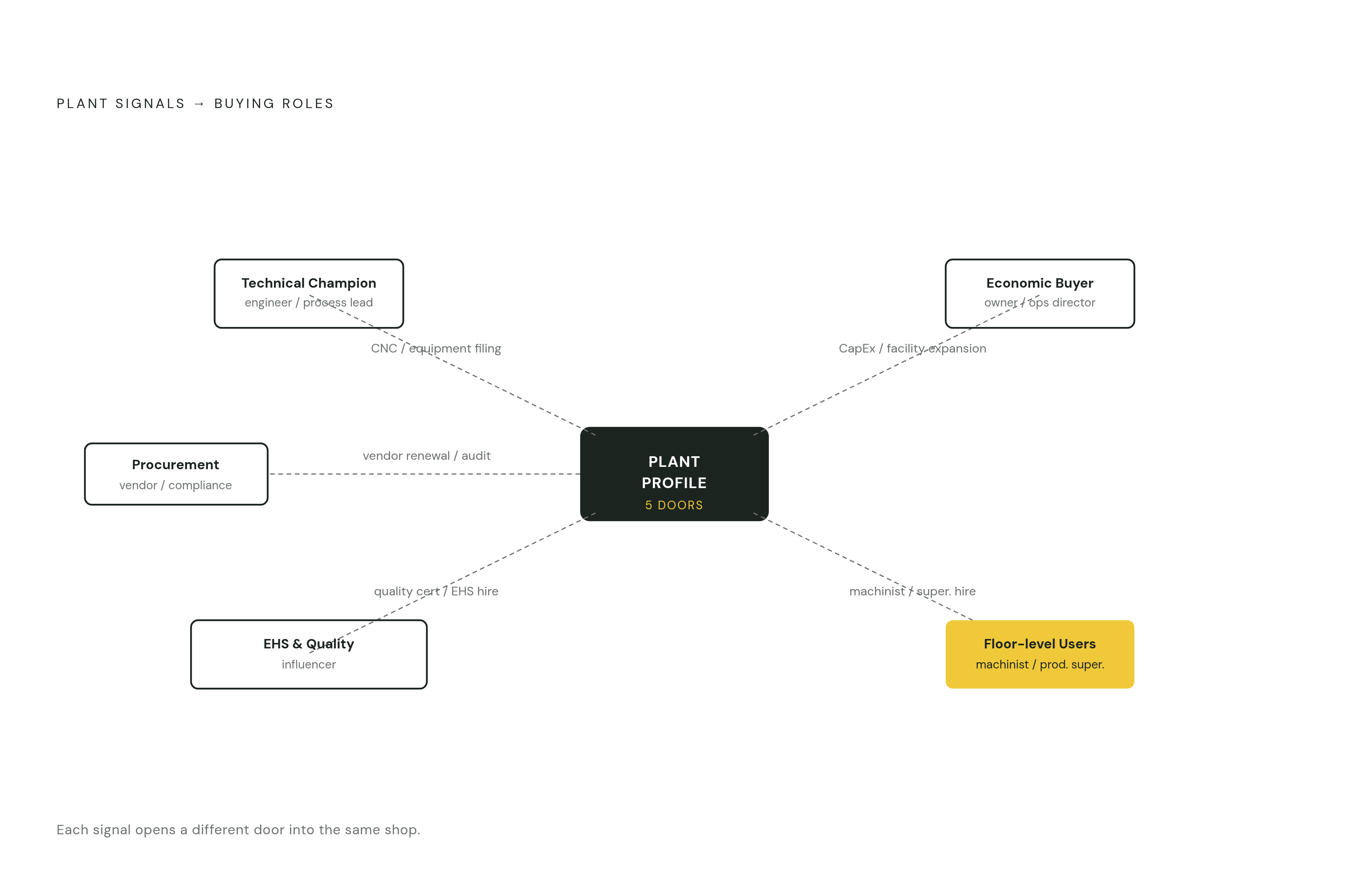
A facility expansion or new construction line indicates that capital expenditure authority is active. The owner or plant manager has made, or is making, a budget decision. That creates a financial entry point. The conversation should cover what the added capacity calls for in fluid management, supplier reliability, and production continuity. Unlike a broad indication of interest in a topic, the signal connects an observable plant change to a specific operating responsibility.
New equipment filings, including CNC additions and UCC liens on tooling, point toward the technical champion. The engineer or process lead is evaluating what the equipment will run and what the application requires. The conversation becomes specific to the machine. Alloy, cutting conditions, finish requirements, and chemistry fit are more useful subjects than a general product introduction. The equipment signal identifies both a possible requirement and the person equipped to assess it.
A new AS9100, IATF 16949, or ISO 13485 certification gives the quality role a distinct entry point. Compliance is now an explicit plant priority. A supplier with documentation, test data, and regulatory coverage can address the qualification requirements associated with that priority. For CNC and tooling suppliers, a shop winning aerospace subcontracts or registering a new quality certification can also support outreach about multi-axis milling equipment suited to high-temperature alloy machining. In that case, the same event opens a technical conversation as well as a quality conversation.
When a shop hires machinists or production supervisors, it signals a production ramp and draws attention to what people on the floor need. Fluid management, operator training, and sump service then need attention right away. A leadership change activates a different part of the buying group. A new operations director or plant manager resets the economic buyer relationship and creates an opening before new supplier loyalties form. Equipment, certifications, hiring, and leadership changes are useful because each points to a different responsibility, rather than treating the entire plant as equally ready for the same pitch.
How a prospecting tool built on plant profiles changes the rep's opening move
In a contact-led workflow, a rep calls the procurement manager with a catalog and leaves procurement to decide whether the offer deserves technical attention. The opening contains little application context. In a plant-led workflow, the rep knows that the shop added a 5-axis cell three months ago and contacts the process engineer with application data for the specific alloy the cell will run. The account scenario serves as a general illustration of the workflow. Its distinction is the sequence of discovery, with the production requirement identified before the contact is selected.
The relevant criteria include equipment visibility, permits, production activity, recent plant changes, and enough application detail to connect those facts to a supplier's portfolio. A contact record serves a different purpose. It helps reach a person, while the plant profile establishes why that person is relevant to the opportunity. For specialty chemistry and metalworking fluid prospecting, the useful distinction is therefore between finding a name and identifying a production requirement that the named person owns.
A CRM-only workflow leaves a different gap because its view of the production opportunity is limited to known accounts and recorded purchases. It cannot reveal an uncalled plant or establish that an existing customer runs three product lines the rep has never touched. Plant profiles make those gaps visible. Detail about alloy type, process step, and application also allows opportunity sizing in product-relevant units such as gallons, pounds, or units, rather than relying on company revenue or employee count. That is especially useful when an existing customer buys a lot from competing suppliers.
The stages in Alexander Group's ILAER model are Identify, Land, Adopt, Expand and Renew. Its guidance for chemicals and specialty materials links landing with a leading product to working with end users through adoption, expansion, and renewal. That supports the account-expansion logic. Visibility across a plant's lines gives the rep a basis for finding requirements beyond the initial purchase.
Matching the right signal to the right role — a working framework for metalworking reps
For the technical champion, the strongest opening signals include a new equipment filing, CNC or machining cell, quality certification, or production ramp involving a new alloy or part family. The conversation should address what the machine runs, what chemistry the process requires, and where current fluids or coatings create tool-life or finish problems. Specifications, test data, and application notes back up that discussion, and a sump audit or on-site trial is a practical next step.
For the economic buyer, facility expansion, new construction, CapEx filings, and a director-level leadership hire support a business-case opening. The focus is production continuity and cost. The discussion should connect the change to fluid management, supplier reliability, and risk reduction. Reference accounts at a similar scale and ROI anchors tied to uptime and scrap reduction give the owner or operations director evidence suited to a budget decision.
For procurement, approved-vendor list renewal, a new purchasing hire, a compliance audit cycle, or supplier consolidation activity creates a qualification-led opening. The first task is to lower the risk of choosing a supplier. Certifications, lead time reliability, pricing structure, and a complete documentation package belong at the start of the conversation. An approved-vendor package and references from the same end-use segment help procurement assess the supplier without first having to assemble missing credentials.
For EHS and quality influencers, a new quality certification, a regulatory filing involving fluid or chemical handling, or an EHS manager hire supports a compliance-led discussion. The opening should address PFAS and formaldehyde exposure controls, SDS documentation, and sump management protocols. Regulatory compliance data, worker-exposure records from similar installations, and qualification support documentation give this role the specific information it needs.
For floor-level users, machinist or production-supervisor hiring, a production ramp, high operator turnover, or training investment points toward practical performance and support. The machine provides the starting point for discussion. The conversation should explain product performance on that machine, changes in handling, and support after the first fill. Application notes, training materials, and a promise of on-site support link the proposed purchase to usage-stage adoption and repeat orders.
A rep who works all five entry points from the same plant profile is running a coordinated account motion.