Building a Sales Operations Tech Stack for Industrial and Manufacturing Sales
Plant-level data is essential to make manufacturing sales tools actually work.

An industrial and manufacturing sales operations stack needs more than a CRM, prospecting software, and automation. It needs intelligence that reflects what individual plants produce, operate, and buy. Building that stack means establishing facility-level data first, then using it to make coverage, outreach, account growth, and automated workflows commercially useful.
Why the standard B2B sales stack breaks when the customer is a manufacturer
A pump manufacturer’s CRM represented one global OEM as a single Chicago record. Plant-level enrichment revealed multiple facilities across several states, including two that were mid-expansion and invisible to the rep. The company record had hidden the opportunity. Although the corporate relationship appeared to be covered, the record did not show where production was expanding or where new supplier needs could emerge.
That gap begins with the buying unit. A corporate parent can operate dozens of plants, each with its own manager, budget, approved vendor list, and production line. Generic B2B stacks assume the company is the account, so their CRM records, territory assignments, and outreach lists inherit the wrong structure. Purchasing authority adds another layer of complexity. At most mid-market manufacturers, purchases above a certain capital expenditure threshold need a formal review by finance and compliance, a step that a generic deal stage does not show well.
How manufacturing's fragmented tech stack is already costing sales teams before they make a single call
Customer-facing teams lose an estimated 12–15 hours per week switching between systems and manually reconciling data that should already be unified. Reps spend time reconstructing the account instead of acting on it, while information needed for proactive communication remains scattered across systems.
The ERP may already hold the missing warning. A key account ordering significantly less over six months, credit holds indicating financial stress, and service tickets spiking on aging equipment all provide clues about retention risk. Yet those clues have little commercial value when the rep cannot access them. Forrester documents that a majority of B2B buyers report dissatisfaction with their chosen provider, driven in part by suppliers whose fragmented systems prevent proactive communication.
The architectural response is consolidation. Manufacturers moving in this direction are organizing around fewer core platforms, including ERP, CRM, and data, connected through an orchestration layer. The commercial purpose is to make information available where decisions happen. Adding another point solution without connecting those foundations leaves the reconciliation work with the sales team.
The CRM layer and what manufacturing accounts require beyond generic setup
A manufacturing CRM must distinguish the plant from its corporate parent. The required structure has a parent record for the group and child records for each plant or subsidiary, with activity and revenue rolled up. Hierarchy is the first test of fit. A team evaluating a vendor should ask for a three-level hierarchy in a live demonstration, rather than accept a slide that promises account relationships.
The records in that hierarchy need fields for manufacturing. These include plant-level firmographics, precise SIC and NAICS codes, equipment context, certifications, trigger events, and ERP and MES technographics. Here, technographics means more than detecting business software. Whether a facility runs SAP, Oracle, or NetSuite, which MES it uses, and whether it has adopted Industry 4.0 technologies define the integration surface for a proposed solution. Modern CRM features such as automatic activity logging, call summarization, deal scoring, and next-best-action prompts can also cut the work reps have to do by hand to keep records up to date.
Product selection follows those structural requirements. Salesforce Manufacturing Cloud is available from $275 per user per month, billed annually, while Microsoft Dynamics Sales Enterprise is $105 per user per month. HubSpot Sales Hub Professional costs $90 per seat per month, with a one-time onboarding fee on top. Its NetSuite integration is available on all HubSpot plans, but custom field mappings require a separate Data Hub subscription. SugarCRM suits mid-size manufacturers selling repeat business and markets a predictive module on higher tiers that reads ERP order data to identify reorder and cross-sell opportunities.
Plant-level intelligence as the data layer that determines whether every other tool works
A well-configured CRM can still hold commercially inadequate data. NAICS codes describe an industry category, but they do not establish what a plant actually makes, which equipment it operates, what it buys, or how much it produces. Category is not a substitute for production reality. A facility qualifies as a prospect when those production details support a credible application for the products being sold.
To show whether a plant is a good fit, plant-level intelligence needs production and equipment data along with its environmental footprint, certifications, and information on the ERP and MES it uses. It also shows what is happening now through hiring patterns, capital expenditure announcements, permit filings, and expansion activity. Together, these attributes support account scoring, cross-sell targeting, supplier qualification, and territory planning. Without them, each tool has to use broad proxies when a sales decision needs a specific fact about how a plant runs.
Existing enrichment does not necessarily close that gap. Generic enrichment appends company-level attributes, while plant-level intelligence profiles facilities individually rather than inferring their operations from an SIC code. A company category may establish broad relevance, but a facility profile can show whether the equipment, output, certifications, and current activity support a particular sales opportunity.
Territory planning built on manufacturing density rather than geography or gut feel
Territory design converts that facility intelligence into coverage. Geographic boundaries and alphabetical account assignments do not reliably reflect where relevant manufacturing activity concentrates. Headquarters locations are especially poor substitutes for purchasing locations. A parent with plants in three territories may have three purchasing authorities, yet a single corporate account assignment can leave two of those plants uncovered.
The appropriate model depends on the product and market. Geographic territories work for smaller teams that sell physical products in local markets, while vertical models match reps who know an industry with its specialized segments. Hybrid models use geographic coverage for smaller accounts and named-account focus for strategic ones. Plant-level data makes those choices meaningful because it shows where suitable facilities sit and what they operate. Geography still has a role, but territories that are balanced on a map can differ in how much commercial opportunity they offer.
That opportunity also moves as production locations change. BDO’s 2026 manufacturing predictions identify reshoring and supply chain regionalization as forces redrawing manufacturing density. Territory maps built even two years ago may no longer reflect where relevant accounts are. Up-to-date facility data helps teams change territory assignments as production moves, rather than keep them tied to an old view of the market.
Buying signals that manufacturing processes actually generate — and how to build them into the stack
Coverage establishes responsibility, but signals establish when to act. Traditional content-based intent data captures purchase research through blogs and misses industrial buying activity because buyers go to trade shows, call peers, and ask directly for specification sheets. Those actions escape standard intent capture. Manufacturing prospecting therefore needs observable events that relate to production capacity, purchasing authority, and approved spending.
Public signals include new facilities, equipment purchases, published RFPs, automation plans, increased capital expenditure budgets, new production lines, and changes in management or ownership. Each points to a different commercial opening. A new production line requires qualification of inputs and supplies, while automation and robotics plans indicate potential tooling, process chemical, and maintenance needs. Accounts showing two or more stacked signals close at more than twice the baseline win rate. A new facility combined with a capital expenditure increase and hiring for automation engineers provides a stronger reason to engage than an isolated event.
A second or third shift indicates demand outpacing capacity, while a program still in design creates an opportunity to become specified before suppliers compete at the RFQ stage. Routing must then reflect deal size. Smaller deals go to the plant manager, mid-range deals involve the operations director or VP, and larger deals above a significant threshold bring in corporate procurement. Facility-level resolution connects the event to the relevant contact instead of treating every signal as a reason to approach headquarters.
Account growth and cross-sell in manufacturing accounts that plant-level data makes visible
Corporate-level records rarely reveal everything individual plants operate, purchase, or lack, leaving expansion opportunities systematically underexplored. A known parent is not necessarily a developed account. Facility-level production, equipment, and certification data can reveal both relevant product lines a plant does not buy and other plants the relationship has not reached.
The ERP-CRM bridge makes that view commercially actionable. Plant-level order history shows when a customer starts buying less before it becomes churn, while service patterns can point to aging equipment and consumption trends can show related needs. This is more than a synchronization task. It connects the existing relationship to the operating conditions that explain where retention or expansion work is needed.
Chemical Management Services shows how this model works in process chemicals. On-site presence generates real-time usage data, making cross-sell and upsell systematic rather than dependent on an occasional account conversation. That presence also deepens a transactional relationship into a partnership with high switching costs. The broader principle does not require every supplier to adopt that service model. Knowing what a facility consumes and how it operates makes account development more precise than treating corporate revenue as evidence that the relationship is complete.
How agentic AI and the emerging industrial AI stack change what sales operations tools can do
Agentic AI makes the intelligence layer more consequential. Knowledge graphs, AI agents, and new integration standards are forming a layer above traditional ERP and CRM systems, shifting the stack beyond separate applications with separate views of the customer. Moving data alone is no longer sufficient. The commercial value depends on preserving enough context for a system to distinguish a plant’s condition from its parent company’s general profile.
MCP, or Model Context Protocol, servers open software platforms to AI agents. For sales operations, those agents can monitor conditions across systems, reason about exceptions, and execute multi-step workflows that previously required a rep to move between four screens. A team evaluating an “AI-ready” platform should test the context beneath its MCP server, rather than treat connectivity as proof that the agent can make sound account-level distinctions.
BDO’s predictions note accelerating private equity interest in mid-market manufacturers with solid data infrastructure but incomplete technology integration. That dynamic puts pressure on commercial teams at acquisition targets to demonstrate stack coherence before deals close.
How to sequence the stack build so each layer is functional before the next one is added
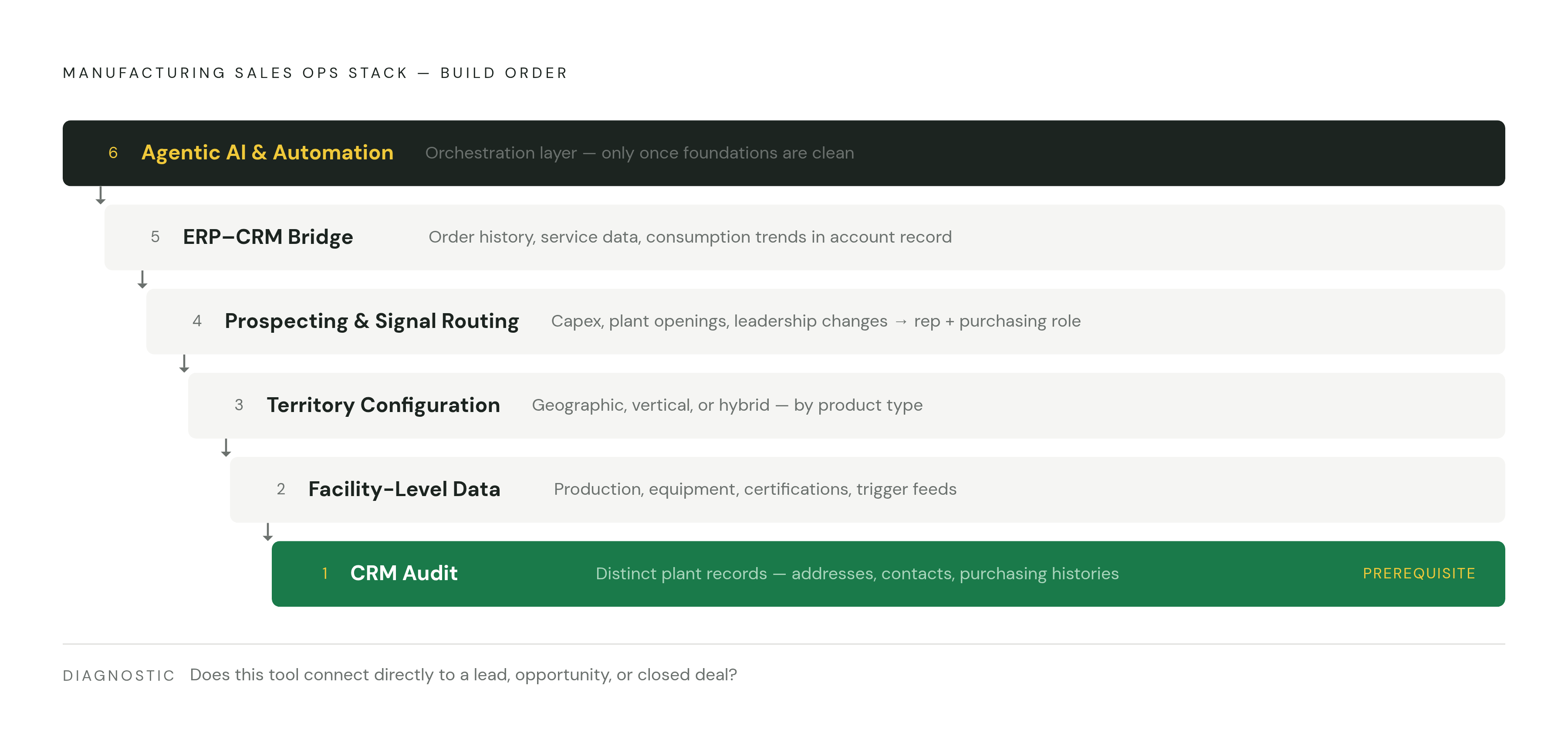
The build should start with an audit of how accounts are set up in the CRM. The audit first checks whether plants have distinct records with their own addresses, contacts, and purchasing histories. If they do not, the dependent tools lack a reliable foundation. The next step is to establish facility-level production data, equipment, certifications, and trigger feeds before configuring territory or prospecting tools.
Territory configuration can then use the enriched dataset. The choice among geographic, vertical, and hybrid coverage should follow product type and market structure. Prospecting follows with monitoring for the events most relevant to the vertical, including capital expenditure announcements, plant openings, or leadership changes. Those signals need routing to the right rep and purchasing role, with deal size informing the contact. This sequence connects a defined opportunity to an accountable seller.
The ERP-CRM bridge comes next in the build. Order history, service data, and consumption trends should reach the account record so managers can act on retention and expansion signals without leaving the CRM. Agentic AI and automation belong at the orchestration layer after those foundations are clean. For each layer, the diagnostic is whether the tool has a direct connection to a lead, an opportunity, or a closed deal. If that connection is absent, the tool is producing reports without an action.
Accurate facility data makes connected layers commercially useful. With that foundation, sales operations can move toward workflows that recognize a change at a plant, place it in the context of the relationship, and direct the next action to the seller equipped to pursue it.