How Facility-Process Classification Turns SIC and NAICS Codes Into Actionable Industrial Segments
Adding process-level detail to industry codes shows what each plant actually buys.
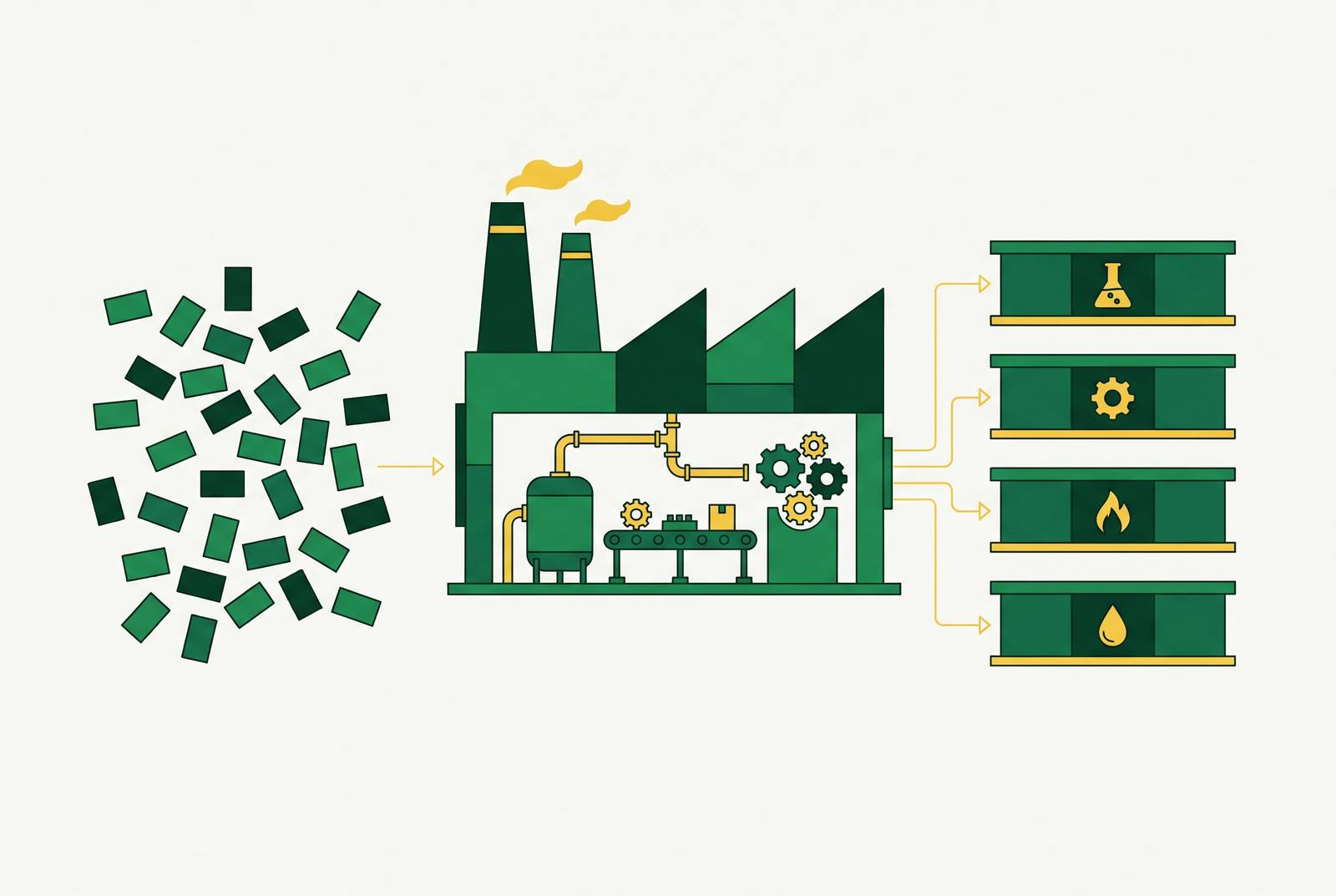
For specialty chemicals and metalworking fluid prospecting, useful account lists start with what each plant runs. Facility-process classification adds operations, chemistries, and equipment to SIC and NAICS records, turning broad categories into segments defined by operational fit. With those plant details, commercial teams can choose accounts, estimate addressable spend, and offer buyers a product that fits.
Why SIC and NAICS codes were built for statistical reporting, not for selling to plants
SIC and NAICS classify establishments for government statistical programs, economic benchmarking, and regulatory reporting, while commercial teams need to understand what those establishments buy. Both systems give an establishment a single code based on its main activity. That serves a reporting purpose. It does not identify every operation inside the site or the products required to run it. The mismatch starts when a commercial database takes a statistical label as enough proof of what a plant needs to buy.
SIC groups businesses by the final product they make, while NAICS groups them by their production process or how they deliver a service. That structural difference makes the systems partially incompatible, complicating records that mix them as though their categories were interchangeable. Their update schedules add another limitation. The official U.S. SIC structure has not been updated since 1987, while NAICS undergoes periodic revisions, with a 2027 revision cycle underway. Even after that revision, NAICS updates will remain periodic.
Connecticut’s 2025 industrial stormwater permit appendix maintains a parallel SIC-to-NAICS crosswalk, illustrating the need to interpret the systems together. Neither alone fully describes what happens on-site. For sellers, the resulting uncertainty concerns both which code is newer and whether either code identifies what a plant needs to buy.
What a single establishment code hides about the plant inside
Antelope Valley’s regulatory guidance formally distinguishes the Facility SIC from the Process SIC. The Facility SIC should show the facility’s main operation, while the Process SIC should match the process itself. The guidance gives the example of a military facility with Facility SIC 9711, National Security, where the hospital emission units have Process SIC 8062, General Medical and Surgical Hospital. The distinction is explicit in the reporting framework. An operation can exist inside a facility without appearing in the code that describes the facility as a whole.
Commercial databases frequently compress that distinction into one field. A large manufacturer may have a production facility, a distribution center, and a corporate office at separate locations, yet records may assign the parent company’s primary code to all of them. The locations are not commercially interchangeable. A supplier needs to know which site operates the relevant equipment. Without that detail, an account that seems to fit may lead a supplier to the wrong location.
NAICS 325, Chemical Manufacturing, includes both a commodity sulfuric acid plant and a high-margin specialty adhesive compounder, despite their different equipment, buying behavior, and product requirements. Even at 6-digit precision, NAICS describes what a plant makes in the aggregate. A plant’s reactors, dryers, granulators, or coating lines show whether a supplier has a reason to offer its products to the site.
How the SIC-to-NAICS crosswalk exposes the many processes hiding behind one old code
Connecticut’s appendix and the EPA’s proposed 2026 MSGP Appendix N document how SIC 2421, General Sawmills and Planing Mills, splits into at least five NAICS codes. Those destinations include 321113, Sawmills, and 321912, Cut Stock, Resawing Lumber, and Planing. The same legacy category also reaches other millwork, wood container and pallet manufacturing, and miscellaneous wood product manufacturing. One old label contains several distinct activities. A seller with only SIC 2421 cannot tell which of those activities led to the account’s code.
The split can also cross sector boundaries. The proposed appendix maps SIC 2671, Packaging Paper and Plastics Film, to both NAICS 322221, Coated and Laminated Packaging Paper and Plastics Film, and NAICS 326112, Plastics Packaging Film and Sheet. It places those activities in different regulatory sectors. This is more than a change in numbering. The crosswalk separates activities that the older system grouped together, exposing distinctions relevant to the operations a supplier needs to understand.
These examples reveal the limits of code conversion. Translating a legacy code into several possible modern codes creates a set of candidate activities. The splits are especially pronounced in plastics, metalworking, electronics, and specialty chemicals, where process variation strongly affects product fit. A crosswalk therefore exposes the ambiguity without resolving it at the site level.
What facility-process classification adds on top of codes
Facility-process classification assigns process-level descriptors to each plant independently of its primary SIC or NAICS code. The code identifies the establishment’s dominant activity, while the added descriptors identify the operations, chemistries, and equipment running inside it. The unit of analysis is the individual plant. Its record can therefore reflect several relevant processes without forcing them into one headline category.
Antelope Valley’s guidance provides a regulatory analogy for that separation. Its framework tracks the facility’s primary classification separately from the process classification of individual emission units. Commercial intelligence applies the same distinction to product fit. The purpose is not to turn prospecting into regulatory reporting, but to avoid losing operational detail when a whole facility receives one label.
In practice, a plant record might identify a pharmaceutical site’s wet granulation line, a food plant’s spray-drying tower, or a coatings plant’s solvent-recovery system. Each operation has its own bill of materials and supplier fit profile. That detail changes what the record can support. SIC and NAICS still help teams find a broad group of establishments, and process descriptors add the detail needed to judge each site.
Why process-defined segments produce better account fit than code-defined ones
A process-defined segment groups accounts by a shared operational requirement. A pharmaceutical compounder running wet granulation consumes binders, lubricants, disintegrants, and solvent-recovery chemicals, none of which NAICS 325412, Pharmaceutical Preparation Manufacturing, would identify on its own. The process identifies the relevant purchasing need. An account list built around that operation gives a supplier a more specific basis for qualification than a list of all establishments sharing the pharmaceutical code.
Specialty chemicals make the distinction particularly clear. The same molecule can serve cosmetics, food, and pharma applications, but those applications involve different value propositions, regulatory requirements, and decision-maker profiles. A code-defined segment can conflate those uses. Process classification separates them into addressable targets, allowing the account record to reflect why the chemistry fits a particular operation.
Code-based segmentation favors familiar accounts whose primary classification shows why they fit, but can miss plants where the operations that qualify them are secondary activities. A code-led CRM can consequently reinforce the boundaries of existing business. Process-classified records expose adjacent plants running the same relevant operations, including sites that have never been approached. The gain is not simply a longer list, but a different list whose members can be connected to an actual buying requirement.
How process classification enables plant-by-plant market sizing
Once a plant’s processes are known, addressable spend can be estimated by applying category-level consumption rates to plant size and operating profile. This produces a bottom-up estimate for each site. Adding the site estimates produces a total addressable market tied to identifiable operations. The estimate remains an estimate, but its basis is visible at the level where purchasing occurs.
Plant size supplies an important weighting factor. Giving every establishment that qualifies the same weight lets a low-spend site count as much as a high-spend site, whatever the operating profile of each. Process classification shows whether a plant has the operation in question, while size helps estimate how much it consumes. Both are needed for a useful baseline. Together, they reduce the distortion created when a dense population of small accounts appears more valuable than a smaller population of larger opportunities.
A supplier can distinguish how many plants running the relevant process are customers from how much those customers buy relative to estimated site consumption. Those are different measures of commercial penetration. A total based on codes needs that process context to show either relationship. Plant-level sizing gives sales planning and customer reviews a concrete basis for discussing both unserved sites and the share of demand captured within existing accounts.
Using process-classified segments to build territories and time account outreach
Territories built from process-classified plant density reflect where addressable spend is concentrated rather than where the most establishments are registered. An ideal customer profile built from NAICS code, plant size, and process classification filters plants by industry and shows whether their operations fit and how much they might consume. Net-new records drawn from those filters support coverage based on serviceable spend. Company count alone cannot provide that distinction.
A new production line, a permit for a new emission unit, or a capacity expansion can indicate changing product requirements, but the event alone does not identify the relevant chemistry. An expansion at a wet granulation site is a signal for binder and lubricant suppliers. The same event at a solvent-coating site points to different chemistry entirely.
Leadership changes provide a separate timing signal. A new plant manager arrives without inherited supplier relationships, creating an opening for re-engagement. The classification makes the approach concrete by giving the rep a basis for discussing what the plant runs. In this setting, outreach combines two distinct forms of evidence. The process establishes why the product fits, while the trigger helps explain why a conversation may be timely.
What commercial teams need to act on process-classified segments
Commercial teams need plant records that link specific processes to equipment, utilities, permits, and signs of changes in how the plant runs. Those details must remain attached to a geographic and firmographic anchor so that an opportunity belongs to an identifiable site. A headline code is not enough evidence. For specialty chemicals and metalworking fluid prospecting, the useful data criterion is whether the record supports a defensible product-to-plant match. A contact list alone does not supply that operational basis.
For sales operations, the practical step is enrichment that appends process descriptors to existing account records and exposes relevant plants that have never been engaged. Marketing teams can then refine segments based on an SIC range into campaign segments built around operational fit. Account managers need a corresponding change in behavior. Account managers should start by discussing the specific process, equipment, and compliance context that applies, rather than repeating a category pitch based on a 4-digit code. The data becomes useful when it changes the account action.
The account fit score should be based on evidence that reps can see, including the process descriptor, permit record, or equipment signal behind the recommendation. That evidence allows reps to explain why a site qualifies and gives buyers a reason to trust the relevance of the approach. It also separates a demonstrated operational match from a code match that still needs investigation. Facility-process classification becomes actionable when the commercial team can trace a proposed product, a target plant, and a sales conversation back to the same identifiable operation.