Selling Specialty Chemicals Into Food and Beverage Processing Plants
Success in this market requires selling to R&D first, not procurement.
Selling specialty chemicals into food and beverage processing plants means selling into a market that behaves nothing like general industrial chemicals, and the difference comes down to one word: function. Growth in this market tracks what a chemical does inside a formulation or a cleaning process, not how much of it moves through a distribution pipe. That distinction decides who wins the account.
Food and beverage processing is a distinct specialty chemical market, not a subset of general industrials
Food and beverage chemical demand is growing, and preservatives, enzymes, emulsifiers, and functional additives are taking a larger share of that growth as manufacturers move from basic preservation toward more complicated formulation work. Natural source additives already hold 32% of the additive segment in 2026, a share built almost entirely on clean-label reformulation, where plants are swapping commodity synthetic inputs for alternatives that cost more but do more. Two forces explain why this market runs on its own rules. The first is clean-label pressure, which keeps pushing plants to find and qualify substitute ingredients. The second is food safety regulation, which raises the bar every new supplier has to clear before a plant will even consider them. The FDA's Food Safety Modernization Act requires traceability and supplier verification systems that make switching suppliers expensive and slow, and that cost turns approved-supplier status into a real competitive advantage, one that a generic industrial sales motion has no way to account for.
How a chemical purchase moves through a food plant, and why most reps enter too late
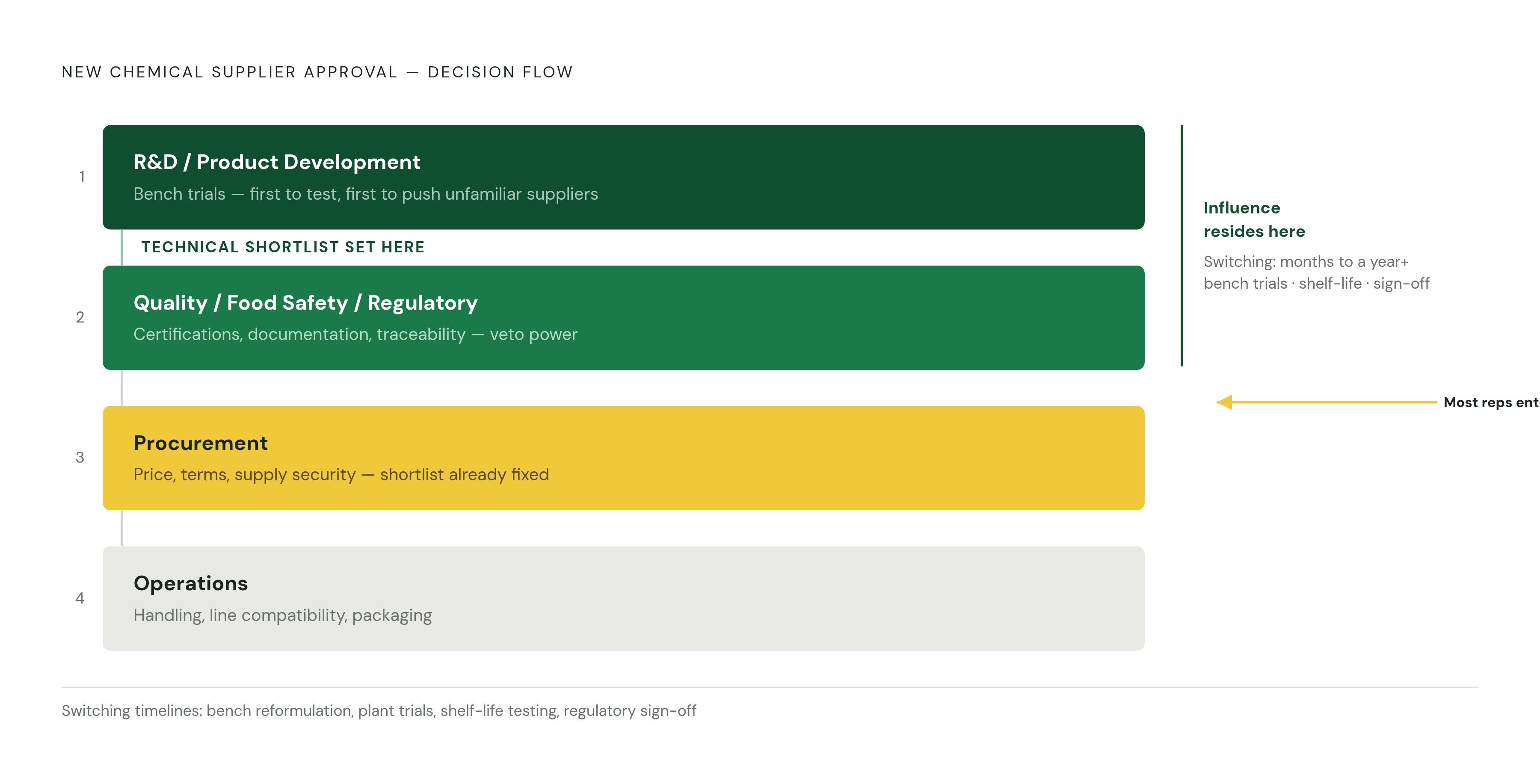
A chemical purchase in a food or beverage plant does not start with procurement, and most reps make contact at exactly the point the real decision has already been made. R&D and product development are usually the first people to test whether a new ingredient performs inside the actual formulation, and they are frequently the ones pushing an unfamiliar supplier name into the building in the first place, which makes them the highest-value contact for anyone trying to get in early. Quality, food safety, and regulatory staff sit downstream of that conversation but hold veto power over it: a chemical can perform beautifully on the bench and still get blocked for lacking the certifications, documentation, or traceability records the plant requires. Procurement enters the process focused on price, payment terms, and supply security, but by the time procurement is the primary point of contact, the technical shortlist has already been set, and a supplier who was not part of that earlier conversation has almost nothing left to compete for. Operations gets pulled in wherever handling, packaging, or line compatibility could slow the line down, which matters most for cleaning chemicals, processing aids, and lubricants. Consider a rep who calls on procurement at a beverage plant only to learn the formulation team ran bench trials with a competitor's emulsifier system two months earlier: the purchase order procurement eventually signs was functionally decided before the rep's first phone call. Switching an ingredient supplier can take several months or run past a year, depending on how central that ingredient is to the formulation, because bench reformulation, plant trials, shelf-life testing, and regulatory sign-off all have to clear before a new supplier gets written into the spec. So that qualification timeline protects whoever already holds the account, and it punishes anyone trying to break in after the reformulation project has already started.
What a plant makes determines which chemicals it needs, and NAICS codes cannot tell you that
The production process running inside a facility, not the industry category stamped on it, determines what chemicals that facility needs, and most sales teams are working from data that was never built to capture that distinction. A NAICS code sorts plants by industry category, so a plant making acidic beverages, a plant making dairy products, and a plant making shelf-stable sauces can all land under the same code, yet they need entirely different chemical programs. Headcount and revenue, the other firmographic data most sales teams default to, say nothing about process intensity, production volume, or how much chemical a plant actually consumes in a given month. Take breweries and beverage plants as a working example: they need alkaline CIP cleaners for organic soils, acid CIP cleaners to strip beer stone, QUAT sanitizers, dry-line lubricants, peroxyacetic acid, and iodine-based sanitizers, a bundle wide enough to sell as one coordinated package rather than negotiating each line item separately, but only if the rep already knows the plant makes beer. Dairy plants run CIP chemistry, and it looks nothing like what a baked goods plant needs. High-acid production environments call for different antimicrobial programs than low-acid ones do, and plants running wet processing need lubricants built for conditions a dry-goods facility never encounters. The fix is to map what a facility actually produces, down to the specific product line, connect that production reality to the chemistry it requires, and score accounts by chemical relevance and volume potential so the target list is ordered by who genuinely needs the chemistry on offer and how much of it they'd need.
The plant-level signals that predict chemical need before a rep makes contact
A handful of observable, publicly trackable signals at the plant level reliably point to which chemical categories a facility will be sourcing, and all of them are readable long before a rep picks up the phone.
What a plant makes at the product-line level, dairy versus baked goods versus beverages versus meat processing, maps almost directly onto its chemical needs: CIP chemistry, antimicrobials, processing aids, lubricants, and water treatment all shift with production type. If a plant makes acidic beverages, it needs acid-tolerant cleaning chemistry, and if it makes ready-to-eat products, it carries heavier antimicrobial requirements than a plant running dry goods.
Capital investment announcements are some of the clearest triggers available, and two from 2026 make the point concrete. In March 2026, The Coca-Cola Co. A major beverage company announced a $650 million investment in one of its dairy production facilities, an expansion of that size that will need new or expanded volumes of cleaning chemicals, conveyor lubricants, antimicrobials, and processing aids. Another major food manufacturer announced plans to expand production capacity at one of its processing facilities, another publicly trackable trigger that belongs in any territory plan. Capital investment of this kind means new equipment, new production lines, and a new supplier qualification cycle, and that window is exactly when approved-supplier status is most available to a seller who was not previously in the account.
A plant with visible clean-label commitments, whether that shows up in product launches, brand communications, or reformulation announcements, is actively working to replace synthetic additives with plant-based, fermentation-based, or enzyme-processed alternatives, which is a direct signal of near-term ingredient-sourcing activity.
Regulatory and certification status carries its own set of signals. FSMA traceability rules raise the documentation and supplier-verification burden on every plant, so if a facility is working through FSMA compliance, it is re-evaluating its supplier list at the same time, and that opens a door for suppliers who can meet that documentation bar. Organic, non-GMO, and kosher certifications at the plant level limit which chemical suppliers can even qualify, so if you know a plant's certification profile ahead of time, you skip dead-end conversations and go straight to where differentiated chemistry is actually required.
Equipment and process technology round out the picture. CIP system configuration, pasteurization type, and packaging technology each point to specific chemical needs, and a plant running HTST pasteurization needs a different cleaning chemistry program than one running UHT. Equipment age and upgrade cycles matter too, because a plant replacing aging equipment is a plant likely to be re-evaluating its chemical program at the same time, and new equipment tends to trigger a new supplier qualification process on its own.
The specialty chemical market's consolidation pattern is changing who wins access to food and beverage plants
The M&A activity reshaping specialty chemicals and ingredients in 2026 shows buyers, both strategic and financial, paying a premium for application expertise and regulatory depth rather than raw production capacity, and that is the clearest evidence available for what competitive differentiation actually means in this market. In the first half of 2026, food and beverage ingredients led specialty chemicals and ingredients M&A with 35 deals, with buyers concentrated on premium nutrition, natural flavors, and functional ingredients. Ingredion built its acquisition of Tate & Lyle around complementary specialty capabilities, innovation expertise, and portfolio synergies, not scale for its own sake. Ambienta built an independent natural flavors and ingredients platform, Nactarome, through a private-equity-backed buy-and-build strategy, and Nactarome kept expanding in natural flavors through further acquisitions. Both cases point to the same pattern: the competitive set is consolidating around differentiated technical capability, not volume. A claimed March 2025 partnership between DuPont and Kerry Group to co-develop clean-label texturants for plant-based foods, an announcement for which no credible evidence has been found, would nonetheless describe a broader and real pattern of large suppliers embedding themselves upstream in the R&D process, locking in preferred status before procurement ever enters the picture. Public market valuations back up the same story: ingredients and beauty-focused businesses including Novozymes, Givaudan, Symrise, Sensient, and Croda traded considerably above the overall peer median, confirming that the market pays up for differentiation and application depth over capacity alone.
Smaller and mid-sized specialty chemical sellers can't match that kind of consolidation on scale or R&D budget. They can compete on speed, technical agility, and plant-level specificity: they know exactly which facility needs what chemistry, and they reach the right conversation before a larger competitor has already embedded itself in that plant's R&D process. That is a narrower path than competing on catalog breadth, but it is a path smaller sellers can actually walk.
Why the Direct Sales Channel Dominates Food and Beverage Ingredient Buying
Direct B2B sales dominate specialty ingredient purchasing in food and beverage because buyers need technical proof before they'll approve a supplier, not because of channel habit. Direct B2B accounts for the majority of the specialty ingredients market precisely because manufacturers prefer technical engagement over ordering from a catalog, and that preference is a structural outcome of the qualification process described earlier, not an incidental one. Selling direct gives a technical sales team access to formulation chemists and QA managers, the people who actually drive the shortlist, but it narrows how much ground a rep can cover unless territory is built deliberately around where the right accounts sit. Food and beverage production clusters geographically by category: dairy processing concentrates in certain regions, beverage production in others, meat processing in others still. If a rep covers territory by zip code rather than by processing density, they end up carrying a mix of irrelevant accounts alongside the handful that actually matter. Territory planning built on real manufacturing density, knowing where plants sit, what they produce, and how much they run through their lines, lets a rep cover the highest-value accounts in a region without burning capacity on facilities that never touch the chemistry being sold. Manufacturers in this market also prefer end-market-specific distributors and regional partners with real technical depth over broadline distributors, so if you build a regional partner relationship on that same plant-level account knowledge, you can extend a rep's reach without giving up the technical engagement that makes direct selling work in the first place.
Growing existing food and beverage accounts by reading a plant's full chemical footprint
Most specialty chemical reps selling into food and beverage plants are capturing a single chemical category per account, even though the plant's own production processes are generating demand across several chemical families at once. That is where a rep can grow revenue fastest, inside accounts they already hold. A plant running CIP, antimicrobial treatment, lubrication, and water treatment is drawing on at least four distinct chemical families simultaneously, and a rep who won the account through CIP chemistry alone may have no visibility at all into the lubrication program running on the same floor. Reading a plant's full production footprint, not just the process a rep first sold into, shows exactly where those adjacent chemical needs sit, visible to the same plant-level intelligence that qualified the account in the first place, applied a second time to the business already on the books.