Recognizing Churn Risk in Manufacturing Accounts Before Renewal
Early warning signs hidden in transaction data predict churn months before accounts slip away.
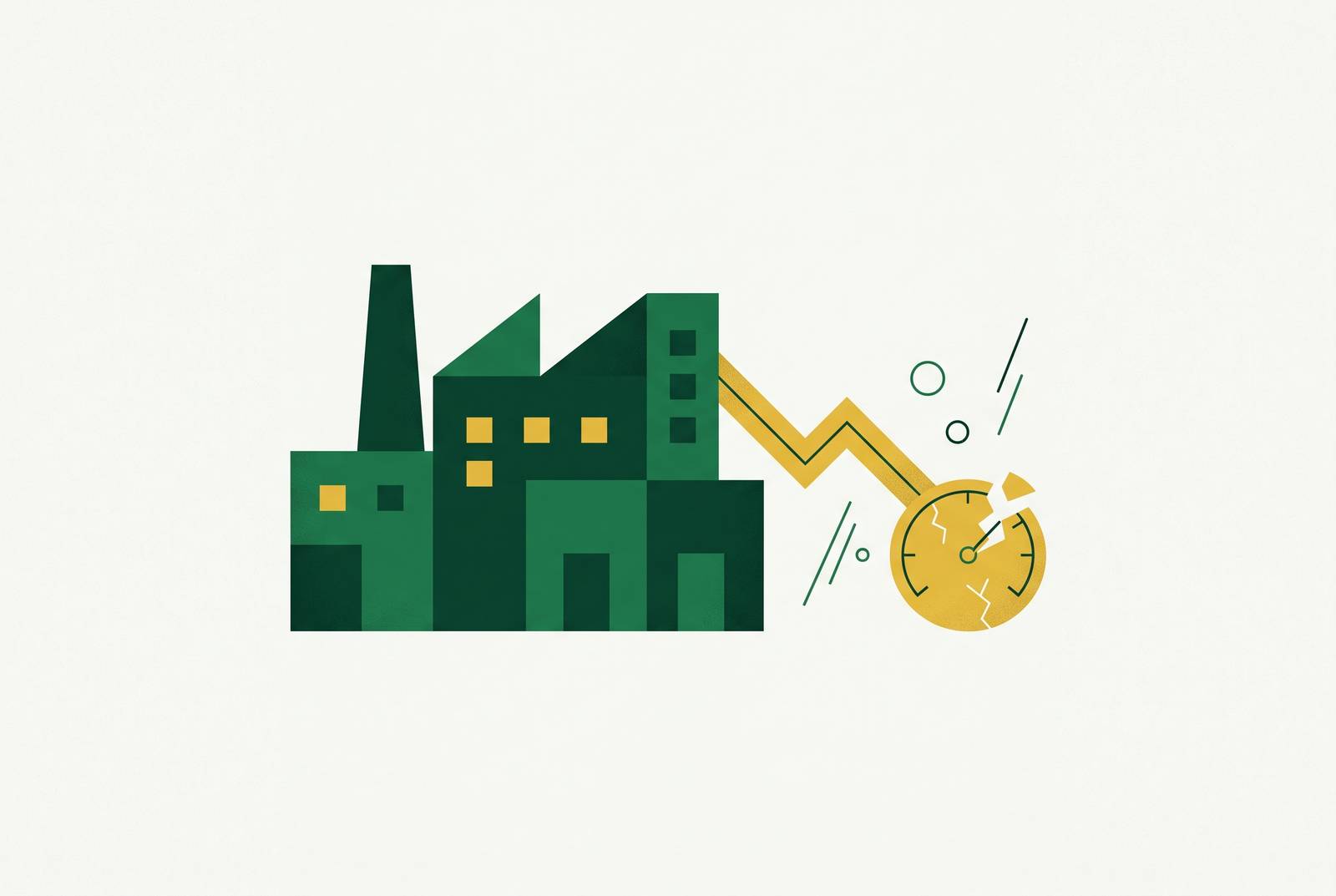
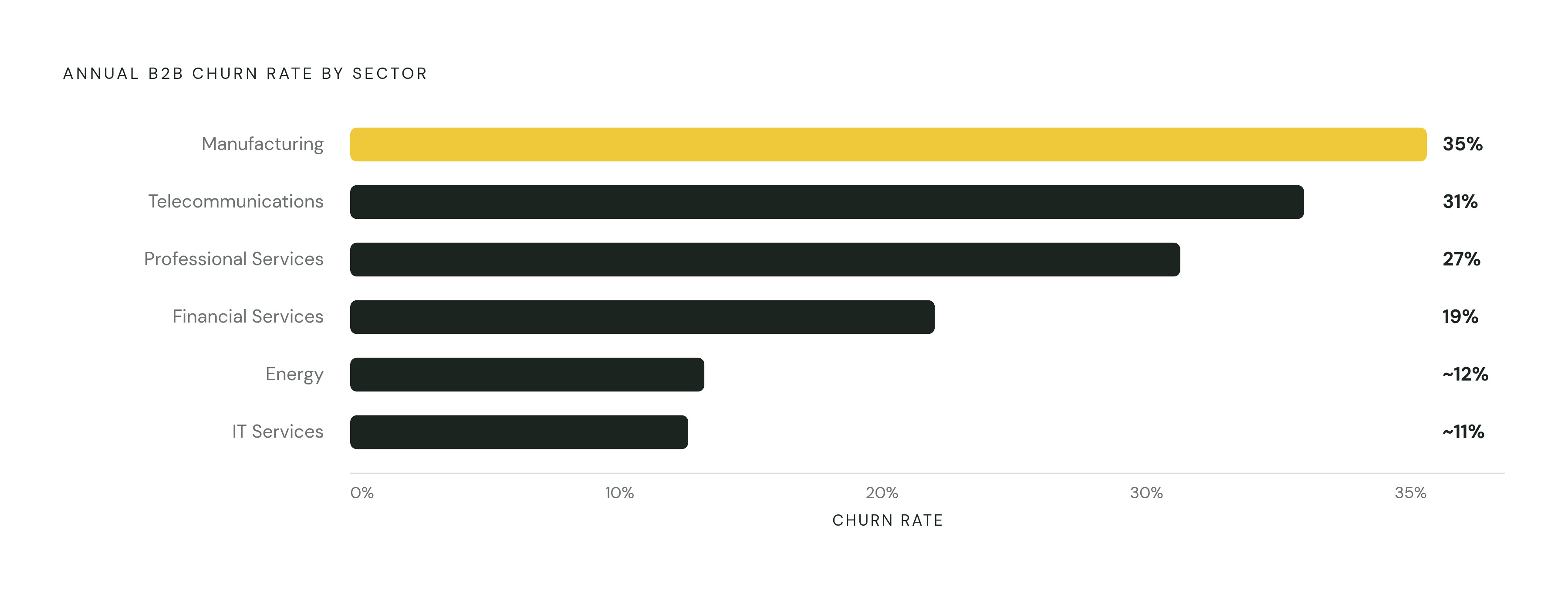
Manufacturing loses more than a third of its accounts every year, and almost none of that loss appears as a cancellation notice. It appears instead as an order that got a little smaller, a service ticket that never got opened, a plant manager who stopped returning calls three months before anyone in sales noticed. The annual churn rate in manufacturing is around 35%, well above telecommunications at 31%, professional services at 27%, and financial services at 19%. Energy and IT services both run in the 11 to 12% range, which makes the typical industrial sales team's churn rate, running well above those of adjacent B2B sectors, uncomfortable; much of that bleeding goes unnoticed until the account has already drifted.
The economics make this more than an efficiency problem. Replacing an industrial customer costs somewhere between five and twenty-five times more than keeping one, returning B2B customers spend 67% more than new ones, and a 5% improvement in retention can lift profits by 25 to 95%. Despite that math, 44% of B2B companies still put their money and attention on acquisition, while only 18% treat retention as a priority. That imbalance is the real subject of this piece: not that manufacturers don't value their customers, but that most of them are structurally blind to how those customers actually leave.
What makes manufacturing churn categorically different from subscription churn
A subscription customer churns with a click. A manufacturing customer churns with a fade, and the fade can run for years before it resolves into a lost account. Purchasing activity declines a little at a time, a service contract lapses and doesn't get renewed, a competitor gets a foothold on one line of a plant, and none of it requires a phone call to your account manager announcing the relationship is over. By the time the revenue drop is visible in a CRM report or a quarterly business review, the erosion producing it has usually been happening for a long stretch already, driven by a service contract that lapsed and went unrenewed or a competitor that gained a foothold on one line of a plant.
Churn also isn't smooth across the calendar. It clusters around renewal windows, which cuts two ways: there's more runway to catch it coming, but the risk is concentrated into a narrow period when it does arrive. Voluntary churn spikes 29% during year-end budget cycles, which makes the fourth quarter the highest-risk stretch of the year for any account tied to an annual procurement calendar. That has a direct operational implication. Retention work started in September, before budget decisions start locking into place, sits in a categorically different position than the same work started in November, after the decisions have effectively already been made.
None of this is visible in the metrics most sales teams watch day to day. Call logs, last-touch dates, open opportunity counts, all of that can look perfectly healthy on an account whose purchasing volume has quietly dropped by a third over two years. The activity metric and the health of the relationship have stopped tracking each other, and nobody built an alert for that divergence.
Why CRM alone cannot detect a drifting manufacturing account
CRM systems were designed to manage the front half of the sales motion. They log contacts, track pipeline stages, record activities, and mark deals won or lost. That's what they're good at, and it's not a criticism to say they weren't built for anything else.
The data that would actually predict churn lives somewhere else. Purchasing frequency trends sit in ERP transaction records. Parts consumption relative to installed equipment sits in field service and warranty databases. Renewal timelines and distribution patterns sit with distributor partners who may not report into the vendor's systems. None of it is CRM data, and none of it gets pulled into the account review unless someone goes looking for it specifically.
Data quality compounds the problem. The average B2B database decays at roughly 30%, meaning close to a third of contact records are wrong, stale, or missing key fields at any given moment. In industrial markets, where the total addressable market for a given product category might only run into the hundreds or low thousands of facilities, a bad contact record isn't a minor nuisance, it's a blind spot on an account that may represent a meaningful share of the pipeline. NPS scores and satisfaction surveys are lagging indicators by design, reporting on sentiment that already happened, so they don't fix this. They're lagging indicators by design, reporting on sentiment that already happened. They tell a sales team what went wrong well after the point where anyone could have acted on it.
The plant-level signals that accumulate before an account churns
Manufacturing purchases get triggered by operational events, not by a marketing campaign or a renewal reminder. A plant orders more specialty chemical when a line runs more shifts, not because a rep sent a good email. Churn follows the same logic in reverse: it's triggered by operational shifts inside the plant, not by a customer waking up one day dissatisfied. Reading those shifts, rather than waiting for a satisfaction score to catch up to them, is the entire game.
Purchasing and consumption patterns are the first place to look. A decline in order frequency or volume for consumables like specialty chemicals, metalworking fluids, or lubricants, measured against what's known about the facility's production capacity, is about as direct a warning sign as exists in industrial accounts. A plant that's still running the same output but ordering less of a given input has done one of two things: found an alternative supplier, or changed the process so it no longer needs as much of the product. Either way, that's invisible in a CRM record and only readable when transaction data gets layered against a facility's actual production profile.
Equipment and operational lifecycle events form a second category. Maintenance intervals, warranty expirations, and equipment upgrade cycles are all moments when a supplier relationship goes back up for review, whether or not the incumbent knows it. A plant entering an upgrade cycle with no account rep involved in that conversation is a plant where the incumbent relationship is already exposed. This matters more now than it used to: industrial equipment upgrade cycles continue to accelerate, and every one of those installations forces a downstream review of consumables, technology, and supplier fit around it.
Facility-level operational change is the third category, and probably the least monitored. A new production line or a new contract win changes what a plant makes, which changes what it needs, and a supplier whose product mix doesn't track that shift becomes gradually less relevant without ever being formally dropped. A facility expansion or a new plant opening forces standardization decisions that reopen the supplier conversation well before the facility is even running. A new compliance deadline resets the evaluation criteria entirely, and an incumbent who hasn't repositioned proactively against the new requirement is exposed the moment a competitor does.
How the buying committee structure in manufacturing makes churn detection harder
A single industrial purchase can involve a wide range of stakeholders, including an engineer, a procurement officer, an operations manager, a maintenance lead, a CFO, and sometimes a dedicated compliance officer. A $500,000 equipment purchase typically pulls in 5 to 11 people across procurement, operations, engineering, finance, and safety. Only 7% of industrial manufacturing sales happen through digital channels, which underscores just how relational these decisions still are, and how much of the real signal lives in conversations that never touch a CRM field.
Churn risk in this environment is often specific to one stakeholder rather than uniform across the account. An account can look completely retained at the corporate procurement level while a plant manager quietly shifts volume to a local supplier relationship that never appears on a national contract. The reverse happens just as often: a plant manager is perfectly happy, while a newly hired VP of Operations is reviewing the entire supplier portfolio from the top down, with no knowledge of or loyalty to the existing relationship. Tracking only the primary contact, which is what most CRMs default to, misses both failure modes completely.
A plant manager cares about uptime, ease of use, and operational efficiency day to day, while other stakeholders read entirely different signals. A plant manager cares about uptime, ease of use, and operational efficiency day to day. A VP of Supply Chain is watching disruption risk, reliability, and contract terms. A CIO or digital transformation lead is evaluating integration with MES and ERP systems and data compatibility. A CFO is tracking total cost and price trend, largely independent of how anyone on the plant floor feels about the product. An account team monitoring only one of these lenses is, by definition, blind to risk building in the other three.
Building an early-warning system using facility-level data rather than lagging account metrics
The starting point is data that already exists inside the organization but has never been wired together: ERP transaction records, field service logs, and purchasing frequency data, all set alongside the CRM. It's connecting data that already exists inside the organization but has never been wired together: ERP transaction records, field service logs, and purchasing frequency data, all set alongside the CRM account record instead of living apart from it. Leading organizations are already doing this, combining CRM, ERP, and operations data into a single forecasting model so that a plant manager's service history and a procurement team's contract terms inform the same account view instead of two disconnected ones.
A practical signal stack, at the facility level, has a few core components. Purchase frequency trend measured against known production capacity catches substitution or lost process relevance directly, since declining orders against stable or rising output has only a couple of honest explanations. Service and support engagement is a second layer: a facility that stops opening tickets or requesting technical help isn't necessarily satisfied, it's disengaging, and those two states look identical on a satisfaction survey but very different in what happens next. Stakeholder map health is a third, tracking whether a champion has left the account or a new decision-maker has arrived with no existing relationship with the vendor. Operational event monitoring rounds it out: facility expansions, new equipment installations, leadership changes, and compliance deadlines, flagged as they happen rather than discovered after a competitor has already responded to them.
None of this works off approximated data. Facility-level intelligence that indexes plants by what they actually manufacture, what equipment runs on the floor, and what production signals they emit gives a sales team something to build on that a NAICS code and an estimated headcount never could. The comparison is between guessing at a facility's profile and knowing it.
What intervention looks like when signals are caught early enough to act on
The window between a first warning sign and a formal supplier evaluation is the only window where intervention costs less than replacement. Catching a signal 90 days out from a renewal decision puts a sales team in a fundamentally different position than catching the same signal 10 days out, and what separates the two isn't really time on the calendar. It's about whether the account is still in a stage where a conversation can change the outcome, or whether the decision has effectively already been made and the conversation is just a formality.
The response has to match the specific signal, not default to a generic check-in call. Declining consumption at a facility calls for a proactive technical review: has the process changed in a way the account team missed, and is the product still matched to what the line is actually doing now? A new plant manager or VP of Operations calls for direct reintroduction at the plant level, ideally before that person formalizes a supplier review of their own. An announced facility expansion is an invitation to get involved as a partner in the new line design, not to wait around hoping to be carried over as the incumbent. A champion's departure means finding and building a relationship with the replacement immediately, before a competitor gets there first.
The installed base is where all of this points. Every piece of equipment in the field, every active process, every consumable relationship is both a retention anchor and an upsell opportunity, and treating those as two separate motions misses the point. A rep who is actively mapping what a plant makes today and what it's likely to need next isn't choosing between defending the account and growing it. The same facility-level intelligence does both jobs at once, because in manufacturing, retention and growth were never really separate problems to begin with.