Industrial Sales Outreach Timing Aligned to Manufacturing Plant Cycles
Early entry during plant planning cycles—not sales cadences—determines vendor qualification odds.

Industrial sales outreach timing depends on where a manufacturing facility sits in its operational cycle. Turnarounds, CapEx approvals, line expansions, and regulatory deadlines create procurement windows with firm limits. Teams that spot those windows and arrive before scope freezes can help shape specifications and the choice of supplier. Teams that arrive later cannot make up the difference with outreach volume.
Why plant operational cycles, not sales cadences, govern when manufacturers actually buy
Sales teams often organize timing around cadence, seasonality, and quota pressure. Manufacturers organize purchases around the work a plant must complete and the capital approved to support it. A plant that has not scheduled a turnaround is not in the market for turnaround-related materials, however persuasive the message. The gap is a mismatch between the seller’s schedule and the buyer’s operational need.
That mismatch explains why volume-first campaigns underperform against industrial accounts. They treat demand as continuous when the opportunity is bounded by an event. Plant managers, procurement leads, maintenance engineers, and OEM purchasers look at whether a supplier understands their process before they look at price. An outreach program built around the rep’s urgency therefore weakens the case it is trying to make.
How a turnaround planning cycle creates four distinct procurement tiers — and where most sellers enter too late
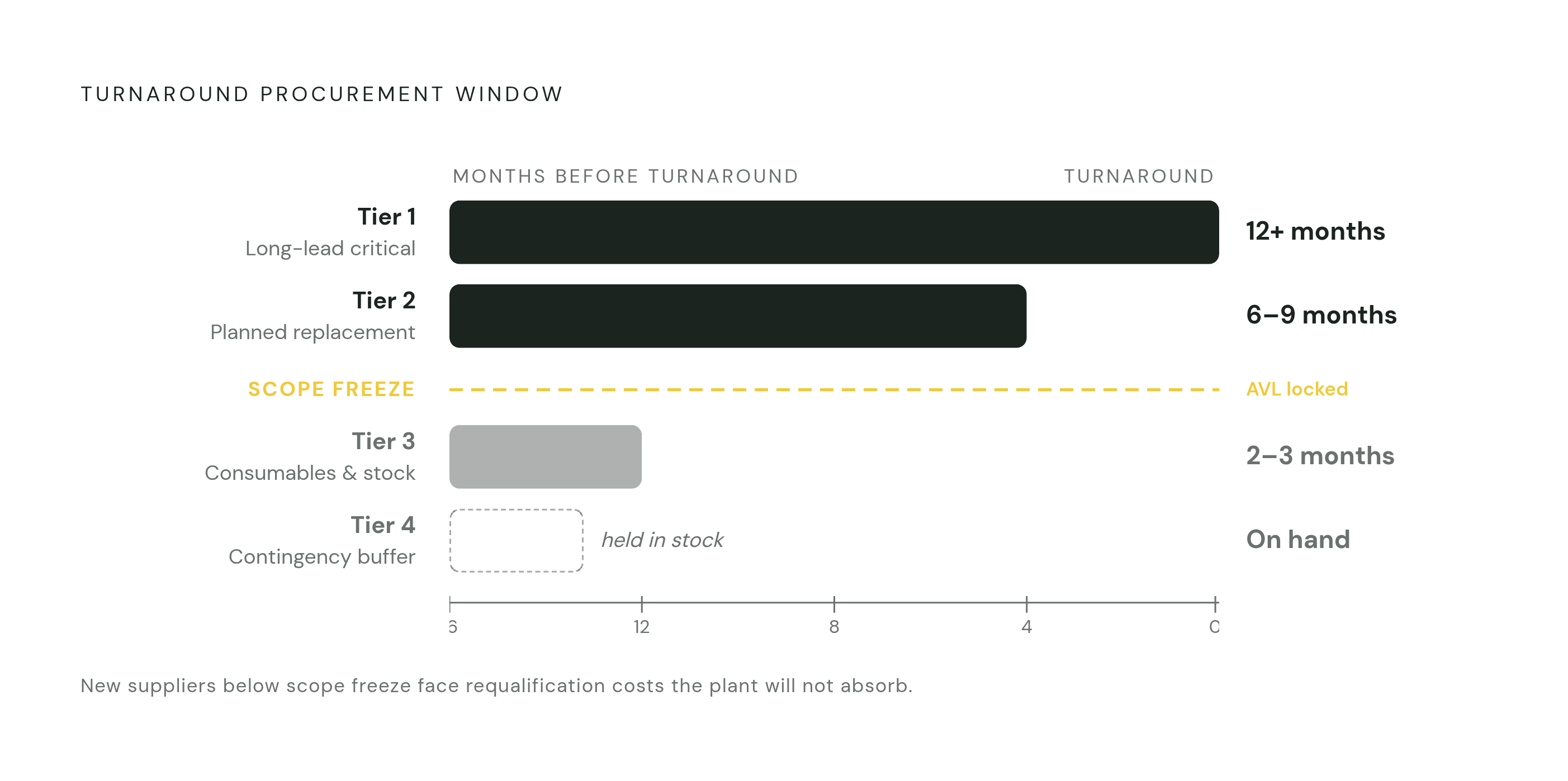
Texas refinery turnarounds provide a concrete example of this structure. Their four-to-six-year cycles anchor the largest concentration of energy-sector procurement activity, but the shutdown itself is only the visible endpoint of a much longer planning process. Planning for a major turnaround commonly begins well over a year before work stops, with timing shaped by plant complexity and scope. Procurement then moves through four tiers, each with its own lead time. A seller must identify the tier relevant to its product.
Tier 1 covers long-lead critical parts required more than a year out. Tier 2 covers planned replacement parts required six to nine months out. Tier 3 covers consumables and standard stock required two to three months out. Tier 4 is the contingency buffer held in stock for high-consequence emergency needs. These tiers distinguish planned commitments from emergency provision, so a later material requirement does not necessarily mean a later opportunity for a new supplier to qualify.
The controlling deadline is scope freeze. Plants completing turnarounds within scope and schedule define that date well in advance, making it the practical cutoff for vendor influence. After scope freeze, the approved vendor list is set and the product specification is locked. A new supplier then faces requalification costs the plant will not absorb mid-cycle. By the time a turnaround is announced, outreach has likely missed the qualification window, even if the shutdown still seems far off.
The other plant-level events that create procurement windows beyond turnarounds
Facilities do not need a periodic shutdown to have predictable procurement windows. CapEx approvals, production line expansions, and regulatory deadlines create their own sequences of commitment and qualification. When a manufacturer increases CapEx year-over-year, it has moved from discussing the spending to committing board-approved capital. That financial commitment is a stronger forward indicator of procurement than browsing behavior. The seller’s task is to connect it to the facility and process where spending will occur.
The 2026 CapEx environment makes that task especially important. Reshoring, the energy transition, IRA manufacturing credits, CHIPS Act buildout, and supply chain resilience investment are collectively unlocking long-postponed spending across U.S. manufacturing. This creates an unusually wide procurement window, but it also compresses competitive response time as vendors pursue the same expansion signals. A production line addition changes the plant’s needs before the line becomes operational, including chemistry qualifications, equipment procurement, and maintenance supply relationships. Regulatory deadlines impose a different constraint, because environmental compliance timelines, permit renewals, and emissions regulations make the purchase schedule mandatory.
Public announcements can also show changes in ties with suppliers before an RFP opens. Oemeta Chemische Werke GmbH's July 2026 MOU with Bharat Petroleum Corporation Limited for strategic cooperation in metalworking fluids and industrial manufacturing solutions in India illustrates a forward-looking signal of competitive displacement opportunities at regional plant accounts. Americo Chemical Products' November 2025 acquisition of Fusion Chemical broadened its metalworking fluids, Hybrid-Cool technology, and high-performance lubricant portfolio. That acquisition signals both a new competitive entrant at shared accounts and a requalification opportunity at plants previously tied to the acquired supplier’s narrower range. These events give sellers a reason to investigate affected facilities, but their value depends on detecting them early through public filings, permit applications, job postings, and capital announcements.
Why a 130-day sales cycle makes early detection mandatory, not optional
The average manufacturing sales cycle takes about 130 days from initial contact to close. That time spans four stages, which are initial contact, proposal, negotiation, and closing, with the proposal stage taking the largest share. With that much time needed, even a procurement event several months away can leave a new vendor little time to work through the sales process. The relevant calculation is whether qualification and commercial evaluation can finish before the plant commits.
The full buying journey starts earlier still. Dentsu found that the average time from initial research to a closed deal in B2B manufacturing has risen materially since 2021. Internal research can precede vendor contact by a substantial period, so the first cold email may reach a plant that already has a shortlist, a specification document, and an internal timeline. As more people join the buying committee and take part in the decision, the process takes more time. Contact with one person is therefore not the same as entry into the buying process.
This distinction is especially acute for specialty chemicals and metalworking fluids. The product can be qualified or disqualified before a commercial conversation begins, placing qualification upstream of selling. A rep who has not reached the shortlist in the early months of an extended cycle is outside the conversation that shapes the purchase.
How HQ-level account data causes teams to miss the plant-level events that trigger buying
Detecting that window requires the right unit of analysis. One company in a CRM can represent many plants with different processes, equipment, and operating schedules. For a capital-equipment or specialty-chemical seller, a parent firm with eight facilities becomes eight accounts. Enriching only the corporate address leaves individual plant events undetected and can route opportunities to the wrong territory. The missed expansion is then a consequence of the account structure.
Broad NAICS codes and headcounts do not establish what a facility makes, what equipment it runs, or which operational stage it has reached. A plant within a broad classification may not use the process that requires the seller’s product. Sub-code, production model, and equipment generation make that distinction possible. Topic-based intent data is also limited by manufacturing buyers’ use of trade shows, peer calls, and direct spec-sheet requests and their limited reliance on B2B blog content. Public filings, permit applications, and job postings provide more reliable evidence of an operational buying event.
Framework pricing agreements and approved vendor lists are usually negotiated centrally, so work with the plant and HQ must happen at the same time. Without facility signals, sellers reach those negotiations with no account-level leverage. Keeping that intelligence useful requires quarterly updates to plant firmographics and monthly, or at minimum quarterly, updates to contacts. Longer refresh intervals leave line additions, new shifts, and leadership changes invisible until the window has closed, making bad data a cost in missed opportunities as well as wasted research time.
Signal stacking to identify accounts in an active procurement window right now
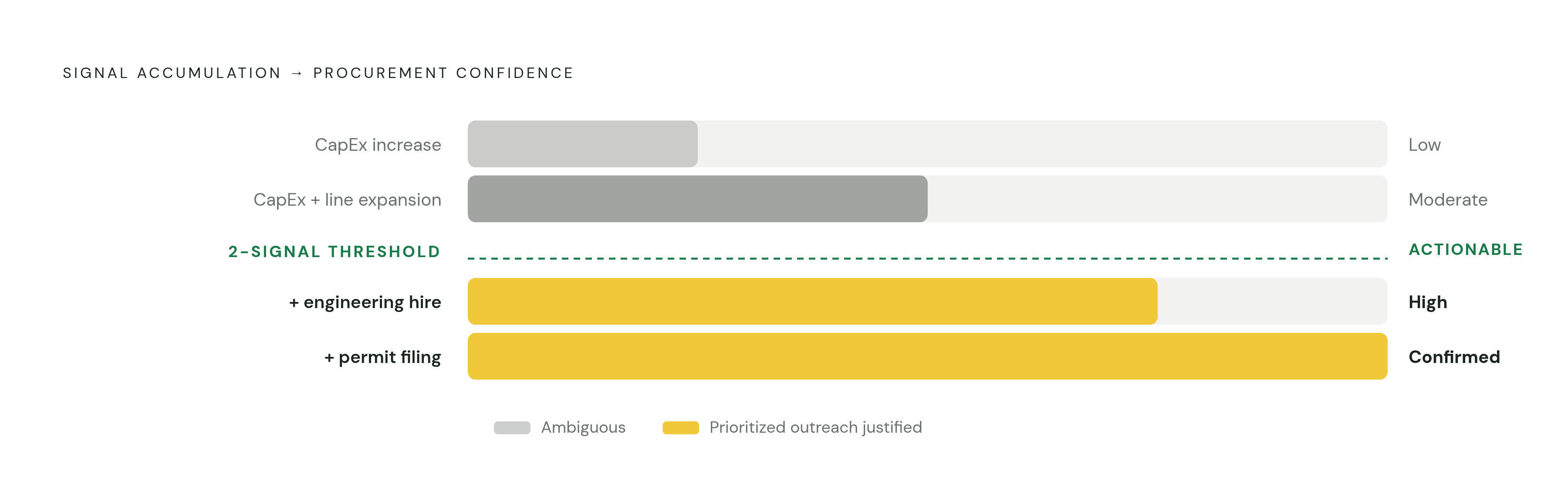
A single signal can be ambiguous, so prioritization should depend on multiple independent indicators at the same facility. Signal stacking connects evidence such as a CapEx increase, a line expansion announcement, an automation engineering hire, and a permit filing. Two or more concurrent signals indicate an active or imminent procurement window with enough specificity to justify prioritized outreach. Accounts with stacked signals close at materially higher rates than single-signal accounts.
The signals become useful when their relationship to procurement is clear. A rise in capital shows that funding has been committed, and new facilities and line expansions change what plants consume. Automation or maintenance engineering hires indicate upcoming equipment procurement, and environmental filings establish mandatory deadlines. When suppliers make acquisitions or form partnerships, there may be a chance for requalification, and changes in who leads a plant or its operations can upset ties with current suppliers and open approved vendor lists. Stacking these indicators is more informative than treating every announcement as an equally urgent lead.
For specialty-chemical and metalworking-fluid sellers, the next step is to connect the facility’s production sub-classification, shift count, and announced line addition to a specific product need. That connection turns a public event into a qualified reason for contact. The intelligence must then reach the rep responsible for that facility. A signal at one plant in a five-plant network does not place the other four in the same procurement window. Plant-level CRM records updated when facility signals change make this method executable at scale without confusing corporate activity with local demand.
How to structure outreach once a plant-cycle window is confirmed
Once the window is confirmed, the outreach sequence must match the plant’s procurement stage. Manufacturing prospecting cadences run 4–6 touches over three to four weeks, mixing email and phone to establish the relationship before the shortlist is set. A milestone-timed nurture sequence runs in parallel for the duration of the plant cycle. Its timing follows the facility’s decisions rather than extending the opening cadence indefinitely.
The first message should name the operational event at the specific plant. A line expansion, turnaround window, or permit filing establishes why the contact is relevant before asking for the buyer’s time. The first useful ask is often document-based, such as a one-page comparison or spec sheet that the recipient can put in front of an engineer or forward to the committee. This gives the buyer something usable without requiring a meeting on the seller’s schedule. The evidence in the message should match the event that justified outreach.
Engagement must also run across the buying committee. A process engineer wants performance data under specific conditions, procurement wants a competitive comparison, and finance wants a payback period. The plant manager needs different evidence, and sellers must reach people at the level that has to approve the purchase. A plant manager cannot sign off on a committee-level purchase, while corporate procurement may not review a deal below its approval threshold. Role-specific content and parallel contact prevent the available window from being spent at the wrong level.
Existing accounts with active plant-cycle events should be high on the list for outreach. The vendor relationship is established and qualification is already complete, allowing expansion into adjacent product lines or additional facilities without the full qualification cycle. Plant-level records show which facilities are adding lines or running processes that existing contracts do not cover, chances for new business that records at the parent level often hide.