Identifying Upsell Triggers in Specialty Chemical Accounts
Spot operational changes at plants before competitors to unlock upsell timing.

Most upsell motions in this industry still run the same way: wait for the quarterly business review, pull up the purchase history, ask the buyer what else they might need. That approach fails specialty chemical accounts for a simple reason. Qualification cycles run long, procurement teams stay conservative by design, and the buyer often doesn't know a new chemistry problem exists until scrap, downtime, or a failed part appears on the plant floor.
The industry can't afford to keep leaving that gap unaddressed. Global specialty chemicals production growth was pegged at 3.5% heading into 2025. Actual growth came in at 1.9% for the year, with 2026 projected at 2.0%. That's a meaningful downgrade, and it changes the math on where a sales team should spend its time. In a slower-growth market, getting more out of the accounts already on the books beats chasing new logos, dollar for dollar and hour for hour.
Direct sales still carries the bulk of this channel, with estimates of direct sales share varying considerably across sources but consistently placing it as the dominant distribution channel. Whatever the exact split, the rep sitting on the account remains the main commercial lever available to a specialty chemical supplier. What that rep knows, and how fast they learn it, sets the ceiling on how much of that account's spend a supplier ever captures.
What plant-level change signals about chemical needs
Manufacturing plants don't have static chemistry needs. What a plant buys is a direct function of what it produces, how it produces it, and what equipment sits on the floor doing the work. Changing any one of those three things shifts the chemistry profile with it, often before the plant's own purchasing department has gotten around to updating its supplier list.
This is a different kind of signal than the web-browsing and content-download data that most sales teams already track. Intent data tells you someone opened an email or read a whitepaper. Plant-level operational change appears in hiring patterns, permit filings, equipment purchase records, and facility announcements. None of that lives in a cookie.
Speed matters more than most reps assume. The window between a live operational trigger and a cold, stale one runs about 48 hours before a competitor who's watching the same public filings gets there first. That's not a long runway, and it means passive account management (waiting for the buyer to call) concedes the opening to whoever's actually monitoring the account.
Capacity expansions and new production lines
Nothing signals unmet chemical need as cleanly as a new production line going in. New substrate, new process, new qualification testing, often all three at once. A plant that starts stamping a different alloy or adds a coating step doesn't just need more of what it already buys. It needs chemistry that's never been on its approved vendor list before.
The visible markers are concrete and public: building permits filed with the county, capital project announcements in trade press, job postings for production operators or process engineers at a known account, delivery schedules for new equipment. None of this requires inside access. It requires someone paying attention.
Expansion opens up several specialty chemical categories at once, and they tend to cluster:
- New cleaning chemistry, because a new line running a different substrate needs a different pretreatment step
- New metalworking fluid qualification, if the expansion involves forming, stamping, or machining
- New wastewater or waste-stream treatment chemistry, often mandated by the environmental permit the expansion required in the first place
- New coating or adhesive specs, if the product line changes what the surface has to do once it leaves the plant
Facility expansion often trails an acquisition rather than leading it, so the M&A layer deserves attention too. Facility expansion often trails an acquisition rather than leading it. The first half of 2025 saw 78 deals in the specialty chemical sector, with financial buyers behind 26% of them. Post-merger integration at a newly acquired plant is its own trigger: new ownership reviewing every supplier contract on the books, incumbent or not.
Automation and CNC adoption as a fluid-upgrade trigger
The metalworking fluid market was valued at $14.14 billion globally in 2025 and is projected to reach $21.85 billion by 2033, a 5.62% compound annual growth rate. The U.S. piece of that market is expected to grow from $2.45 billion in 2025 to $4.06 billion by 2033, at 6.53% a year. Growth that fast doesn't happen because plants are buying more of the same fluid. It happens because the equipment underneath the fluid is changing.
High-speed CNC and precision machining ask more of a fluid than conventional soluble oil can reliably give back. Faster cutting speeds need better heat transfer. Tighter tolerances need lower bacterial growth in the sump, because a fouled fluid throws off part consistency long before anyone notices the smell. Broader alloy mixes on one line need a fluid compatible with all of them, not tuned to just one.
Synthetic fluids hold roughly 16% of the global MWF market as of 2025, growing at a 4.0% compound annual rate through 2035. That gap between how fast automation is spreading and how slowly synthetic fluid adoption is catching up to it is the opening. Synthetic MWF sales themselves grew 6.8% in 2025, reflecting the broader shift toward advanced machining in automotive and aerospace shops. A plant installing new CNC capacity without a matching fluid upgrade is running equipment that's ahead of its own chemistry.
Process changes and substrate shifts that rewrite the chemistry spec
A plant can rewrite its chemistry requirements without buying a single new machine. Switching from aluminum to high-strength steel does it. Tightening a surface finish tolerance does it. Adding a paint or coating step to a line that never had one does it. None of these appear as a capital project on a public filing, but all three send the existing chemistry spec back to the drawing board.
Automotive accounts show this clearly. Automotive held 31.62% of specialty chemical demand in 2025, and the shift toward EV components inside that segment is rewriting fluid specs across the board. EV parts run lighter alloys, hold tighter tolerances, and carry different contamination profiles than an ICE powertrain part ever did. A fluid that worked fine on a cast-iron engine block doesn't necessarily work on an aluminum battery housing.
Coatings and paints were the largest specialty chemical product segment in 2025, at 28.45% share. A plant adding a powder coat or e-coat line is, in effect, three sales calls in one: pretreatment chemistry, adhesion promoters, and cleaning chemistry all come up for review at once, because none of the old cleaning chemistry was qualified for the new coating step.
Catalysts are the fastest-growing segment on the list, projected at 7.21% annual growth from 2026 to 2033, largely on the back of sustainable production methods spreading through chemical processing. A plant adding a catalyst-based step to its process is, almost by definition, a plant mid-review of its entire chemistry program.
Leadership and procurement turnover as a window for chemistry review
A new plant manager owes nothing to the incumbent supplier. Neither does a newly hired EHS director or a procurement head brought in six months ago. These hires frequently arrive with an explicit mandate to review vendor relationships, and signal-based selling research identifies personnel turnover at the C-suite and plant-director level as a notable external trigger for a competitive re-evaluation.
The EHS hire deserves particular attention. Environmental regulation around MWF disposal and emissions has tightened enough that it's now flagged as a market restraint in industry research on the fluid segment. A new EHS director walking into that regulatory environment faces immediate pressure to review compliance, given the tightening rules around fluid disposal, emissions, and worker exposure.
For the rep, a leadership change is the one moment a "let's meet and review the program" call doesn't sound like a sales pitch. It's the outreach a stable, unchanged account would find odd or pushy. Against a fresh hire reviewing every supplier on the list anyway, it's simply timely.
Sustainability mandates and compliance deadlines as a forcing function
Around 80% of basic and specialty chemical demand originates in the industrial sector. ESG pressure aimed at manufacturers lands, eventually and directly, on their chemical purchasing decisions. A public sustainability commitment made by a corporate parent turns into a chemistry review at the plant level, usually on a timeline the plant didn't set for itself.
The trigger can come from several directions, including a new state or federal discharge limit, a revised OSHA restriction on a formulation category, a corporate net-zero pledge with a public deadline attached, or an ESG requirement one of the plant's own customers is now imposing up the supply chain. Whichever one lands first, the review it forces tends to open the same set of doors:
- Low-emission or bio-stable MWF reformulation, driven by worker exposure limits
- Wastewater treatment chemistry, driven by discharge compliance
- Sustainable coatings or adhesives, driven by VOC reduction rules
- Specialty cleaners replacing solvent-based processes, driven by air quality regulation
Industry growth forecasts for metalworking fluids already bake in worker safety and low-emission demand as a named driver, alongside sustainable manufacturing and the EV and aerospace buildout. The regulatory tailwind is already priced into the market's growth curve, and an account that hasn't upgraded yet is, by definition, behind where the market expects it to be. It's already priced into the market's growth curve, and an account that hasn't upgraded yet is, by definition, behind where the market expects it to be.
How signal clustering separates high-priority accounts from noise
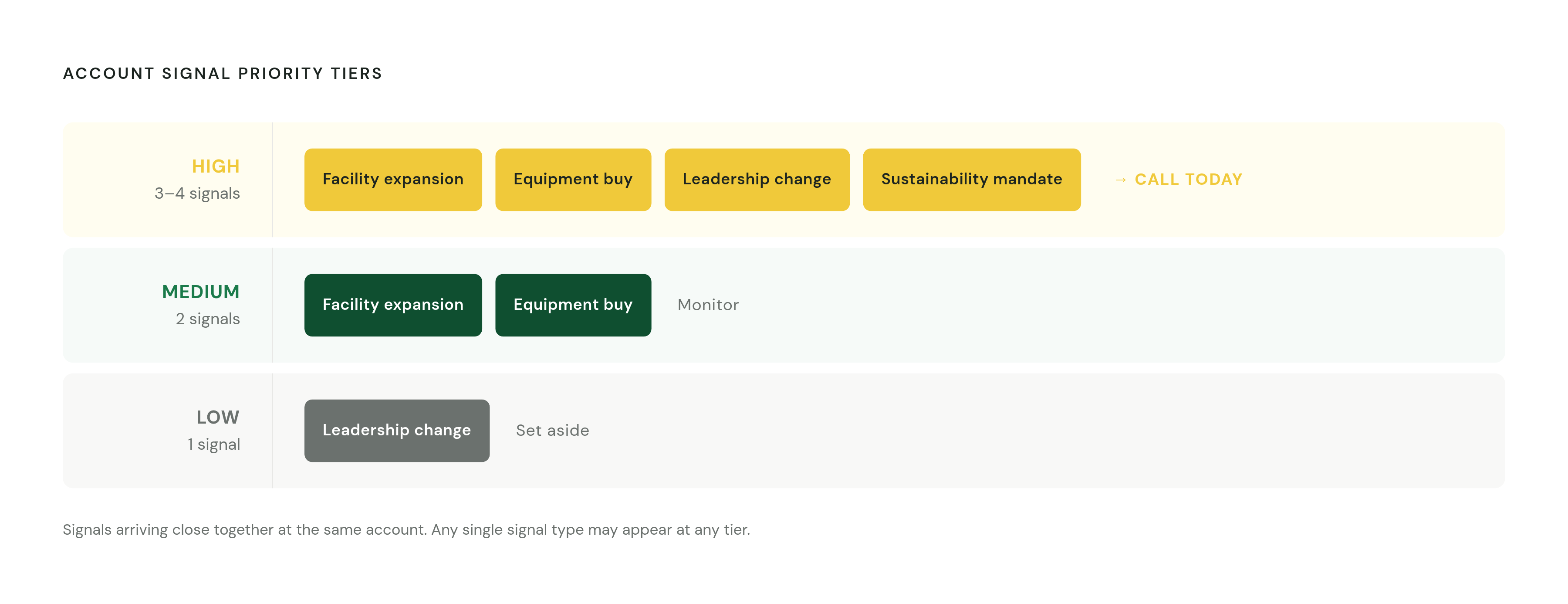
One signal at one account can be logged and set aside. Three or four signals at the same account, arriving close together, are worth a phone call today. An account showing multiple converging signals, facility expansion, equipment investment, leadership change, arriving close together sits in an entirely different tier from an account with just one of those. It's in an entirely different tier.
The win-rate gap backs this up. Accounts with an active, identifiable buying trigger consistently convert at meaningfully higher rates than cold outreach with no trigger attached, a gap large enough to justify rebuilding how a prospecting list gets prioritized.
Signal density should sit on top of a second filter, not replace it: fit. The highest-return expansion motion targets accounts already using at least one product that's performing well. Logo acquisition inside a well-fitted account profile runs substantially more efficient than acquisition outside it, and the same logic carries over to expansion selling. A plant that's already satisfied with its current metalworking fluid is the right account to approach about a rust preventive or cleaner, not a random account that happens to be expanding.
Requirements for seeing these signals before a competitor does
Most reps selling into manufacturing already understand, at some level, that plant-level intelligence reveals buying triggers that a purchase-history report cannot. Gathering this information by hand, sifting trade press, scanning LinkedIn job postings, setting up Google alerts, pulling permit databases one county at a time, takes enough hours that it q... It's that gathering this information by hand, sifting trade press, scanning LinkedIn job postings, setting up Google alerts, pulling permit databases one county at a time, takes enough hours that it quietly stops happening on any kind of schedule.
The scale of the problem makes manual tracking worse than it sounds. With more than 80% of specialty chemical demand running through industrial end markets, a single rep's territory can easily include hundreds of facilities worth watching. Checking all of them by hand, every week, is a math problem that doesn't close. It's a math problem that doesn't close.
What closes it looks less like a bigger spreadsheet and more like better indexing. Facility data organized around what each plant actually makes, what equipment sits on its floor, and what its production activity is signaling right now can tell a plant that just added a CNC cell apart from one that hasn't touched its floor plan in five years, unlike a NAICS code and an employee count. Real-time signals (hiring, permits, expansion announcements) surfaced at the account level instead of buried in a raw data feed nobody has time to read. And a way for that signal to land inside the CRM the rep already works from every day, rather than a separate tool with its own login that quietly stops getting checked after the second week.
None of this changes the basic fact that the incumbent supplier still holds an advantage at most accounts. But that advantage only holds if the incumbent rep actually sees the signal first. A competitor with sharper plant-level monitoring can be on the phone with a new plant manager before the incumbent even knows the old one left.