Sales Intelligence Tools That Map Plant Operations Instead of Corporate Org Charts
Understanding which plant runs your process beats knowing the parent company's org chart.
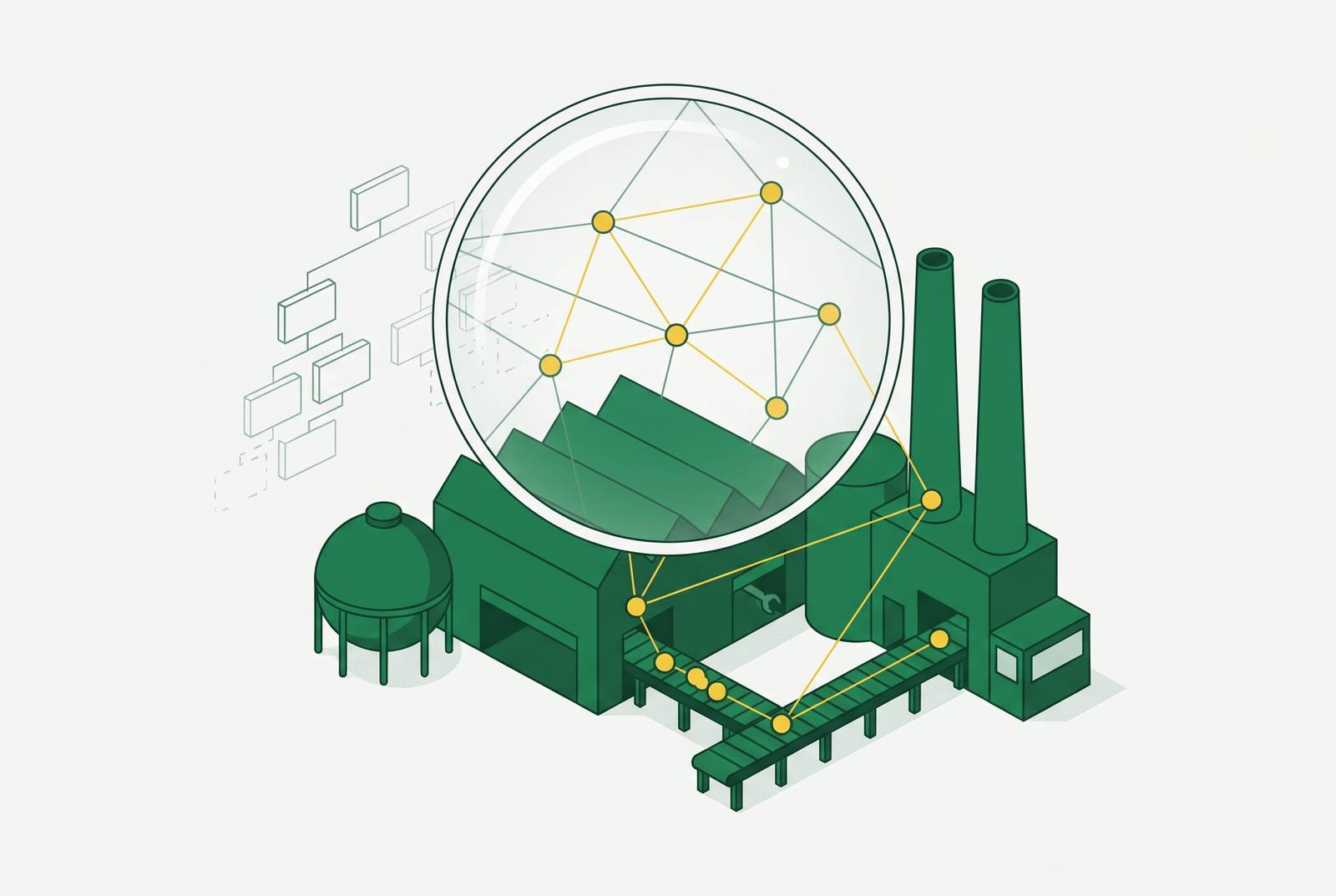
Plant-level manufacturing intelligence for industrial sales teams describes what each facility makes, runs, and buys, rather than stopping at its parent company’s contacts and firmographics. That distinction gives industrial sellers a stronger basis for qualification, territory planning, and account growth. The right tool depends on what the team needs: facility data, buying signals, outbound capacity, or technical sales coaching.
Why generic sales intelligence tools fail manufacturers' customers before the first call
A rep sees one account record, while the customer operates a dozen facilities with different managers, budgets, production lines, and purchasing authority. The record supplies a headquarters address, an employee count, and a NAICS code. It does not show which plant runs the process the rep’s product serves. The mismatch exists before the first call happens.
Generic sales intelligence platforms were built for SaaS-to-SaaS selling, with the company as their core record. Manufacturing purchases involve procurement, engineering, operations, maintenance, and plant management, whose responsibilities cannot be reduced to a single headquarters contact. The timing signals differ, too. Facility expansions, automation investments, reshoring announcements, new certifications, and CapEx disclosures reveal changes that can precede a purchase. An org chart does not show those changes.
But general platforms cover more of an organization and have enterprise integrations that manufacturing-specific tools often lack. Those are genuine strengths, particularly where a sales team needs contacts across a large organization. A detailed corporate directory may help a rep find people, but it does not establish which facility needs the product or why that need exists.
The real account is the plant, not the company
A pump manufacturer makes the distinction concrete. At the company level, a rep sees one manufacturer and one apparent account. At the plant level, that account separates into facilities with different production environments, product needs, and people approving purchases. A plant that is expanding offers a different sales opportunity from another facility under the same parent. The corporate relationship is useful context, but it is not a sufficient description of either opportunity.
The plant is a production specification. What it makes, which equipment it runs, which certifications it holds, and which end markets it serves help determine what it buys. Those details give a rep a basis for technical qualification. Knowing the parent company alone cannot answer what process runs on a particular line, what fluid class its equipment requires, or who authorizes its consumables budget.
This changes the meaning of an addressable account. One parent entity can have a dozen separate buying relationships, and reps need to understand production and purchasing authority at each. Territory size therefore changes when facilities replace corporate entities as the unit of analysis. Priorities change with it, because the most promising plant is the one whose operations fit the offer, regardless of whether it is attached to the largest company record.
What a plant actually signals about what it will buy
A facility’s production environment provides evidence of its consumption needs. High-speed aluminum machining needs a different metalworking fluid from grinding hardened steel, and forming and stamping have different needs again. The process narrows the relevant product class. Equipment type and vintage add clues about replacement cycles, upgrade readiness, and compatible chemistry. Job postings, equipment certifications, trade reporting, and plant-published capabilities can make those clues available before a conversation.
Certifications and OEM approvals provide another qualification layer. FUCHS announced Boeing BAC 5008 Sections 5-6 approval for ECOCOOL GLOBAL 1000. With that approval, Boeing-supply-chain precision machining subcontractors became qualified prospects for reps selling the fluid. The commercial connection is specific and public. Linking an approved product to facilities serving the relevant OEM turns a technical approval into a territory prospecting criterion, although qualification does not establish an immediate order.
Physical events are also a stronger manufacturing buying signal than content consumption alone. New facilities, production lines, CapEx disclosures, automation plans, and management changes point to changes in operating requirements or purchasing decisions. The useful distinction is between a signal that suggests general interest and one that identifies a change in what a plant may need to buy.
How org-chart-based data degrades pipeline quality, territory coverage, and close rates
When reps prospect at the company level, technical qualification comes too late in the sales cycle. NAICS codes and headcounts cannot distinguish a facility running the relevant process from one that does not. Reps then spend time checking basic fit after they have begun outreach. Pipeline volume can obscure that weakness. When opportunities enter without evidence of production fit, the team has a weaker basis for judging which deals can close.
Manual research adds a separate cost. A meaningful portion of an industrial rep’s week can disappear into reconstructing account information that should already be available. That time adds up when reps have a large book of accounts. Meanwhile, territory plans based on company counts and geography miss facilities whose opportunities have changed through new equipment, certifications, ownership, or end-market exposure. They describe where companies are registered more readily than where relevant production is concentrated.
The same gap weakens CRM records and forecasts. Stale deal data, missing multi-stakeholder tracking, poor follow-up continuity, weak forecast accuracy, and no early warning on quiet deals all become harder to address when the account record does not reflect plant activity. External data is not the only missing input. ERP ordering declines, service ticket spikes on aging equipment, and credit holds can indicate churn, expansion needs, or financial stress. Teams that work with customers can get more from those signals when they understand what they show about the facility concerned.
What tools help sales teams understand plant-level operations instead of company firmographics
Purpose-built manufacturing intelligence starts with the facility as the primary record. Each plant profile describes its production, equipment, certifications, and operating environment, rather than treating those details as incidental additions to a corporate profile. That is the architectural distinction. It allows a seller to connect product suitability to a particular location before using contact data to reach the people involved.
The signal layer tracks what changes in that operating environment. Relevant events include facility announcements, new lines, automation and robotics plans, plant management changes, supply chain restructuring, and OEM certification changes. Earnings calls and public filings can supply CapEx disclosures. Together, the profile and the event explain both fit and timing. A rep can approach a facility with a clearer understanding of its process, equipment class, fluid compatibility requirements, and plant-level decision influencers.
Signal aggregators look for events in public information, while autonomous sales platforms research prospects and reach out to them. Conversation intelligence supports the discussion itself. A tool that detects a plant investment or coaches a technical objection should not automatically be treated as a database of facility production profiles.
The tools that map plant operations in 2026, compared on what actually matters for manufacturing sales
The useful comparison rests on manufacturing-native signals, facility-level detail, pricing transparency, and workflow fit. For the tools below, the strongest use case is more informative than a universal rank. Their functions are not interchangeable. Some help sellers spot industrial demand, while others help them act on an opportunity they have already found. None should be credited with facility-level production profiling merely because it can find a manufacturing company.
SUPPLYCO AI is the strongest fit here for industrial buying-signal discovery within a demo-first enterprise engagement. It analyzes expansions, RFQs, workforce changes, facility investments, UCC filings, and government awards. Its named customers include Kawasaki Robotics, GROB Systems, ANCA, and CMS. GovCon and equipment intelligence each supply their own layer of signals. The platform launched in February 2026 and describes itself as the first AI agent platform built exclusively for industrial manufacturers and distributors. Its manufacturing-native focus is a strength, while the absence of public pricing requires a different purchasing process from a published-price service.
It watches market and public signals against the company’s stated goals each week, then provides a short, explainable shortlist with dates and source links. It requires no ERP integration or IT project. Its public pricing as of September 2026 is $500/month flat for the whole company, with a free panel available first. That low-overhead model suits a business without a large sales operation, but it is not designed for a large distributed sales organization.
Salesmotion fits teams seeking a general-purpose signal aggregator with manufacturing-relevant triggers. It monitors facility construction, plant investments, capacity expansions, production line additions, supply chain restructuring, automation investments, and operations leadership changes. It also surfaces production commentary from earnings calls. The boundary is important for this comparison. It is not manufacturing-native and does not offer facility-level production profiling, so its event coverage should not be mistaken for a plant data foundation. The pricing information provided lists monthly per-user pricing and a limited-term promotion, but gives no firm current price to use in a comparison.
YTTAI, through its AI Global Sales Rep, helps teams do more outbound work and reach markets around the world. Its autonomous digital worker identifies target plants and distributors, analyzes machine compatibility, finds technical buyers, drafts technical outreach, and maintains follow-up context across multi-month cycles. Its role is execution rather than territory architecture. That makes it relevant when a team needs more prospecting capacity, but its stated fit differs from a platform chosen primarily for account profiling or facility-density analysis.
Phosai Labs’ AI Sales Assistant addresses technical conversations and rep development. Its desktop app runs during calls on Zoom, Google Meet, or Microsoft Teams and delivers tactic cards in under one second when it detects objections forming, buying signals, missed qualifying questions, over-talking, or a need to adjust tactics. It operates at a different sales stage. For manufacturing and distribution teams with long cycles and technical buyers, it is best suited to helping newer reps learn what the organization already knows. It provides conversation support while leaving the need for plant intelligence and a facility account model unresolved.
How to decide which approach fits your commercial bottleneck
The lesson for buyers is to diagnose the account model before comparing features. If the CRM holds one record per parent entity, facility-level enrichment is the foundational priority before adding another signal layer. More alerts will not supply the missing structure. Territory teams then need facility-density data grouped by production type, equipment class, or end market, so sales opportunities take priority over ease of access in coverage planning.
The next diagnostic is where time disappears. If reps spend a large part of the week researching accounts, teams should first add pre-qualified plant data to the CRM they already use. If research is adequate but outbound capacity is constrained, an execution tool fits that bottleneck more closely. In-call performance is a separate investment decision. Teams struggling with technical objections or slow rep development have a stronger reason to consider conversation intelligence than another prospecting feed.
Team size also changes the tradeoff. An owner-led shop has different tolerances for integration work, onboarding overhead, and enterprise pricing from a distributed sales organization. For account growth, the key requirement is a production profile that reveals adjacent products or services a facility already qualifies for. That information makes cross-sell opportunities visible without requiring a fresh investigation of the entire company. The durable advantage begins when the rep opens the account and finds the plant’s operating reality already structured in the CRM.